What you will learn
On this pageContentsCloseOpen
The one link in an Instagram or TikTok profile used to have a Shopify-native answer. Linkpop, launched in 2022, was free, and it opened Shopify checkout from the bio page itself. It is gone. So is the Starter plan that was sold around the same idea. What's left is a shelf of third-party apps, and the question this article answers is which of them is actually a Shopify page, and which is someone else's page with your products on it.
What Shopify removed, and when
Two things disappeared roughly a year apart.
Linkpop. Shopify emailed account holders in June 2025 that "Linkpop is retiring July 7, 2025. After this date, you won't be able to make changes to your current Linkpop pages or create new ones." Coywolf reproduced the email and confirmed on the day that the service was no longer available. As of September 18, 2026, linkpop.com redirects to shopify.com, and the App Store page at apps.shopify.com/linkpop — developer: Shopify — reads "This app is not currently available on the Shopify App Store," one of the three listing states Shopify uses for dead apps.
The Starter plan. Shopify's Starter plan page now opens with a note: "The Starter plan isn't available to new stores. If you're a merchant currently on the Starter plan and you decide to change your plan, then you can't revert back to the Starter plan." The page still describes what the plan was for — merchants "who want to sell to their customers through social media platforms or messaging apps," using product links "which you can share on social media posts or in messages." That is a link-in-bio business model, and Shopify no longer sells it to new stores. shopify.com/starter itself now redirects to the free-trial offer page. Ecommercetrix reported the change on August 15, 2026, put the plan's price at $5 per month, and noted there was no announcement.
The new $0 plan is not the replacement. The Agentic plan has "no monthly subscription fee," but it is "for merchants that don't already use Shopify as their ecommerce platform." You can build an online store on it, and Shopify is explicit about the catch: "Your online store stays password protected when you're on the Agentic plan, so customers can't visit it." Keep that sentence in mind. It decides which apps below can work on that plan at all.
What Shopify's own blog recommends instead
On July 21, 2026, Shopify published 6 Link-in-Bio Tools for Instagram and TikTok. It lists LinkShop, Linktree, Hoo.be, Beacons, Milkshake, and Linkin.bio by Later. Only the first two are linked to Shopify App Store listings. The other four are external services with no App Store install path mentioned in the post.
The post's FAQ also contains the sentence most merchants skip: "No, you don't need a link-in-bio tool to share links on social media, especially if you already have a website." That is Shopify telling you the native path exists. It just doesn't say what it is.
What you already have without an app
Three things ship with every store that most link-in-bio buyers never price in.
A page on your own domain. Any Online Store 2.0 theme lets you create a page and fill it with sections — a heading, a few buttons, a featured collection, a newsletter block. Put that page's URL in your bio and you have the thing a $9 app sells, on your domain, with your theme's fonts. The Agentic plan's own setup guide walks through adding pages, menus, and collections as the first tasks of building a store. What you don't get is a mobile-first editor built for the format, per-link click analytics, or add-to-cart from the page without leaving it.
Cart permalinks. Shopify's cart permalink documentation is written for exactly this use: "You can share cart permalinks in email campaigns, social media posts, or chat messages." A link in the form your-store.com/cart/VARIANT_ID:1 drops the buyer straight into checkout with the product already in the cart, and can carry a discount code or send the buyer into Shop Pay with ?payment=shop_pay. From a product's More actions menu the admin generates one for you as Create checkout link. One caveat from the same page: that admin button requires the Buy Button channel to be installed.
Your Shop store URL. If your store is eligible for the Shop channel, Shopify gives you a shop.app storefront with a URL you choose — 4 to 30 characters, changeable "only one time every 30 days," per the Shop Store details page. The store profile carries social links for "Instagram, Facebook, Pinterest, YouTube, and Twitter." TikTok is not on that list, and there is no field for arbitrary custom links, so a Shop store is a storefront you can put in a bio, not a link hub. The eligibility page requires an "Active Starter plan or higher," Shopify Payments, a chargeback rate under 1%, and an online store that "isn't set to private mode."
That last requirement sits awkwardly next to the Agentic plan page, which says the plan "also lets you sell on other Shopify channels, such as the Shop channel," while keeping the online store password-protected. Shopify's two pages don't reconcile this. If you are on the Agentic plan and counting on a Shop store as your bio link, confirm eligibility in your own admin before assuming.
The seven apps, and the one thing that separates them
A search for "link in bio" in the App Store on September 18, 2026 returns ten dedicated apps mixed in with page builders. Three of them — Mezink Link in Bio Tree, UtterLink, and Link In Bio by Xe/io — have either no reviews or a single 1-star review, so we set those aside. The remaining seven split cleanly on one axis: whether the bio page is served from your storefront or from the vendor's domain.
The mechanism behind the first group is Shopify's app proxy. Shopify takes "requests to Shopify URLs, and proxy them to your app," under a path that must begin with a, apps, community, or tools. That is why a LinkShop page lives at your-store.com/a/linkshop — we confirmed a live one at adomanisleep.com/a/linkshop — and a Linkfront page at your-store.com/a/profile. The page carries your domain, your SSL, and your cookies, so a click from it into checkout never crosses a domain boundary.
The consequence Shopify's docs don't spell out but every demo store in this category demonstrates: an app-proxy page is part of your online store, so it is behind your store password. Both the Saku and bitLink demo links on the App Store resolve to a /password page. On a paid plan with the password off, that's irrelevant. On the Agentic plan, where "your online store stays password protected," none of the on-domain apps can show a public page.
| App | Price (USD) | Page lives at | Built for Shopify | Reviews | Launched |
|---|---|---|---|---|---|
| LinkShop ‑ Link in Bio Shop | $15/month flat, 7-day trial | Your store, /a/linkshop | Yes | 4.6 (26) | April 4, 2025 |
| Saku: Link In Bio Shop | Free; $9/month removes watermark | Your store domain | Yes | 5.0 (7) | August 8, 2025 |
| Linkfront, Link in Bio Page | Free (one page); $9.99/month for up to 10 pages and analytics | Your store, /a/profile | Yes | 5.0 (1) | August 21, 2026 |
| bitLink ‑ Shoppable Link Bio | Free; $6, $19, $299/month | Your store domain; custom domain from $6 | Yes | 3.9 (9) | November 17, 2021 |
| Linkly: Shoppable Link in Bio | Free; $9/month removes watermark | Linkly subdomain on Free; custom domain mentioned | No | 5.0 (1) | May 13, 2026 |
| POWR: Link‑in‑Bio | Free; $7.04, $15.84, $98.99/month | Not stated on the listing | Yes | 4.9 (3) | July 7, 2014 |
| Linktree | Free; $5, $9, $24/month, billed by Linktr.ee | linktr.ee/yourname | No | 3.6 (18) | November 9, 2021 |
Prices are the App Store listings as of September 18, 2026. Review counts are tiny across the board — the largest is 26 — so treat every rating here as a handful of opinions, not a verdict.
The on-domain four
Source: Shopify App Store (LinkShop ‑ Link in Bio Shop), retrieved September 18, 2026
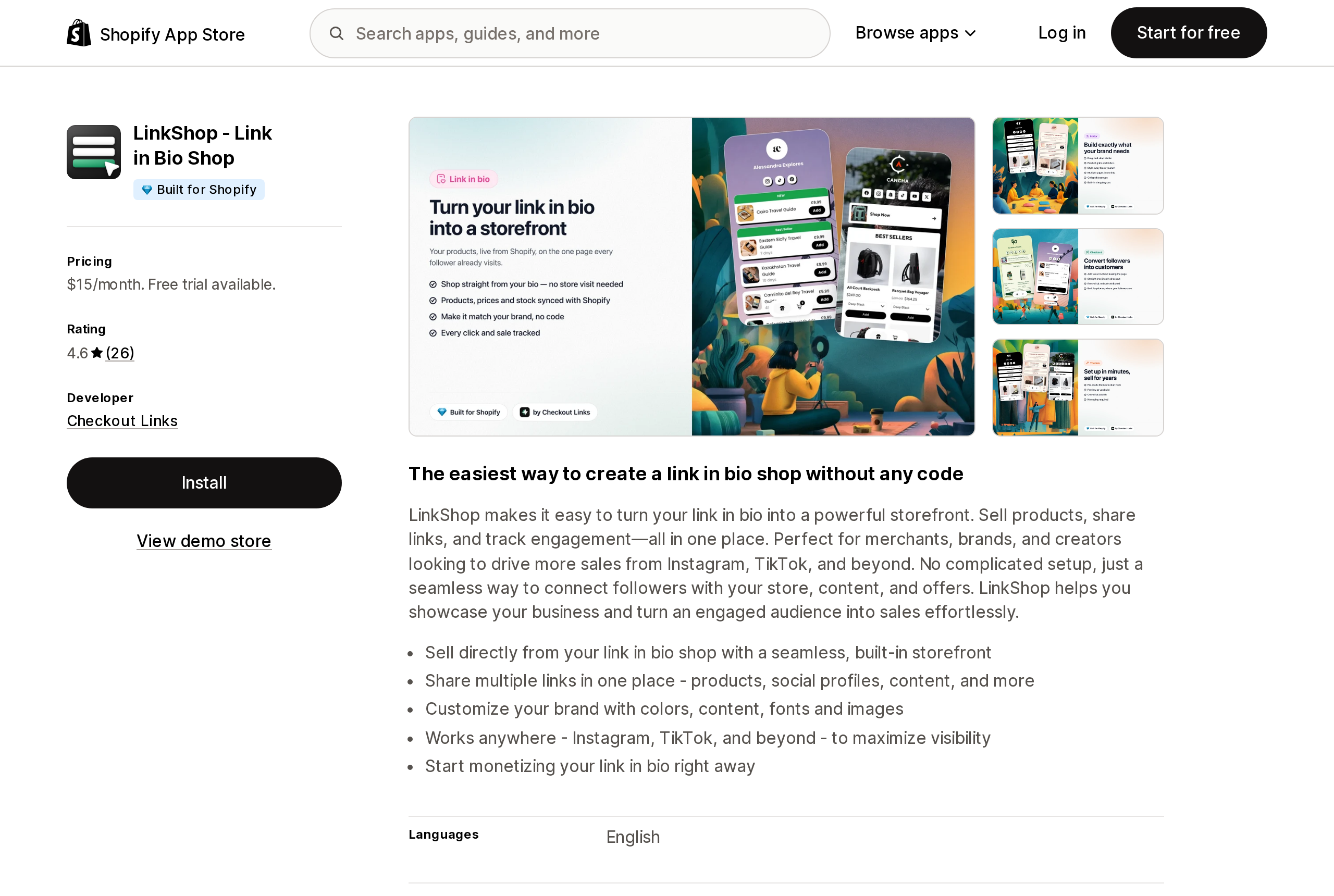
LinkShop is the app Shopify's blog leads with, and the only one in the group with a flat fee and no free tier: $15/month, "Everything included!", 7-day trial. The developer is Checkout Links, a Stockholm company whose other app is the checkout-link generator of the same name. The listing's Works with line names Checkout, Shopify Admin, Alia, Kaching Bundles, and Quantity Break. Its data access section is the broadest of the five listings that publish one (bitLink and POWR don't) — "Sensitive data, device and activity data" on the customer side, and customers, products, discounts, store analytics, Online Store, and custom data on the store side. Of its 26 reviews, 23 are five stars; the most recent, from June 24, 2026, describes using it for "a seamless, on brand transition from my Instagram page to our site."
Source: Shopify App Store (Saku: Link In Bio Shop), retrieved September 18, 2026
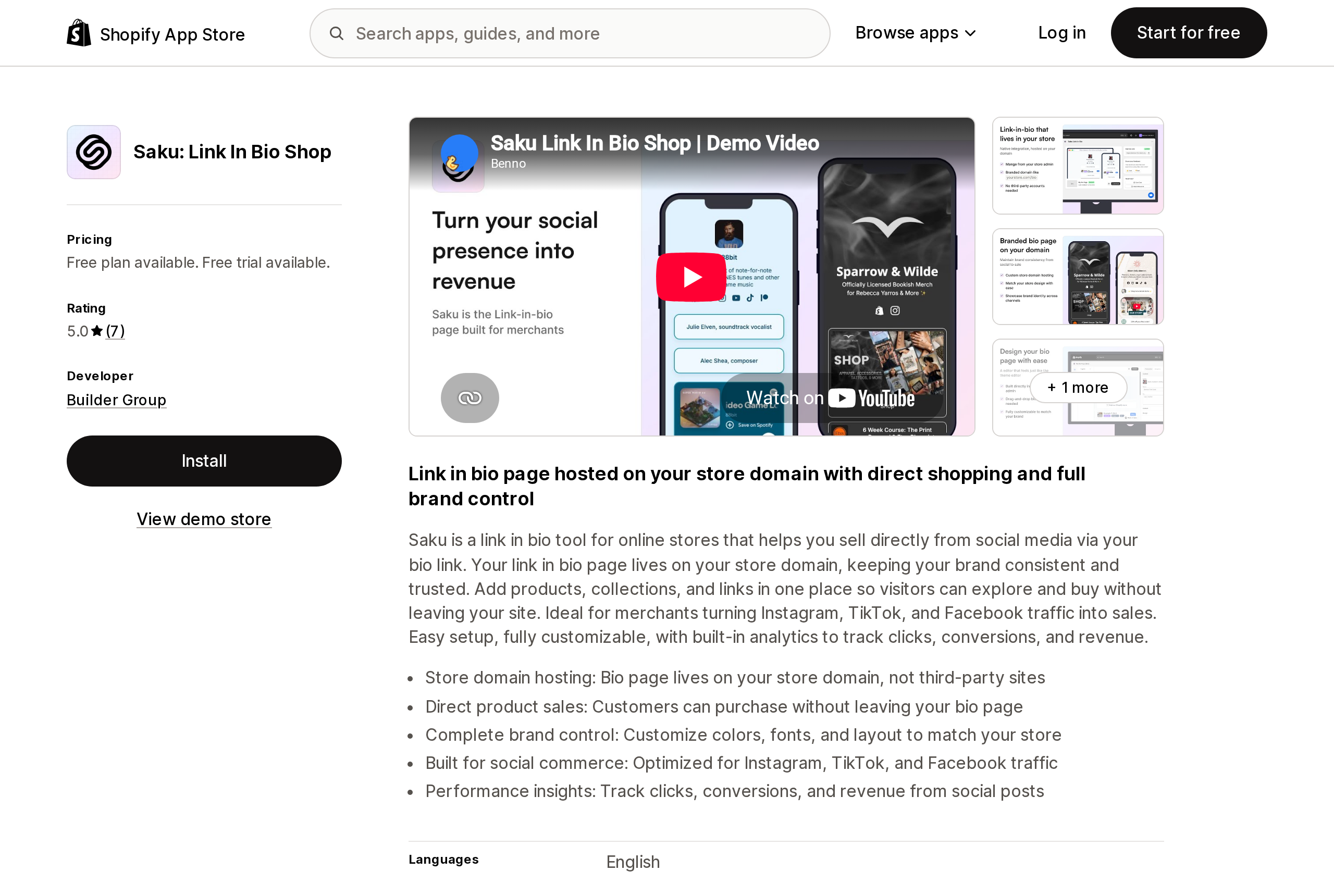
Saku makes the domain point its headline: "Bio page lives on your store domain, not third-party sites." The Free plan includes the page, basic customization, and Google Analytics plus Meta Pixel; the $9/month Awesome plan adds advanced customization, priority support, and removes the watermark. Its data access is narrower than LinkShop's: products, Online Store, custom data, and device and activity data. Seven reviews, all five stars, since an August 2025 launch.
Source: Shopify App Store (Linkfront, Link in Bio Page), retrieved September 18, 2026
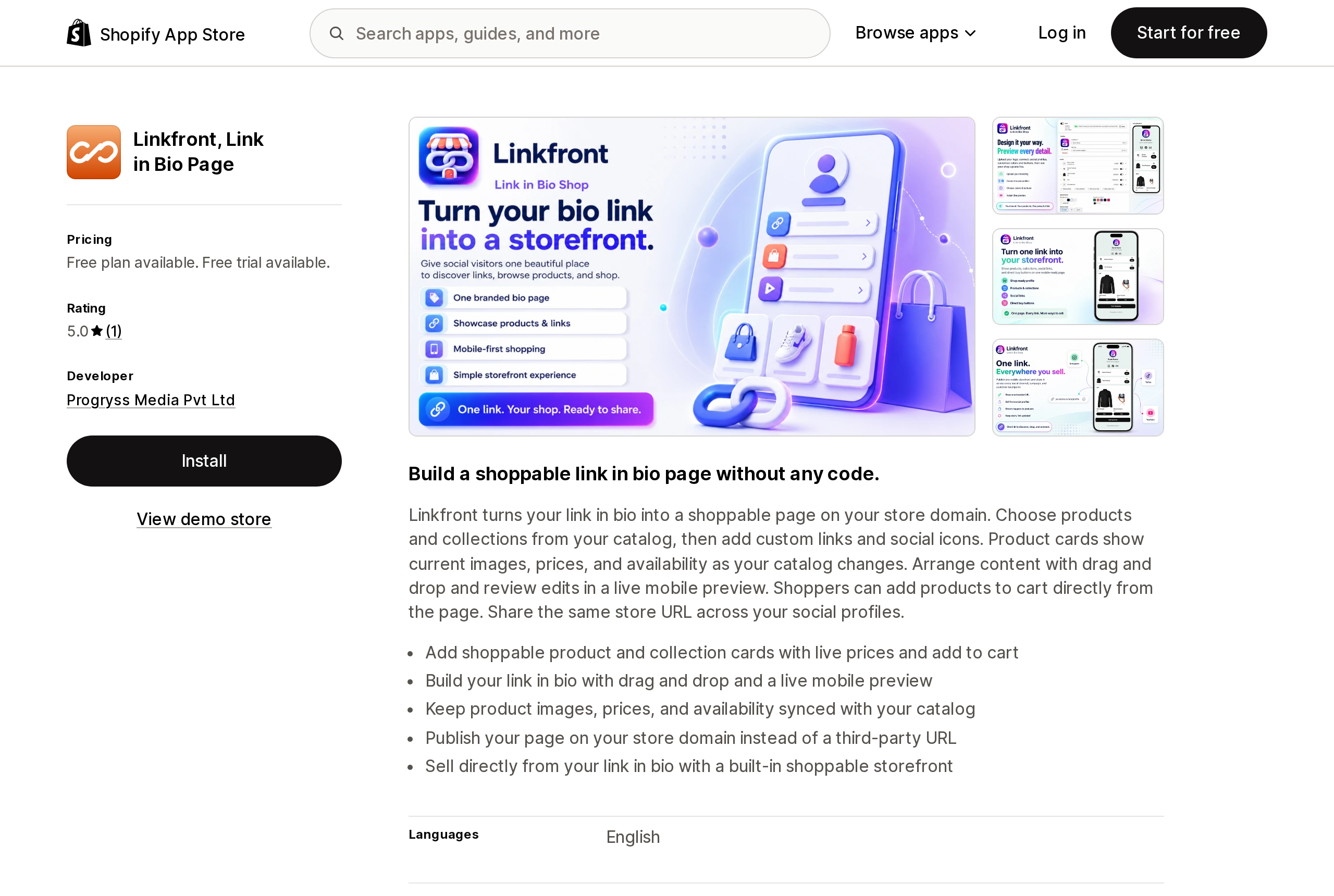
Linkfront launched on August 21, 2026 — four weeks before this article — and has one review. It is included because its free tier is the most complete in the set: one bio page, unlimited product and collection links, on your own domain, with colors and button shapes. The $9.99/month Pro plan ($59.99/year) buys up to 10 pages and page analytics. Its data access is the narrowest of the seven: products, Online Store, Shopify admin, and nothing customer-side. The developer's own demo describes the page as "served from your own storefront at /a/profile."
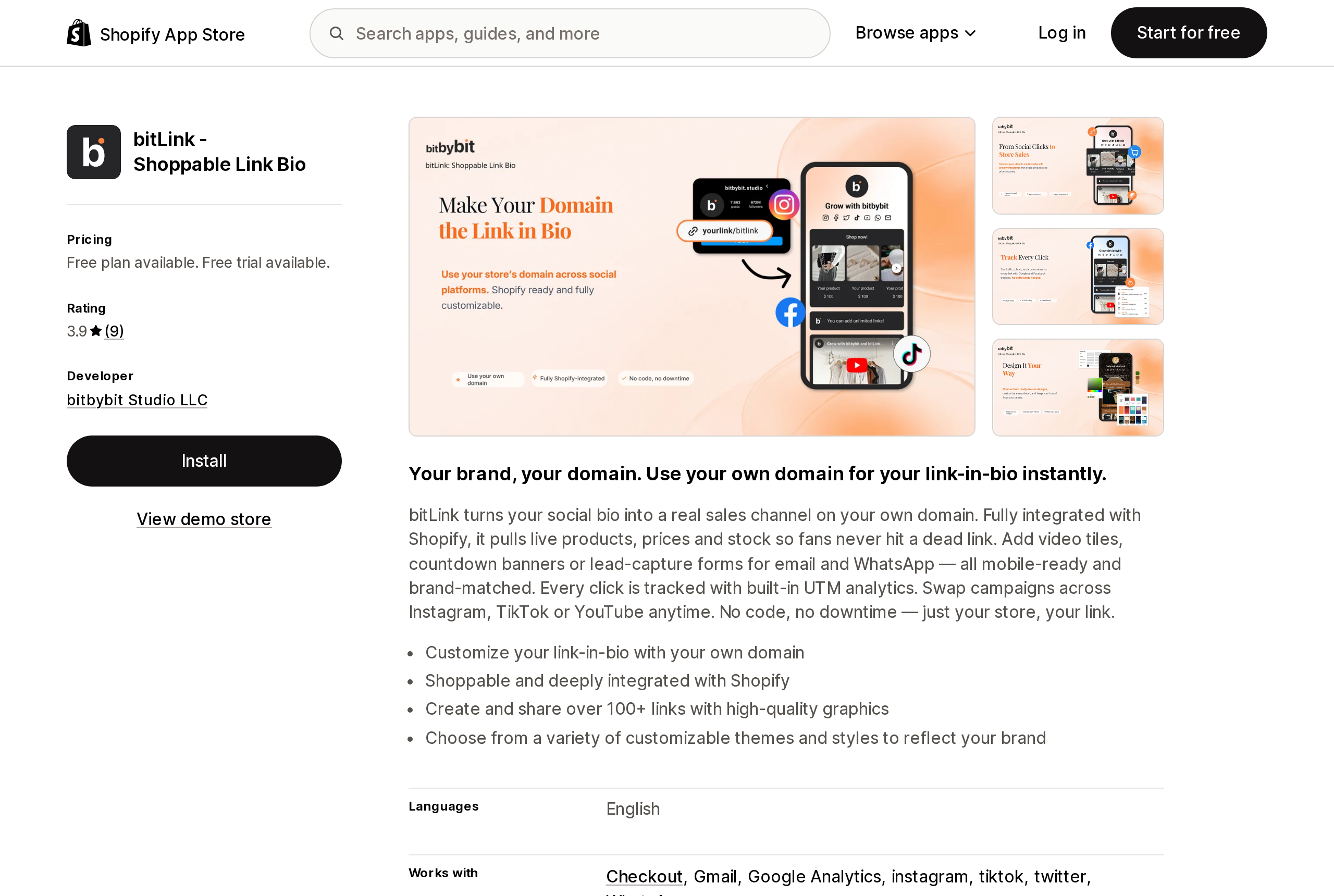
Source: Shopify App Store (bitLink ‑ Shoppable Link Bio), retrieved September 18, 2026
bitLink has been in the store since November 2021 and has the deepest plan ladder. Free includes unlimited links, basic click analytics, and real-time product sync. Starter at $6/month adds a custom domain, UTM tracking and ad pixels, email capture, and hides the "Powered by bitbybit" line. Growth at $19/month adds multi-page bios, scheduled changes, and funnel analytics. The $299/month Pro Bundle is a bundle of five products from the same developer, not a link-in-bio tier. Its rating is 3.9 across 9 reviews, the lowest of the on-domain group.
The hosted three
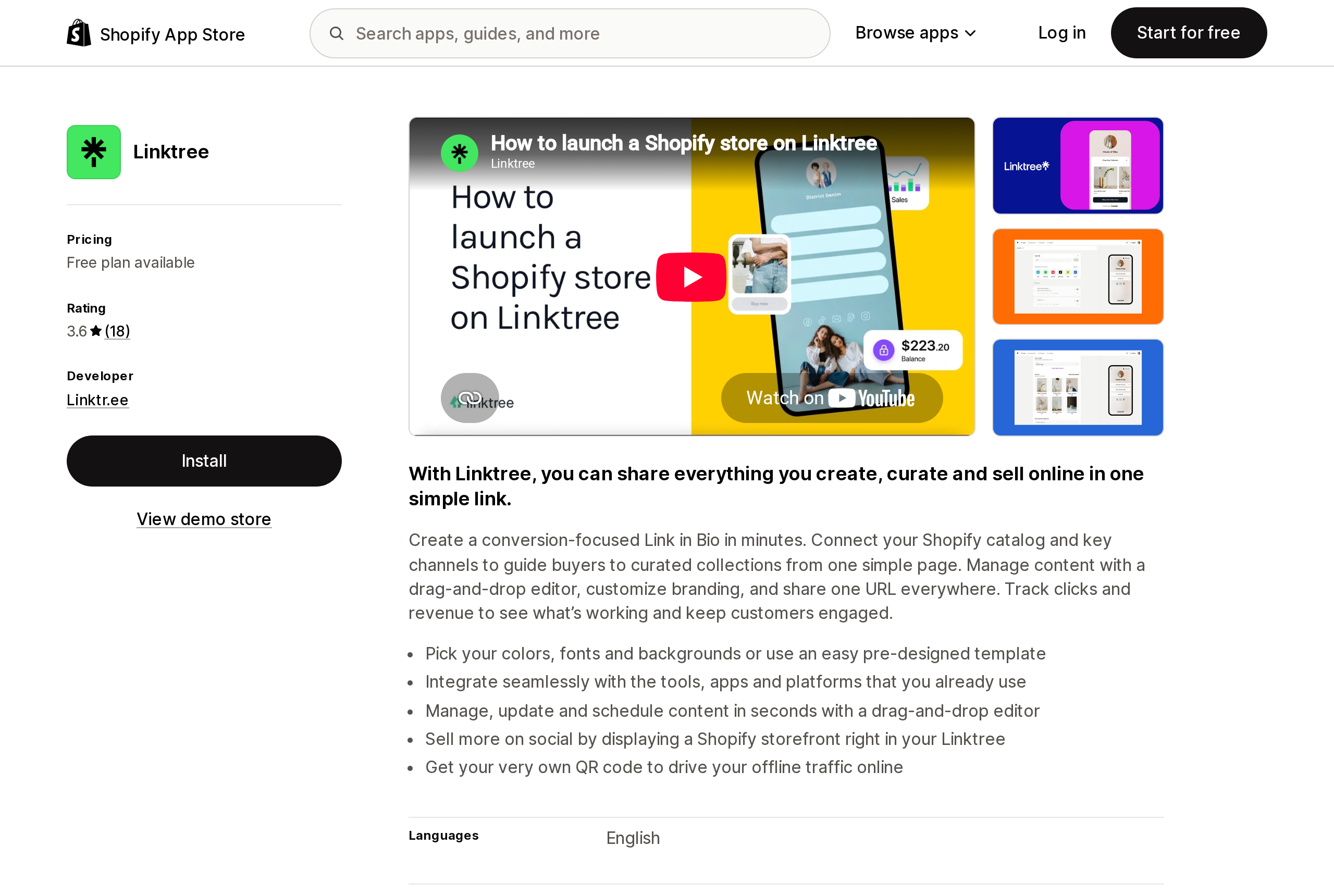
Source: Shopify App Store (Linktree), retrieved September 18, 2026
Linktree is the name most merchants arrive with, and its Shopify listing is unusual in three ways. It is filed under Marketplaces, with feature tags for "Listing management," "Product sync," and "Order sync" — a sales-channel framing, not a page builder. Its pricing box carries the line "External charges may be billed by Linktr.ee separately from your Shopify invoice." And its rating is 3.6 across 18 reviews, with four 1-star reviews. The recent ones are about the integration rather than the product: "It's in a perpetual loop where I need to link an account, add a store, ect. It won't go anywhere" (May 22, 2025), "Doesn't work anymore" (October 7, 2024), and a two-word "not working" from February 15, 2026. A February 24, 2026 five-star review says the opposite — "Worked in 1 minute." Data access is products and orders.
The page itself lives at linktr.ee/yourname. On a live Linktree page for a Shopify brand we checked, product buttons link out to the brand's own product URLs with utm_source=linktree appended, and the page footer carries an "Explore other Linktrees" block listing unrelated accounts. That is the trade the hosted model makes: Linktree's domain, Linktree's footer, your products one click further away.
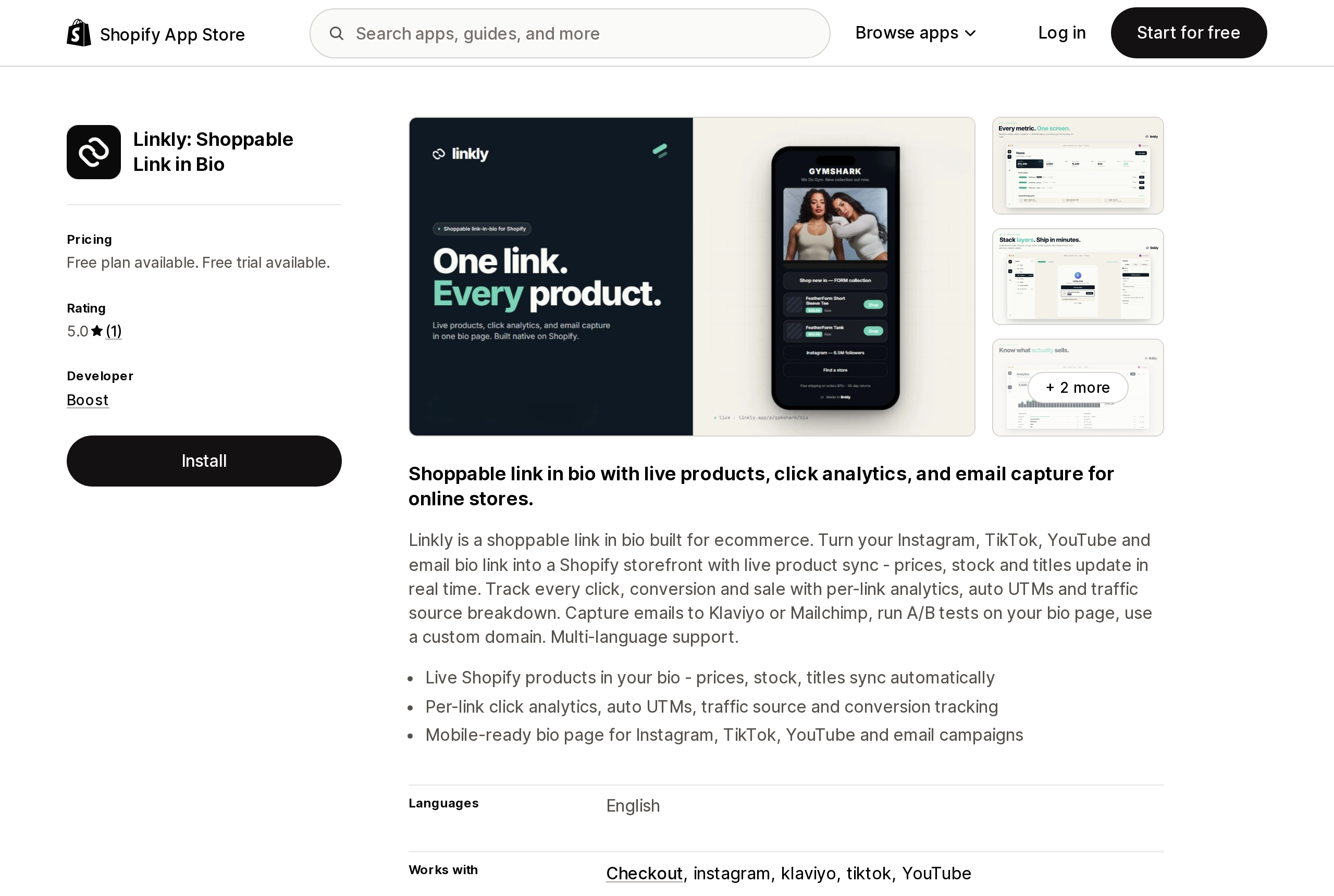
Source: Shopify App Store (Linkly: Shoppable Link in Bio), retrieved September 18, 2026
Linkly launched in May 2026 from a developer called Boost, has one review, and describes live product sync, per-link analytics with auto UTMs, email capture to Klaviyo or Mailchimp, A/B tests, and a custom domain. The Free plan is explicit that the page sits on a "Linkly subdomain"; the $9/month Awesome plan removes the watermark. Which plan unlocks the custom domain is not stated on the listing. Data access includes customers and orders.
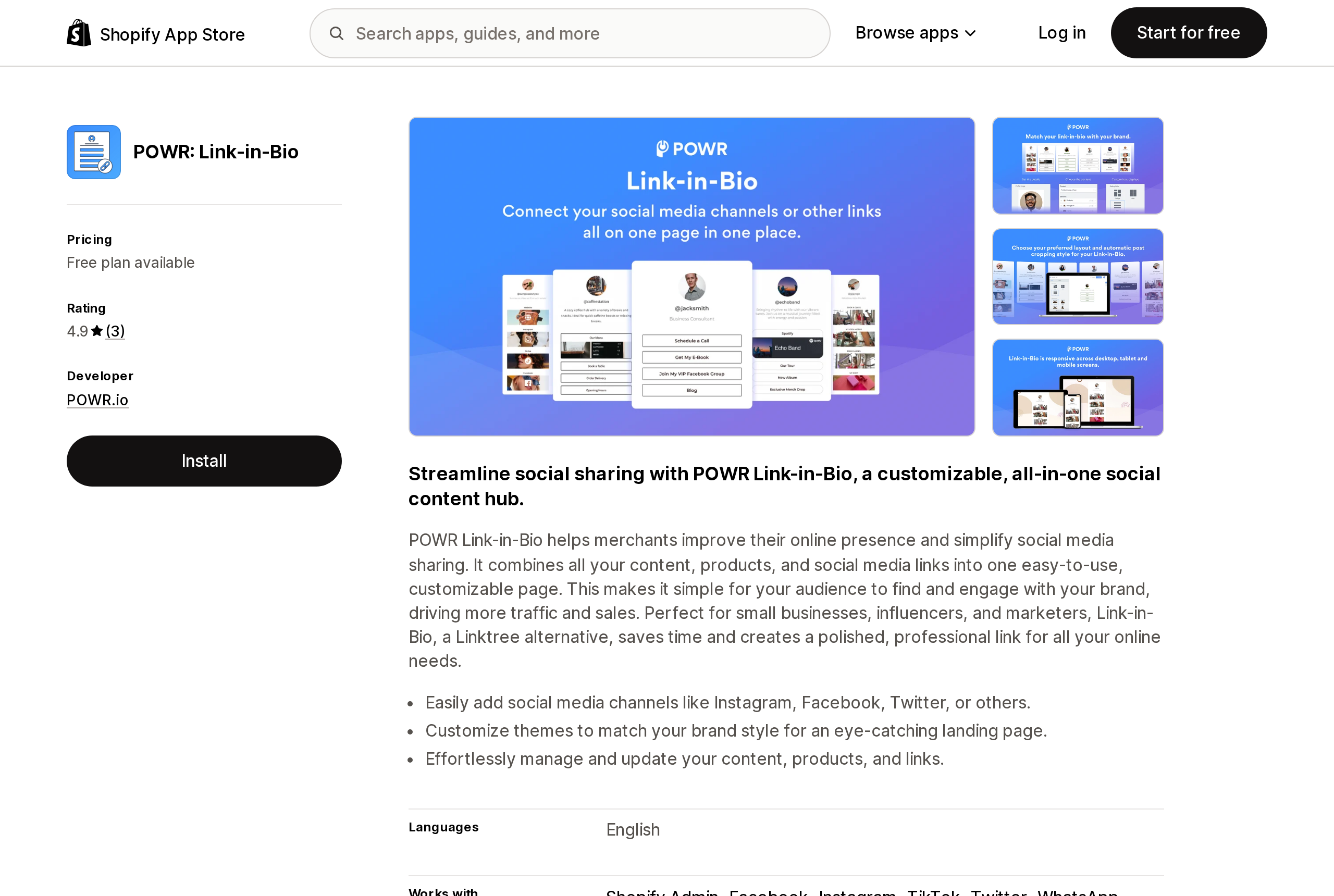
Source: Shopify App Store (POWR: Link‑in‑Bio), retrieved September 18, 2026
POWR is a 2014-era widget vendor with a Built for Shopify badge and three reviews on this particular app. Its tiers meter something no one else does: the number of social channels — 5 on Free, 12 at $7.04/month, 20 at $15.84/month, unlimited at $98.99/month. Branding removal starts at the $7.04 tier. Where the page is hosted is not stated in the listing, and the listing has no demo store, so we couldn't verify it.
Which one, by situation
You want the cheapest page that is unmistakably yours. Linkfront's free tier or Saku's free tier. Both put the page on your domain with product cards, and Linkfront's does it with no watermark clause on the free plan. The cost of "free" is a one-review app from August 2026 versus a seven-review app from August 2025; neither has a track record.
You want the page to sell, not just link. LinkShop at $15 flat is the only on-domain app with a meaningful review base and a developer whose whole business is checkout links. If your bio traffic converts, a flat fee is the easiest line to defend on the app bill.
You already run Linktree for a creator profile. The Shopify app connects that existing page to your catalog, and there is no reason to pay Linktree to be told to leave. Just read the integration reviews before assuming the connection works on the first try, and know the bill comes from Linktr.ee, not Shopify.
You are on the Agentic plan. Only a hosted page can be public, because your storefront can't be. That rules out LinkShop, Saku, Linkfront, and bitLink until you move to a paid plan and remove the password — and on that plan, product links "continue to point to your existing online store," not to Shopify.
You only need one product behind one link. Skip the category. A cart permalink with ?payment=shop_pay does more for that buyer than any of the seven.
What we could not verify
Where POWR hosts its page. Which Linkly plan unlocks the custom domain. Whether an Agentic plan store is in practice eligible for a public Shop store, given the two Help Center pages quoted above. And the exact date Shopify removed the Starter plan from sale — the Help Center note carries no date, and the August 15, 2026 figure is a third-party report. None of the seven listings publishes a page-view or click cap, so if a vendor throttles free tiers by traffic, the App Store doesn't show it.
Sources
- Shopify Help Center, Starter plan
- Shopify Help Center, Agentic plan
- Shopify Help Center, Online store access with the Agentic plan
- Shopify Help Center, Cart permalinks
- Shopify Help Center, Edit your Shop Store details
- Shopify Help Center, Requirements for displaying your store in Shop
- Shopify Help Center, Shop Website
- shopify.dev, About app proxies and dynamic data
- Shopify Blog, 6 Link-in-Bio Tools for Instagram and TikTok (2026), July 21, 2026
- Coywolf, Shopify shut down Linkpop
- Ecommercetrix, Shopify Starter Plan Ends, August 15, 2026
- Shopify App Store listings and reviews for LinkShop ‑ Link in Bio Shop, Saku: Link In Bio Shop, Linkfront, Link in Bio Page, bitLink ‑ Shoppable Link Bio, Linkly: Shoppable Link in Bio, POWR: Link‑in‑Bio, and Linktree, retrieved September 18, 2026
Shopify Messaging ships a Convert abandoned product browse automation on every plan from Basic up, built on the Shopify Flow trigger Customer left online store without making a purchase. It fires on a product view — the same stage Klaviyo calls browse abandonment and Omnisend calls Product Abandonment. Omnisend's Browse Abandonment is one stage earlier and, by its own documentation, captures no product data and offers no return URL. Every email-based option shares the constraint nobody puts in the listing: the visitor must already be identified, which is why a flow with thousands of contacts sends almost nothing. Web push is the one channel that routes around it, at $79/month. 402 apps carry the App Store's Browse abandonment feature tag, including wishlist and review apps. Verified against primary sources on September 12, 2026.