
What you will learn
On this pageContentsCloseOpen
Ask a subscriber to change their next shipment date and you find out how many identities your store has handed out. There is the Shopify account they use to check an order. There is the emailed link from your subscription app that drops them into a different portal on a different domain. There is, on some stores, a third lookup form that wants an order number and a ZIP code.
Shopify has now put a date on collapsing that.
The short version
The requirement. Shopify's developer changelog entry of June 17, 2026 states it in one sentence: "Effective December 1, 2026, Returns and exchanges apps and Subscription apps that provide buyer-facing self-service experiences must authenticate customers using the Customer Account API."
The penalty. The same entry says apps that miss the deadline "are at risk of losing Built for Shopify status." That is the whole stated consequence. Nothing in the Built for Shopify requirements says a non-compliant app is removed from the Shopify App Store.
Why that matters more than it sounds. The requirement is enforced through a badge, so it only binds apps that hold the badge. On September 7, 2026, checking every major app in both categories on the Shopify App Store shows the badge missing from Recharge, Skio, Loop Subscriptions, Loop Returns, Return Prime, ReturnGO, and Redo — several of which are the largest apps in their category by review count.
The already-broken combination. Recharge's own documentation lists, under considerations for passwordless login, that "Stores must use legacy customer accounts to use this feature." Shopify deprecated legacy customer accounts on February 26, 2026. If you upgrade, that login path goes away.
What the requirement actually says
Two numbered clauses were added to the Built for Shopify requirements, one per category, and they use identical wording.
Clause 5.12.4, for Returns and exchanges apps, and clause 5.14.5, for Subscription apps, both read: "Your app must support the Customer Account API as the primary method for customer authentication."
The phrase doing the work is primary method. An app is not required to delete its own portal. It is required to stop making a separate sign-in the default way a buyer proves who they are.
Subscription apps carry a second, older clause worth reading alongside it. Clause 5.14.4 requires that the app "must use Customer Account UI extensions to enable customers to view and manage their subscriptions." Between them, 5.14.4 and 5.14.5 describe the same destination from two directions: the subscription management surface lives inside Shopify's customer accounts, and the buyer gets there with a Shopify sign-in.
Shopify's own framing of the problem appears not in the developer docs but in the Help Center guide to upgrading customer accounts, which tells merchants what they lose by linking out: "The benefit of using Shopify features and apps is that customers can access all of these features by signing in only one time, whereas linking to an external portal often requires additional verification steps."
What buyers do today instead
Two patterns dominate, and neither is Customer Account API authentication.
The tokenized link. Recharge sends a tokenized customer portal link — a magic link — in its notification emails. Its alternative, passwordless login, replaces the link with a four-digit access code delivered by email and, for United States and Canada numbers only, SMS. Recharge's documentation puts the code's lifetime at four minutes and caps login attempts at five.
The order lookup. Loop Returns & Exchanges asks the shopper for an order number plus a ZIP code, email, or phone number. Loop's integration guide documents a deep link that skips the form entirely, with the URL format https://{return_portal_domain}/?order={order_name}&zip={zip_code} — the order name and postal code travel in the query string.
That deep link is a fair illustration of what Shopify is legislating against. It is convenient, it is documented, and it is not authentication.
Who actually has to change
Because the enforcement mechanism is the Built for Shopify badge, the practical question for a merchant is narrow: does the app I run hold it?
Every figure below was read from each app's Shopify App Store listing on September 7, 2026.
Subscription apps
| App | Developer | Built for Shopify | Pricing (USD) | Rating (reviews) |
|---|---|---|---|---|
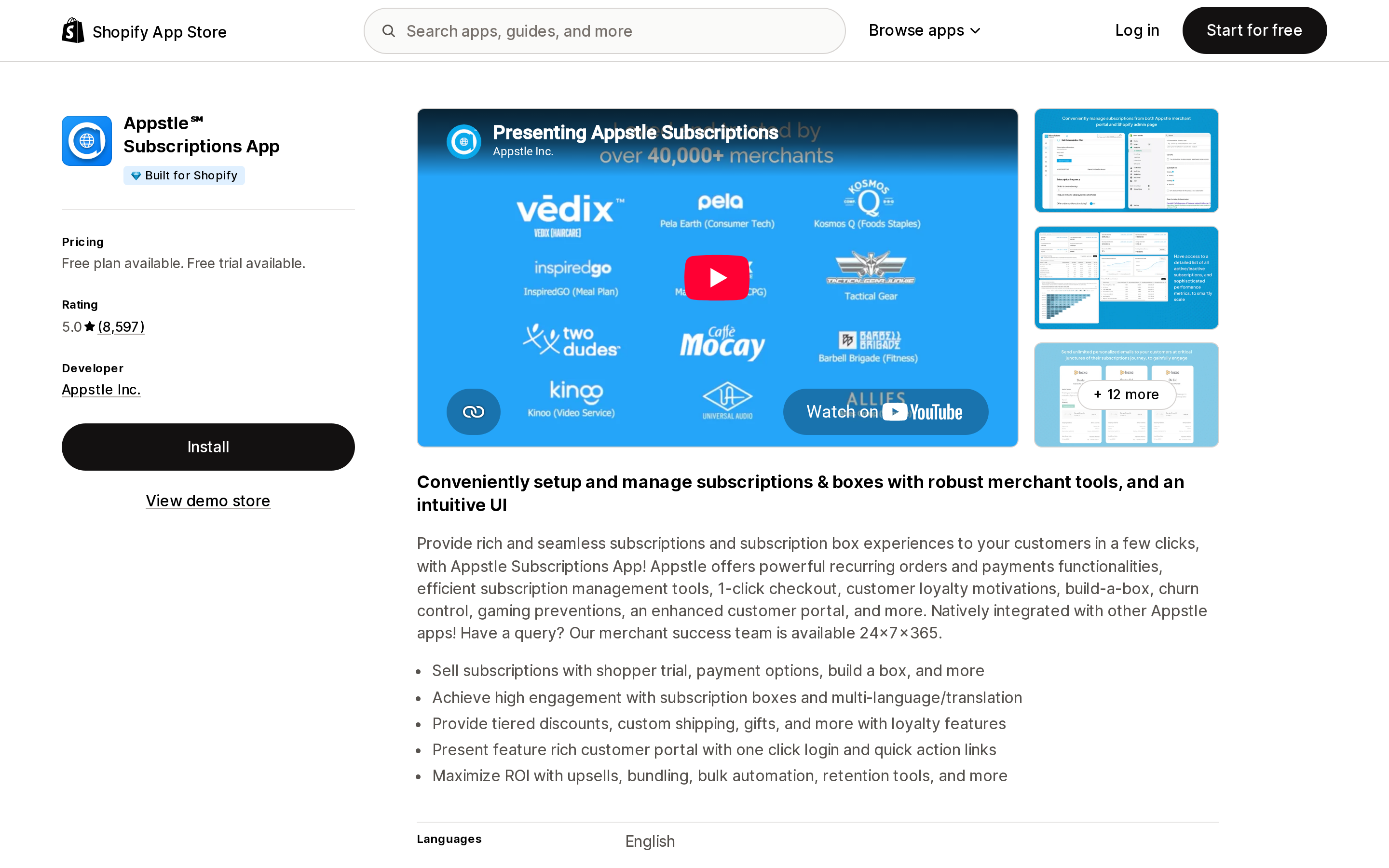
| Appstle℠ Subscriptions App | Appstle Inc. | Yes | Free plan available. Free trial available. | 5.0 (8,597) |
| Seal Subscriptions App | Seal Subscriptions | Yes | Free plan available. Free trial available. | 4.9 (3,080) |
| Kaching Subscriptions App | Kaching Bundles & Upsells | Yes | Free plan available. Free trial available. | 5.0 (1,007) |
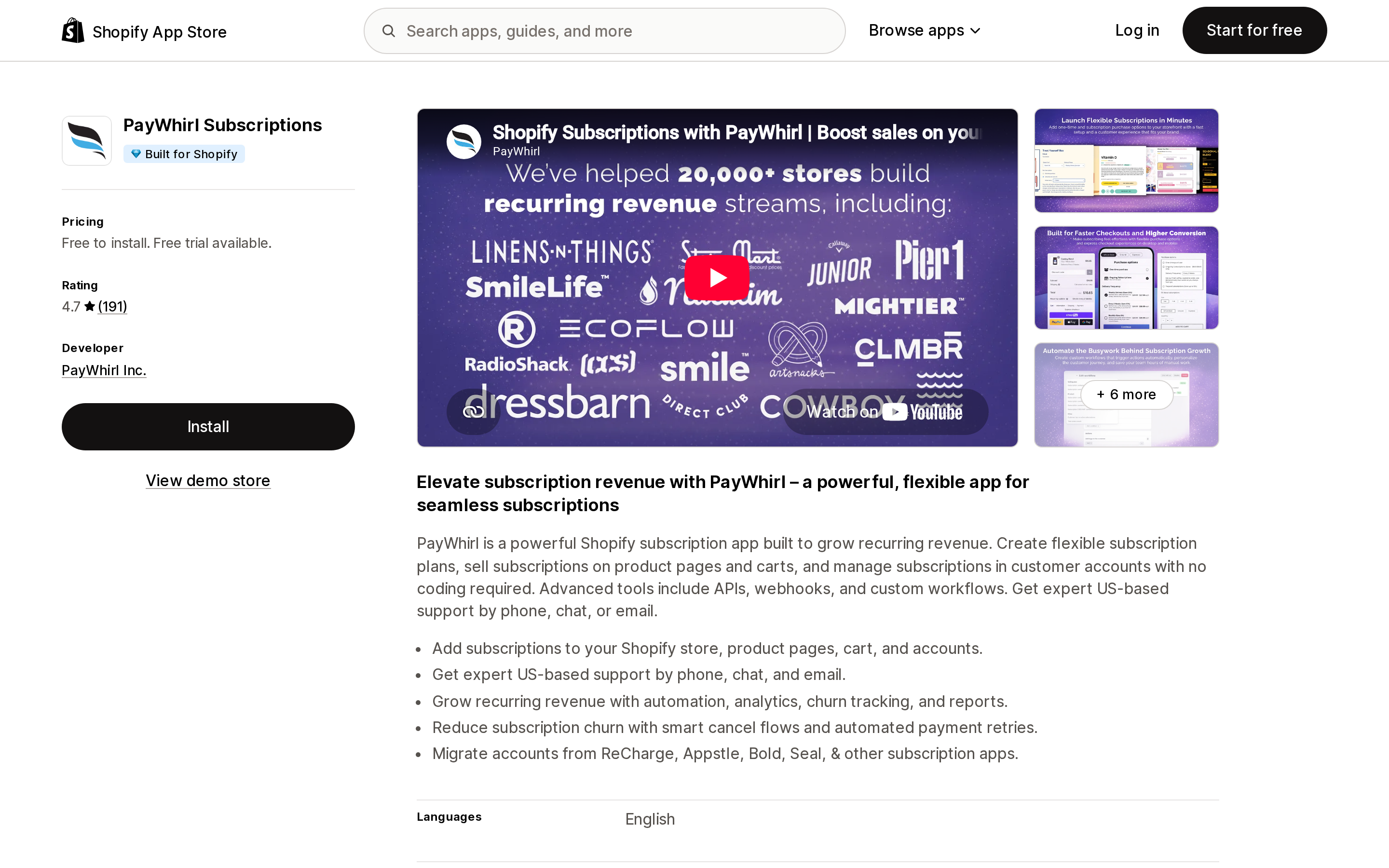
| PayWhirl Subscriptions | PayWhirl Inc. | Yes | Free to install. Free trial available. | 4.7 (191) |
| Utterbond Subscriptions App | Utterbond | Yes | Free to install. Free trial available. | 4.7 (92) |
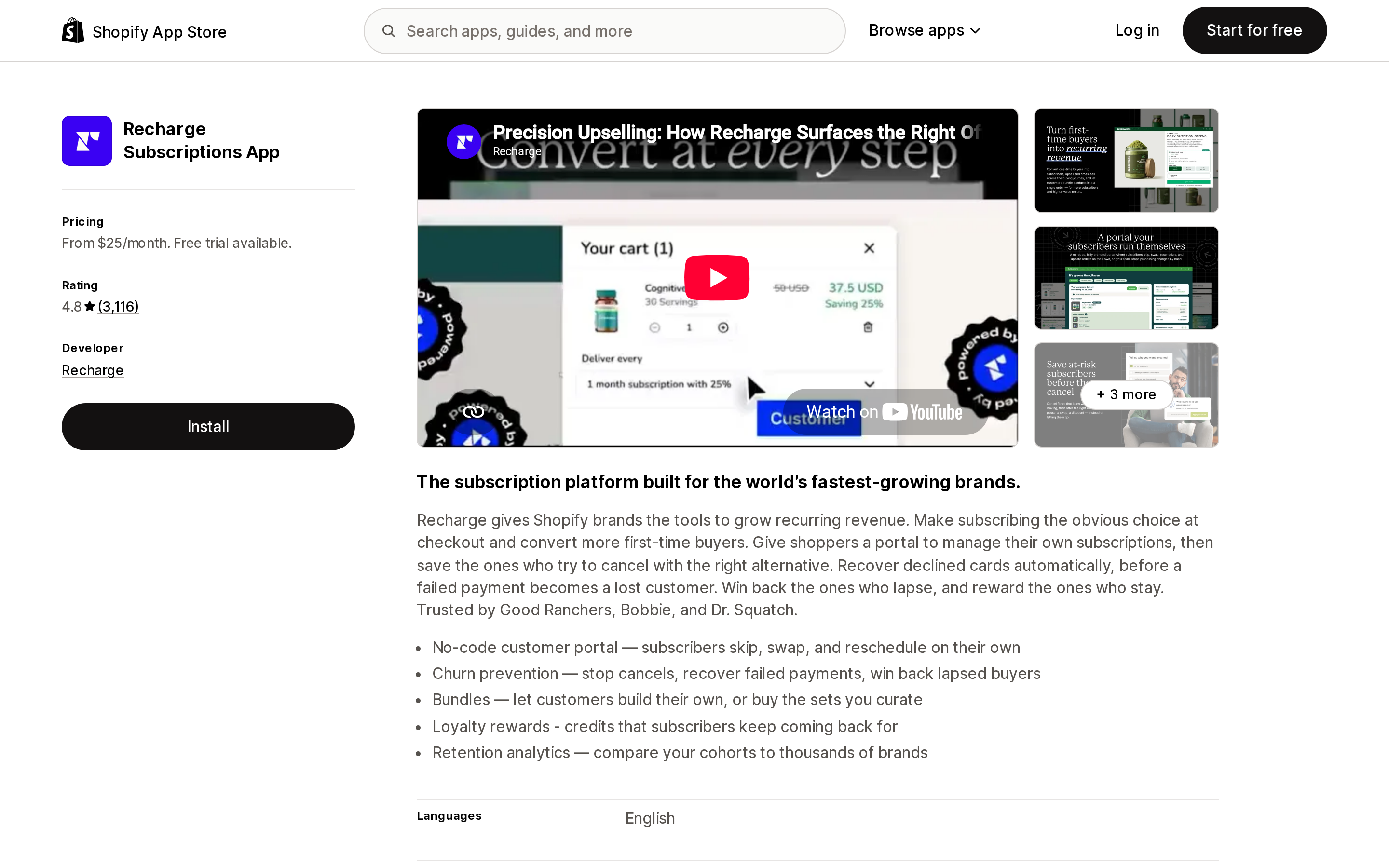
| Recharge Subscriptions App | Recharge | No | From $25/month. Free trial available. | 4.8 (3,116) |
| Loop Subscriptions App | Loop Solutions Inc | No | Free plan available. Free trial available. | 5.0 (748) |
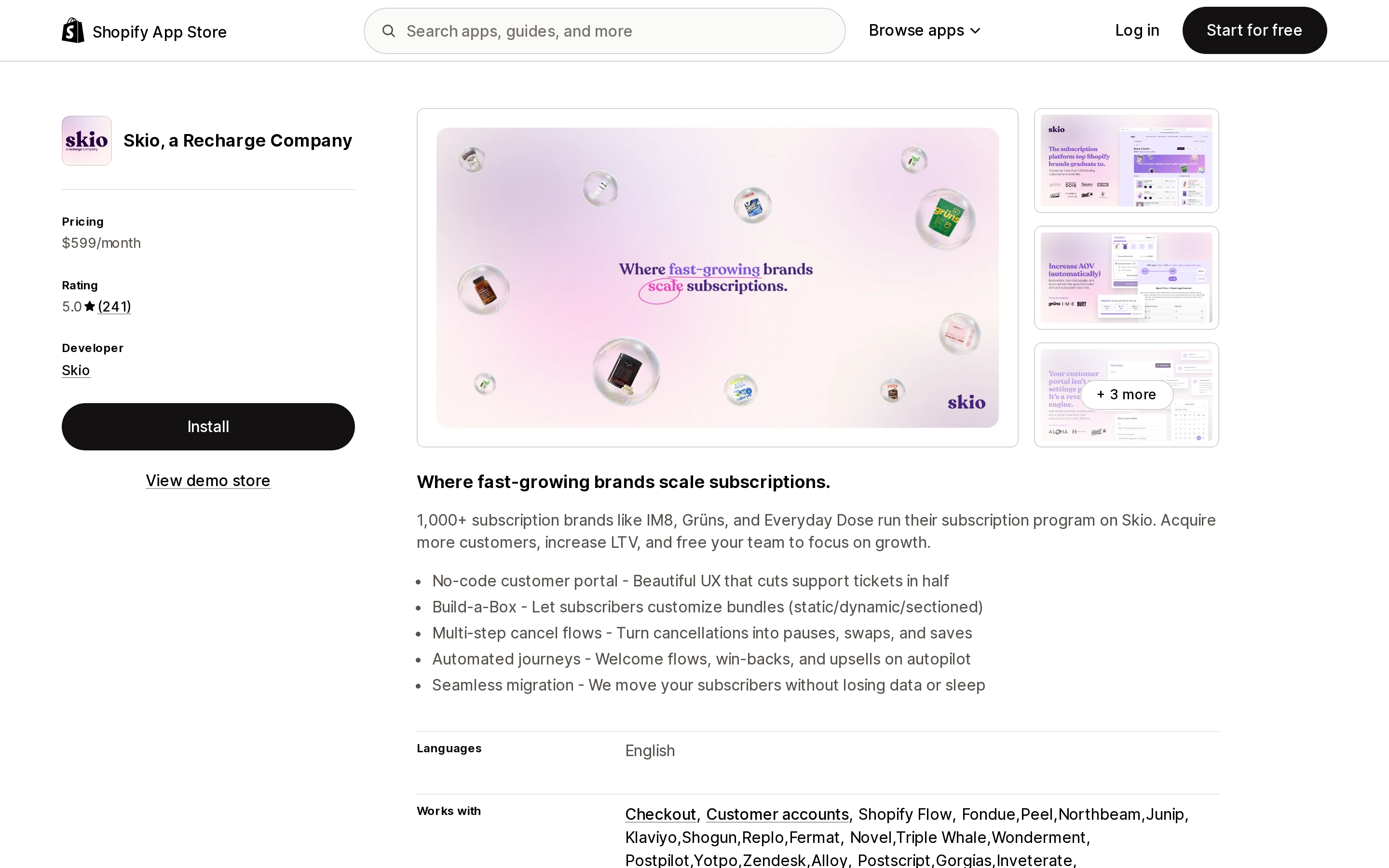
| Skio, a Recharge Company | Skio | No | $599/month | 5.0 (241) |
| Shopify Subscriptions | Shopify | No | Free | 3.7 (802) |
Returns and exchanges apps
| App | Developer | Built for Shopify | Pricing (USD) | Rating (reviews) |
|---|---|---|---|---|
| AfterShip Returns & Exchanges | AfterShip | Yes | Free plan available. Free trial available. | 4.7 (1,538) |
| CWILL Returns & Exchanges | CWILL INC | Yes | Free plan available. Free trial available. | 4.9 (488) |
| Yanet Returns & Exchanges | Yanet | Yes | Free plan available. Free trial available. | 4.8 (273) |
| ReturnZap Returns & Exchanges | ReturnZap | Yes | From $39/month. Free trial available. | 4.9 (108) |
| Return Prime: Return & Exchange | Appsdart Solutions Private Limited | No | Free to install. Free trial available. | 4.8 (768) |
| Redo | Redo Tech, Inc | No | Free plan available | 4.9 (749) |
| Loop Returns & Exchanges | Loop | No | Free plan available | 4.6 (442) |
| ReturnGO Returns & Exchanges | ReturnGO | No | From $147/month. Free trial available. | 4.8 (402) |
The distribution is the finding. In subscriptions, every badged app in this set starts free or free-to-install, while the three platforms that charge from the first dollar or run at the top of the market — Recharge, Skio, and Loop Subscriptions — do not carry it. Shopify's own Shopify Subscriptions app does not carry it either. In returns, the two apps with the most reviews split: AfterShip has the badge, Loop does not.
If you run Recharge or Loop, December 1 imposes no obligation on your vendor at all.
The apps at the center of it
Recharge Subscriptions App
Source: Shopify App Store (Recharge Subscriptions App), retrieved September 7, 2026
Recharge already publishes a route into Shopify customer accounts, and it is not a toggle. Its guide asks you to add four extensions in the checkout and accounts editor: a Subscription page extension, an Upcoming Orders extension on the orders page, and Payment Methods plus Addresses extensions on the profile page. Stores using Recharge Rewards install a fifth, Credits.
Two constraints are worth flagging before you plan that work. Recharge notes that with the Affinity customer portal, clicking Subscriptions redirects the customer out to the standalone Affinity portal rather than keeping them inside their Shopify account. And its passwordless login — the four-digit-code flow — carries the requirement that "Stores must use legacy customer accounts to use this feature."
That second one is a genuine fork. Legacy customer accounts were deprecated on February 26, 2026. Upgrading is the direction Shopify is pushing every store, but for a Recharge store it retires the passwordless widget. Multipass is not a fallback: Shopify's upgrade guide lists it among the limitations, stating Multipass is not supported on customer accounts.
Skio, a Recharge Company
Source: Shopify App Store (Skio, a Recharge Company), retrieved September 7, 2026
Skio is listed at $599/month with a 5.0 rating from 241 reviews, and its listing shows Customer accounts under Works with. It does not carry Built for Shopify. Merchants paying enterprise money for a subscription platform should note that the badge that carries the December 1 obligation is the one their vendor does not hold.
Appstle℠ Subscriptions App
Source: Shopify App Store (Appstle℠ Subscriptions App), retrieved September 7, 2026
Appstle is the largest badged subscription app in this set by review count — 8,597 reviews at 5.0 — with a free plan and a paid ladder above it. It carries Built for Shopify, so clauses 5.14.4 and 5.14.5 both apply to it by December 1. If you are choosing a subscription app now and you want the vendor to be contractually pointed at Shopify sign-in, the badge is the signal to look for.
PayWhirl Subscriptions
Source: Shopify App Store (PayWhirl Subscriptions), retrieved September 7, 2026
PayWhirl is free to install, holds the badge, and is the one app in this set whose Works with row lists Customer accounts and Shopify POS but not Checkout. Read that row before assuming feature parity with Recharge; it is a different shape of product.
AfterShip Returns & Exchanges
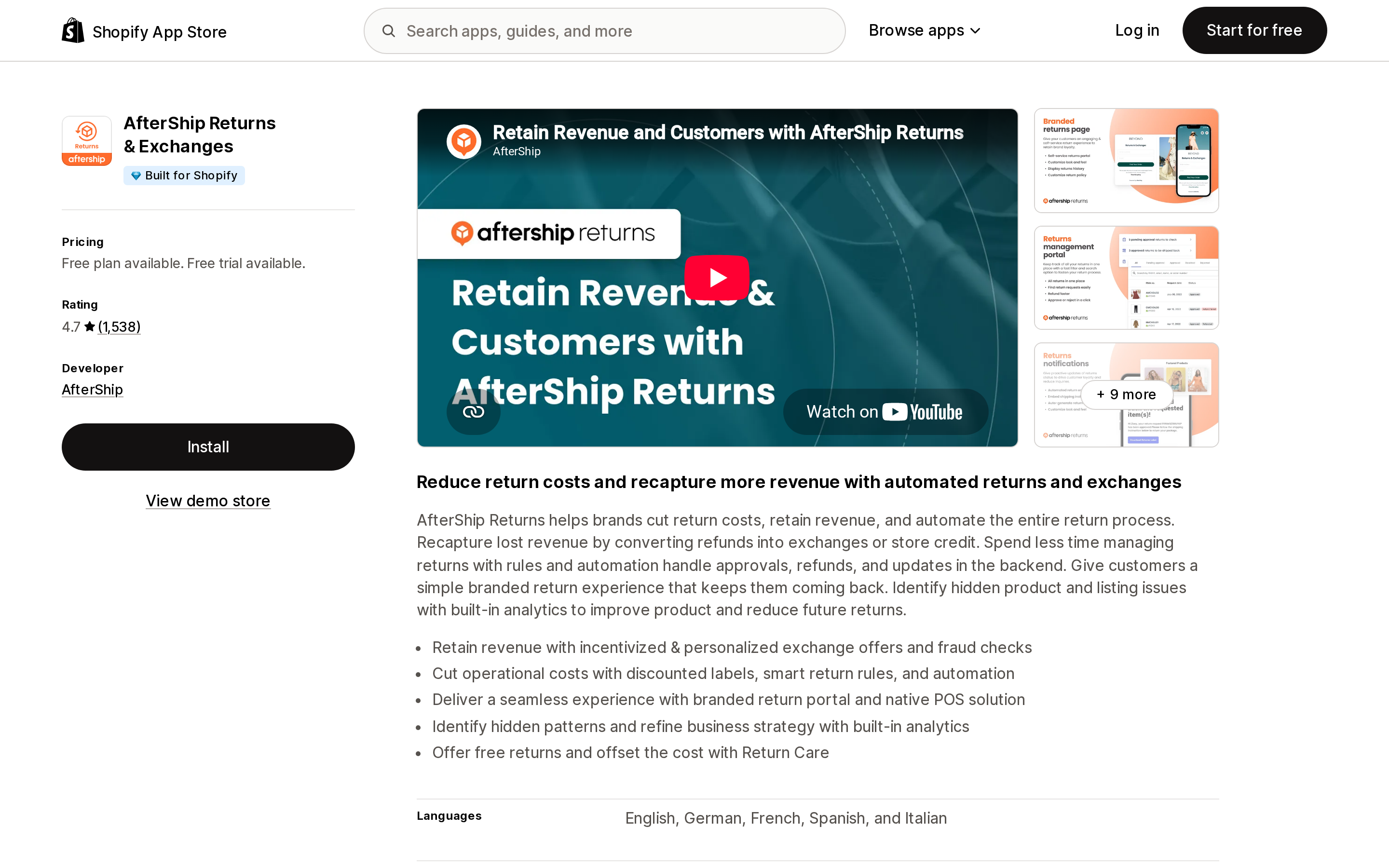
Source: Shopify App Store (AfterShip Returns & Exchanges), retrieved September 7, 2026
AfterShip published its customer-account extension on June 18, 2026 — the day after Shopify's changelog. Its help article is unusually direct about why: Shopify's new customer accounts removed Edit code, so the legacy deep-link method of adding a return button no longer works.
The setup is four clicks in the checkout editor, adding a Request return action to the Orders and Order status pages. AfterShip states the resulting shopper experience plainly: signed-in shoppers can start a return directly from their account, with no order number or verification needed. Two practical notes from the same article: the app needs the View all orders permission in your Shopify admin, and if Shopify's native return portal is also switched on, shoppers see two return buttons — you have to disable the native one.
One limit remains. AfterShip says the button redirects to its own hosted returns page, and that redirecting to your proxy URL is not currently supported.
Loop Returns & Exchanges
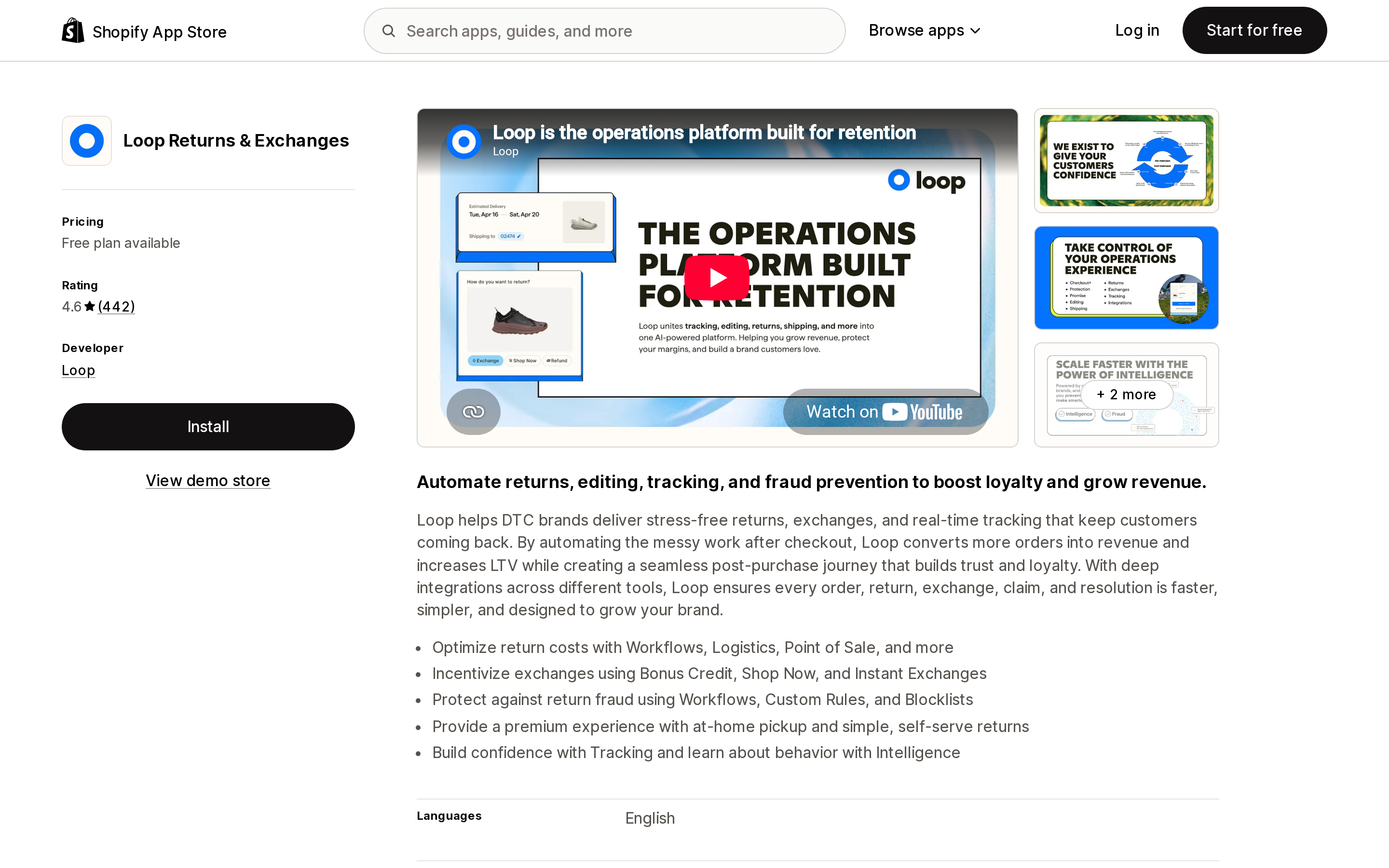
Source: Shopify App Store (Loop Returns & Exchanges), retrieved September 7, 2026
Loop ships a Start Return app extension for stores on Shopify's native customer accounts, and its help article — last edited February 24, 2026 — puts that population at roughly 30% of Loop's merchant base.
That number is worth holding next to Shopify's. Two days later, in the changelog announcing the deprecation of legacy customer accounts, Shopify told developers that customer account UI extensions put an app "in front of over 70% of Shopify merchants (and growing) already using customer accounts," and that 800+ apps had already made the switch. The two figures are not directly comparable — one counts Loop's install base, the other counts merchants platform-wide, and neither publishes its methodology — but the gap is large enough to be worth asking your own vendor about rather than assuming.
Note what Loop's extension does. Clicking Start Return "automatically populates the return flow using the order number and existing lookup criteria (email, zip, or phone)." It prefills the lookup. It does not replace it. Since Loop does not hold Built for Shopify, nothing in the December 1 requirement obliges it to.
ReturnGO Returns & Exchanges
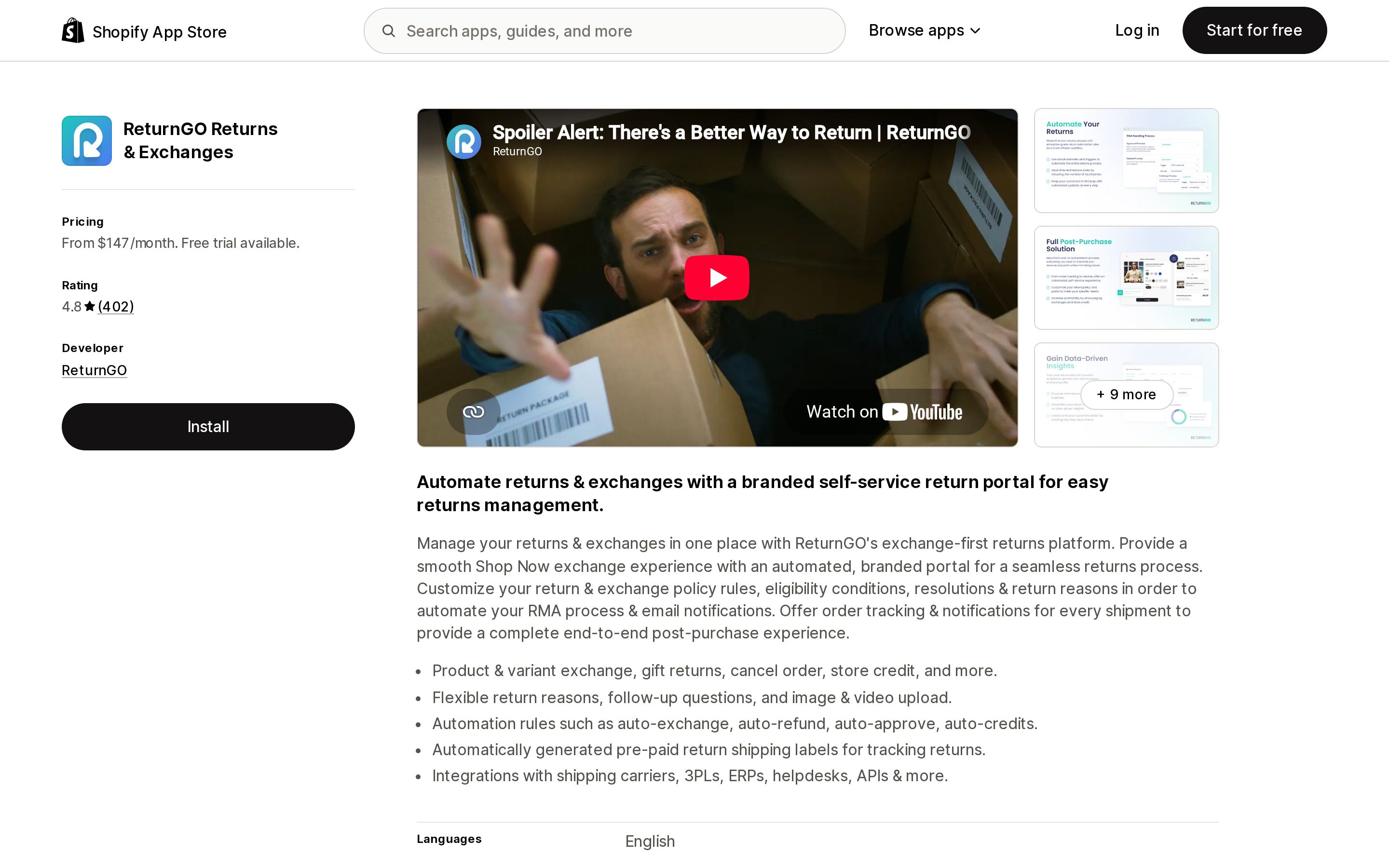
Source: Shopify App Store (ReturnGO Returns & Exchanges), retrieved September 7, 2026
ReturnGO starts at $147/month and is the only app in either table whose Works with row lists no Shopify surfaces at all — it names Canada Post, Gorgias, Sendcloud, Shippo, Shipstation, and USPS, with no Checkout, Customer accounts, or POS entry. It does not hold the badge. At that price, the absence of a customer-accounts surface on the listing is the thing to ask the vendor about directly.
What losing the badge does and does not do
The changelog names one consequence, and Shopify documents the timing elsewhere.
Built for Shopify status is monitored continuously. Automated criteria give an app 60 days of failure before the status drops. Manually checked criteria are reviewed on an ongoing basis and annually, and a flagged app again gets 60 days to fix the issue. Status returns automatically once the app meets the criteria again — no reapplication.
What the documentation does not say is that a non-compliant app is delisted, unpublished, or blocked from installs. Shopify's App listing visibility page describes a separate mechanism entirely, in which fully visible apps are indexed in category pages, App Store search, and third-party search engines, while limited-visibility apps are not. That is a setting the developer chooses, not a penalty tied to Built for Shopify.
So for a merchant, the realistic outcome for an app that misses December 1 is a badge disappearing from a listing. Your subscribers keep their magic links.
What to actually do before December 1
Check whether your app holds the badge. Open its App Store listing and look directly beneath the app name. If Built for Shopify is not there, the December 1 clause does not apply to your vendor and you should plan on the current login flow persisting.
If you are still on legacy customer accounts, sequence the upgrade carefully. Shopify's guide lets you revert within 30 days, but the direction is one-way in practice — and if you run Recharge passwordless login, upgrading retires that flow, with Multipass unavailable as a substitute on customer accounts.
Test the double-button case. If you enable an app's customer-account return extension while Shopify's native self-serve returns are still on, shoppers can end up with two buttons. AfterShip documents this and tells merchants to turn the native portal off.
Check who sends the code. Once buyers authenticate through customer accounts, the one-time passcode goes out from your store's sender email address. Shopify's upgrade guide makes reviewing that address a step in its own right, and a sender address you cannot receive at is a login outage.
Do not treat the badge as a feature list. Built for Shopify tells you a vendor is on the hook for these clauses. It does not tell you the app is better at returns or subscriptions than a larger app without it.
Sources
- Built for Shopify requirements for Returns and exchanges apps and Subscription apps (effective December 1, 2026) — Shopify developer changelog
- Built for Shopify requirements — shopify.dev
- Regain lost status — shopify.dev
- App listing visibility — shopify.dev
- Upgrading to customer accounts from legacy customer accounts — Shopify Help Center
- Legacy customer accounts are deprecated — Shopify developer changelog
- How to set up Shopify customer accounts with your Recharge customer portal — Recharge
- Passwordless login for the customer portal — Recharge
- Deep Link to a Customer Order in the Return Portal — Loop Returns documentation
- Shopify New Customer Accounts — Loop Help Center
- Add a Return Button to the New Shopify Customer Account — AfterShip Help Center
- Shopify App Store listings for each app named above, retrieved September 7, 2026
Shopify added a Bin name column to the inventory CSV on August 25, 2025. It holds one bin per variant per location, it is created only by CSV import, and it prints on Order Printer pick lists. What it does not do is leave Shopify. Shopify staff confirmed on the developer forum in October 2025 and again in January 2026 that there is no public API access to the field, and the developer forum was still reporting the gap in June 2026. That single fact shapes the whole category: EasyScan and iPacky store bins in metafields, Bins-USA and ShelfPilot store them in their own databases, and a free app called Simple Bin Locations copies metafield bins into order notes so packing slips can show them. Shopify's own multi-bin model, with per-bin quantities and an unbinnedQuantity field, exists today only as a feature preview on development stores. Pricing, plan gates, and where each app keeps the bin data, verified on the Shopify App Store, the Shopify Help Center, shopify.dev, and the Shopify community forums on September 18, 2026.