
What you will learn
On this pageContentsCloseOpen
The Shopify App Store has a category called Product comparison. Its description reads: "Help people pick the right product with side-by-side, feature-by-feature comparison tools." It contains 223 apps.
Open it and count what is actually on the first page. Of the 24 apps listed, four compare products. Nineteen are size charts, fit finders, AI virtual try-on, or product badges. The twenty-fourth is an Amazon Buy Button app.
That is the real starting condition for this decision, and no "best product comparison apps" list mentions it.
The short version
- The Product comparison category holds 223 apps, but the first seven results are all size-chart or virtual try-on apps. The first genuine comparison app appears at position eight.
- Dawn 16.0.0 has no comparison feature. Every occurrence of "compare" in its sections, snippets, and blocks is a sale-price variable:
compare_at_price,compare_at_price_varies, orvariant_price_compare. - Horizon 4.1.5 ships a block named Comparison slider. It takes a
before_imageand anafter_image, its preset category isdecorative, and Horizon's own section schema calls itimage_compare. It has nothing to do with comparing products. - The data model for comparison is native. Shopify's Liquid documentation for
product_referencemetafields demonstrates it with an example field namedsimilar_products. What is not native is the table. - The apps in this category are two different products under one name: shopper-driven compare (checkboxes, a compare bar, a side-by-side modal) and merchant-authored spec tables. Buying the wrong one is the most common mistake here.
- Their paid plans meter on six different quantities, so the headline prices are not comparable to each other.
- Equate ‑ Product Compare shows "Free plan available" on the App Store. The plan is named "Free to install" and its first listed feature is "Free for your development store".
- CN Comparison Tables meters on table views — 300 on the free plan — and lists "Ads Removal" as a paid feature. It also does not read your catalogue: its integrations are Airtable, CSV, Google Drive, Notion, OneDrive, and XML.
- Two of the ten apps examined here currently have zero reviews, and one has a single review dated January 2024.
What is actually in the category
Here is page one of Store design › Product display › Product comparison, in the order Shopify lists it, as of September 8, 2026:
| # | App | What it is |
|---|---|---|
| 1–7 | Jotly, MP, Pify, Antla, Smart Size Chart, ScaleChart, GenLook | Size charts and AI virtual try-on |
| 8 | Tably Comparison & Spec Tables | Product comparison |
| 9–12 | SS: AI Virtual Try On, AI Frame, Kiwi Size Chart, True Fit | Try-on and fit |
| 13 | Compareder ‑ Product Compare | Product comparison |
| 14–20 | TryPoint, BF Size Chart, LV Product Badges, Icona, CSC, AI Fit Finder, ILM | Try-on, size charts, badges |
| 21 | Bear Specs & Compare | Product comparison |
| 22 | G: Size Chart & Size Guide | Size chart |
| 23 | Snap Compare: Compare Products | Product comparison |
| 24 | Libautech: Amazon Buy Button | Amazon Buy Button |
Searching product comparison instead of browsing the category returns a much better list — Tably, Compareder, Snap Compare, Iconic Product Comparison, Bear Specs & Compare, Equate, and Comparable occupy seven of the first eight slots. If you have been browsing the category and concluding that the ecosystem is thin, that is a browsing artefact, not a market fact.
What your theme already does, and does not do
Before installing anything, it is worth knowing exactly where the gap is.
Dawn 16.0.0 does not have a comparison feature. Searching its sections, snippets, and blocks directories for "compare" returns five files, and every hit is a sale-price variable — compare_at_price and compare_at_price_varies in snippets/price.liquid and the card templates, and variant_price_compare in main-product.liquid and featured-product.liquid. That is a pricing display, not a comparison tool.
Horizon 4.1.5 is more confusing, because it does ship a block called comparison-slider.liquid. Read the source and it takes two settings named before_image and after_image, renders a draggable handle between them, and declares its preset category as t:categories.decorative. Horizon's sections/section.liquid refers to the same thing by the translation key t:names.image_compare. It is a before-and-after image wipe. Horizon also ships product-custom-property.liquid, which sounds like a specification row but is a line-item property input — a text box or checkbox the buyer fills in, submitted with the product form.
So neither theme compares products. But the data layer does exist, and it is worth being precise about this because it changes what you are paying an app for.
Shopify's Liquid metafield documentation states that a metafield of type product_reference returns a product object, and that list types return an array you can iterate. The documentation's own example for measuring a list's length is:
Number of similar products: {{ product.metafields.information.similar_products.value.count }}
Shopify named its example field similar_products. The product object also exposes category, a taxonomy_category object drawn from Shopify's product taxonomy.
In other words: attaching "these are the products this one competes with" and "these are its specifications" to a product is a native, documented capability. Every one of the apps below is built on top of it. What you are buying is the rendering — the table layout, the difference highlighting, the compare bar, the mobile behaviour, and an admin screen so you are not editing Liquid.
That matters for one specific decision. If you want the same comparison table on a handful of high-consideration products and you already have metafield definitions, a developer can build it. If you want shoppers to tick checkboxes across a 2,000-product catalogue and get a side-by-side view, you are buying an app.
Two products, one category name
The apps split cleanly into two groups that solve different problems.
Shopper-driven compare adds a "Compare" button to product cards, lets the shopper build a list, and shows the result in a modal or on a dedicated compare page. This is the Amazon-style behaviour most merchants picture. Compareder, Snap Compare, Equate, and Comparely work this way.
Merchant-authored tables are built by you in the admin and rendered where you place them — a specification table on the product page, or a "this product versus the alternatives" table you control. Tably, Bear Specs & Compare, Comparable, CN Comparison Tables, and TableAI work this way.
A third pattern is emerging: automatic comparison with no shopper input at all. Iconic Product Comparison describes it as "Related products are compared automatically without any input from shoppers." Tably and Bear both offer dynamic comparison on collection pages.
If you sell one flagship product and want to show why it beats the competition, the shopper-driven apps are the wrong purchase — there is nothing for the shopper to select. If you sell forty similar laptops, a static merchant-authored table is unmaintainable.
Six meters
Here is what each app charges for, verified on the Shopify App Store on September 8, 2026. Every listing states charges are billed in USD every 30 days.
| App | Built for Shopify | Rating | Free plan | Paid | Metered on |
|---|---|---|---|---|---|
| Tably Comparison & Spec Tables | Yes | 4.9 (91) | No | $6.99/mo, $55/yr | Nothing — "Unlimited tables & unlimited views" |
| Bear Specs & Compare | Yes | 4.8 (45) | No | $6.99 / $9.99 | Feature tier |
| Snap Compare: Compare Products | Yes | 5.0 (7) | Yes | $4.99 / $9.99 | Products per comparison (free: 3), then analytics |
| Compareder ‑ Product Compare | Yes | 4.8 (21) | Yes | $4.99 / $8.99 | Feature tier |
| Equate ‑ Product Compare | Yes | 4.8 (35) | Dev store only | $8.99 | Store type |
| Comparable ‑ Compare Products | No | 5.0 (9) | No | $9 / $19 | Catalogue size (1k / 5k products) |
| Iconic Product Comparison | No | 5.0 (1) | Yes, all features | — | Nothing |
| CN Comparison Tables | No | 5.0 (1) | Yes | $5 / $10 / $15 | Table views, tables, rows, columns |
Two more apps in the category have no reviews yet: Comparely (free plan, $7.99/month Premium, launched October 21, 2025) and TableAI ‑ comparison table (free plan capped at one table, $9.99/month Pro).
The consequence is that "starts at $4.99" and "starts at $9" describe different universes. Snap Compare's $4.99 plan is unlimited comparisons. Comparable's $9 plan covers up to 1,000 products with comparison options, and you move to $19 at 5,000. CN's $5 plan allows 2,000 views. If your comparison table is on a product page that gets more traffic than that, you are on the $10 or $15 plan regardless of how few tables you built.
The metafield paywall
There is a second, quieter price. Most of these apps can read the product metafields you already maintain — but the plan on which that unlocks varies enormously.
The cheapest plan on which each app reads product metafields: Iconic Product Comparison at $0, Snap Compare at $4.99, Bear Specs & Compare and Tably at $6.99, Comparely at $7.99, Equate and Compareder at $8.99, Comparable at $9.
Compareder is the sharpest example. Its Business plan at $4.99 does not list metafield support; "Product metafields support" appears only on the $8.99 Enterprise plan. If your specifications live in metafields — which is where Shopify's own taxonomy puts them — Compareder's real entry price is $8.99, not $4.99.
The apps
Tably Comparison & Spec Tables
Source: Shopify App Store (Tably Comparison & Spec Tables), retrieved September 8, 2026
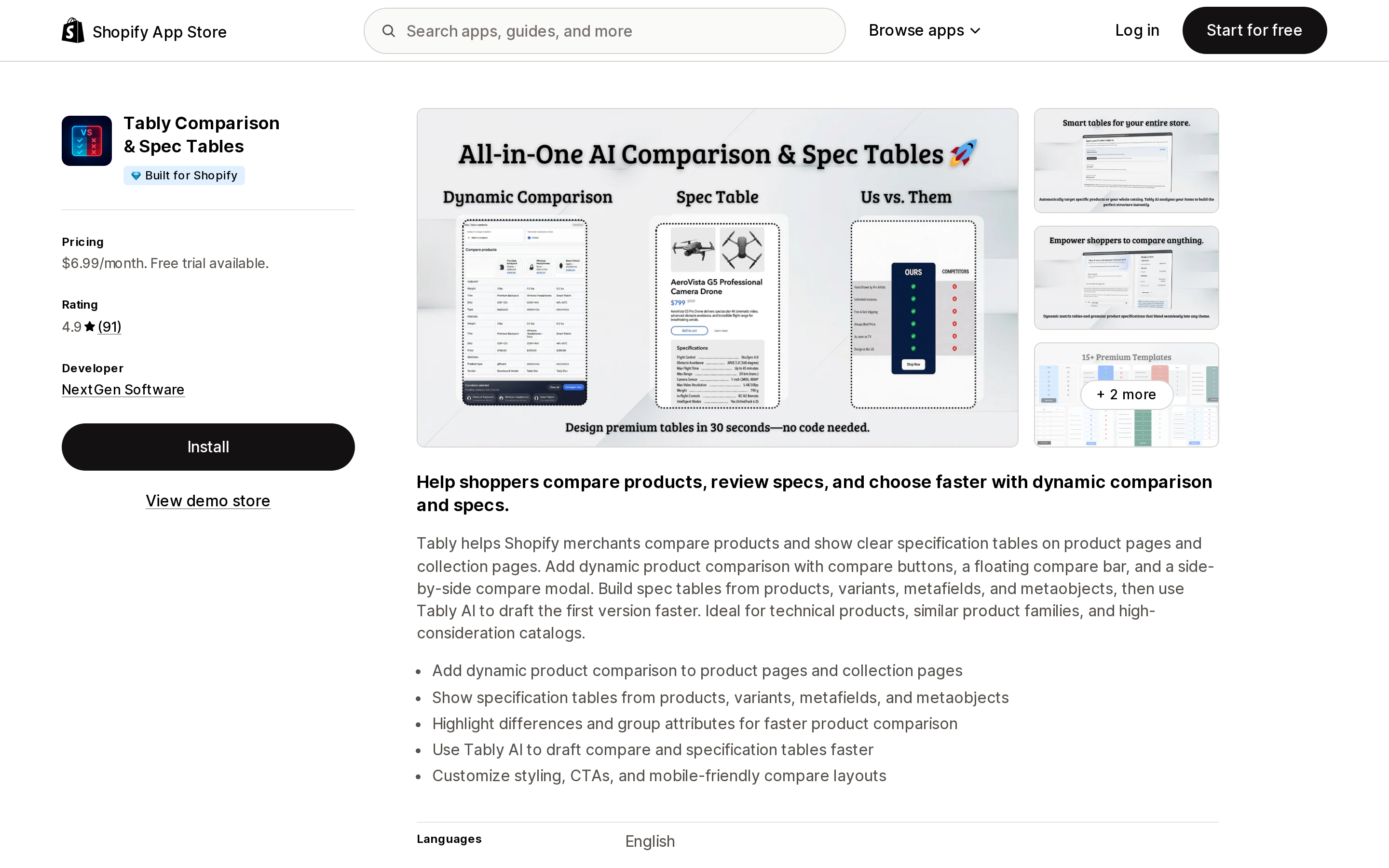
The most-reviewed comparison app in the category, at 4.9 from 91 reviews — and it launched on October 8, 2025. It has accumulated those reviews in under a year, which is why it does not appear in listicles written before this year. One plan, $6.99/month or $55/year, with unlimited tables and unlimited views, a 14-day trial, and no free tier. It builds specs from products, variants, metafields, and metaobjects, and includes "Us vs Them" advantage tables and shareable compare links. Among the listings checked for this article, its requested data access is among the narrowest: store owner, products, and Online Store.
Bear Specs & Compare
Source: Shopify App Store (Bear Specs & Compare), retrieved September 8, 2026
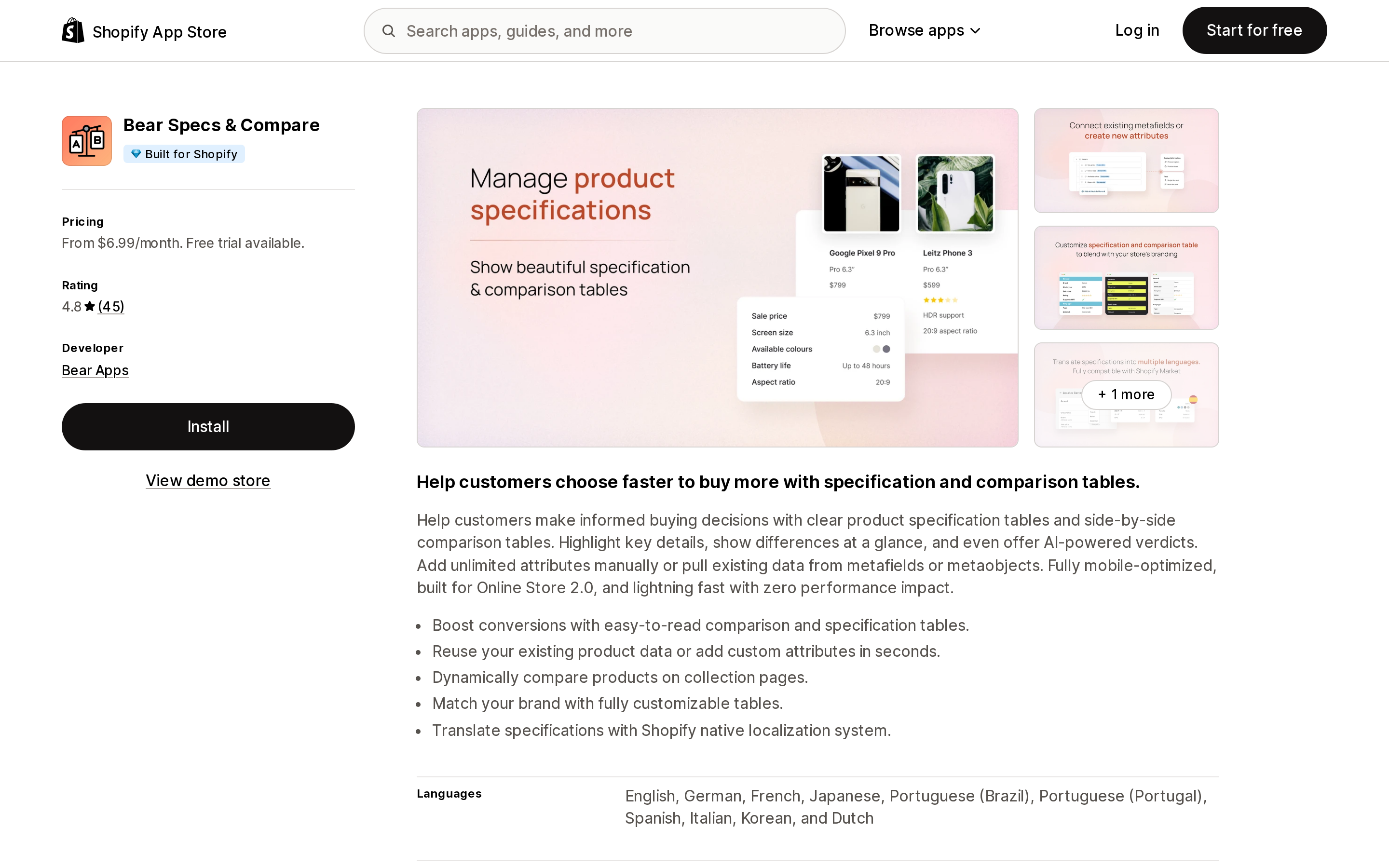
$6.99/month Starter, $9.99/month Pro, no free plan, 14-day trial. Starter already includes metafields and metaobjects; Pro adds dynamic comparison, variant table comparison, and AI-generated comparison verdicts. It is the only app here listing ten interface languages and Shopify's native localization system for translating specifications. A review dated July 25, 2026 from a merchant of eleven months is worth reading in full for anyone choosing in this category — it describes moving from another comparison app that "stopped working" after a Shopify API change while "the developer refused to respond."
Snap Compare: Compare Products
Source: Shopify App Store (Snap Compare: Compare Products), retrieved September 8, 2026
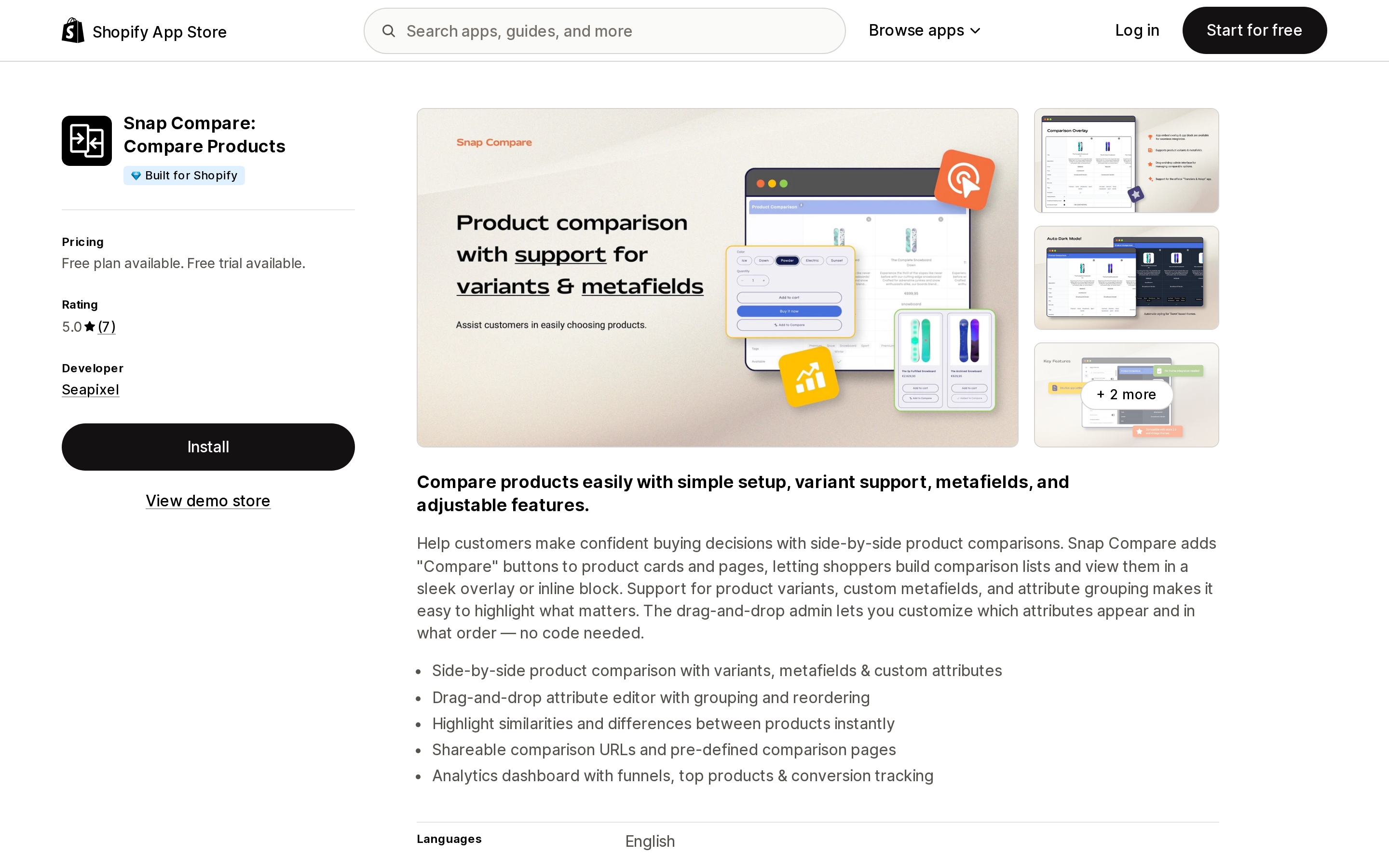
A free tier that works on a live store: compare up to three products, with variants, difference highlighting, and both an app embed overlay and an app block. $4.99 lifts the cap and adds metafields, attribute grouping, and shareable comparison URLs; $9.99 adds an analytics dashboard with funnels and top co-compared product pairs. That analytics feature explains its data access request, which is the broadest in this comparison — device and activity data, blog contributors, and orders, alongside products, custom data, and Shopify admin. That may be entirely reasonable for conversion attribution. It is still worth knowing before you install a table widget.
Compareder ‑ Product Compare
Source: Shopify App Store (Compareder ‑ Product Compare), retrieved September 8, 2026
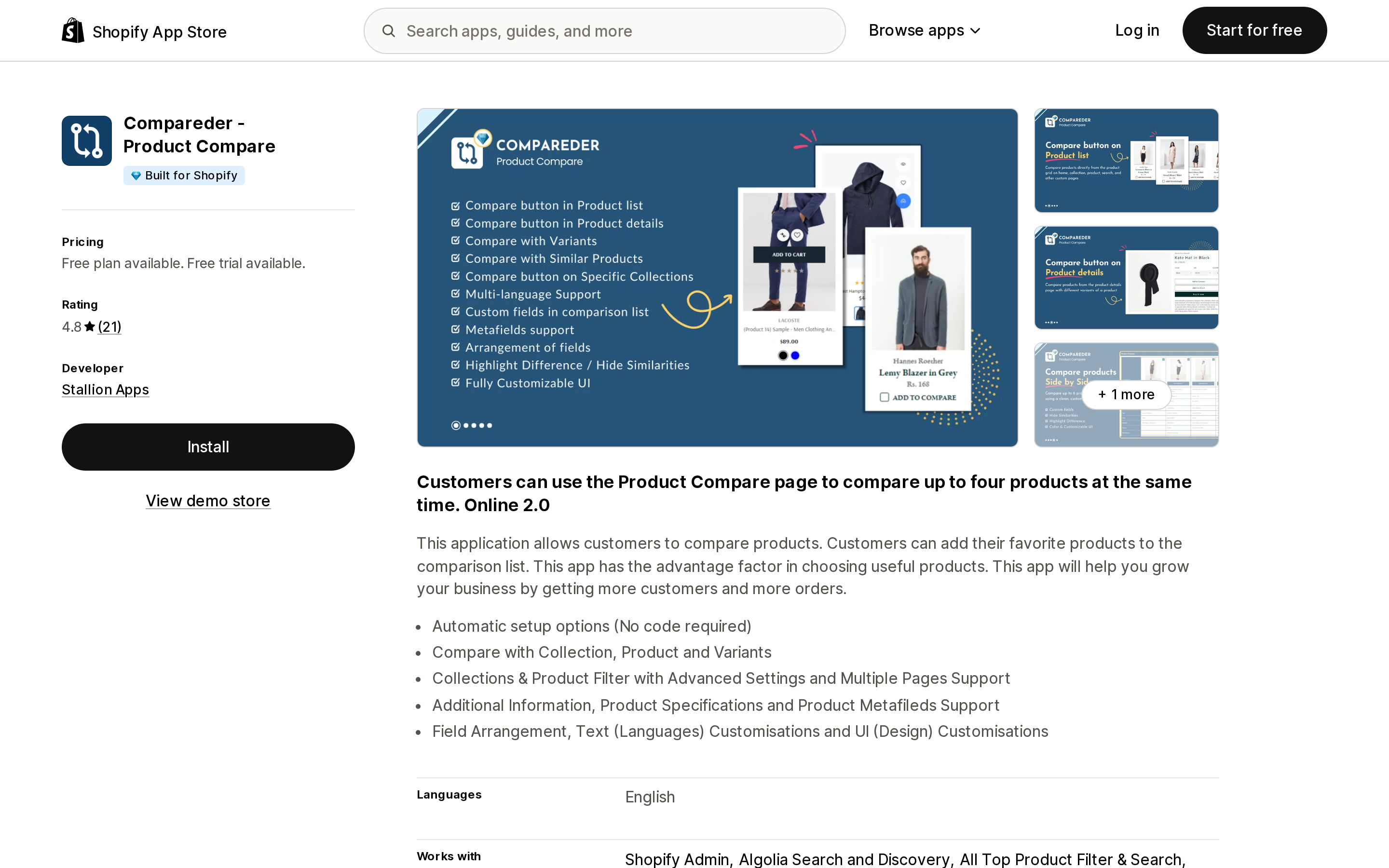
The oldest app in this set, launched June 8, 2021, at 4.8 from 21 reviews. Free Lite plan, $4.99 Business, $8.99 Enterprise. Read the tiers carefully: "Unlimited products" is listed on both the free Lite plan and the $8.99 Enterprise plan, and "Arrangement of fields" appears on both paid tiers. As noted above, metafield support is Enterprise-only.
Equate ‑ Product Compare
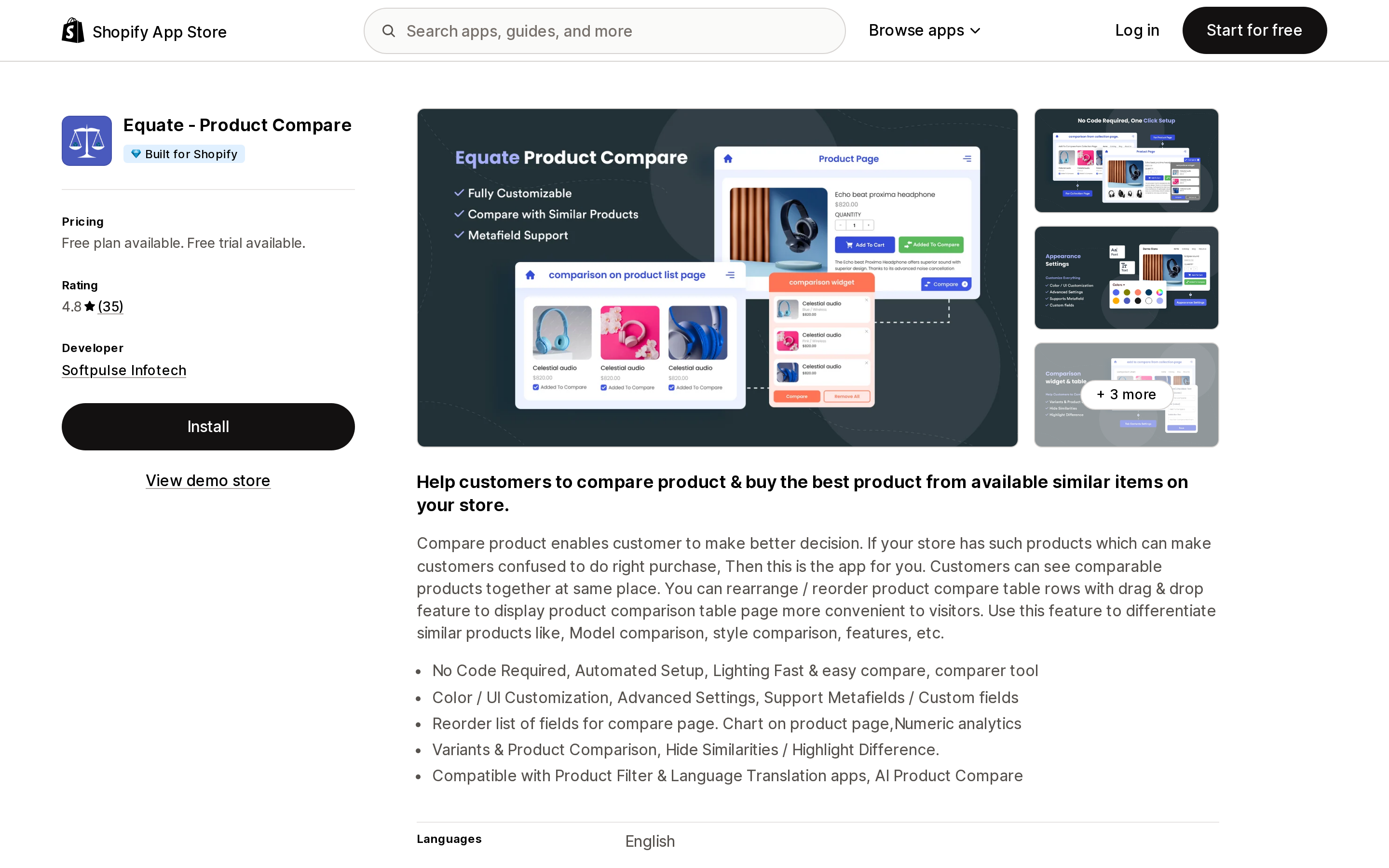
Source: Shopify App Store (Equate ‑ Product Compare), retrieved September 8, 2026
4.8 from 35 reviews and Built for Shopify, with the longest trial in the category at 30 days. The pricing needs care. The App Store search result and listing header both say "Free plan available." The plan is called "Free to install," and its four listed features are: "Setting up your store?", "Free for your development store", "All Features Included", "No additional Cost". On a live store the price is $8.99/month. If you are filtering the App Store by "Free plan available", this is the app most likely to mislead you.
Comparable ‑ Compare Products
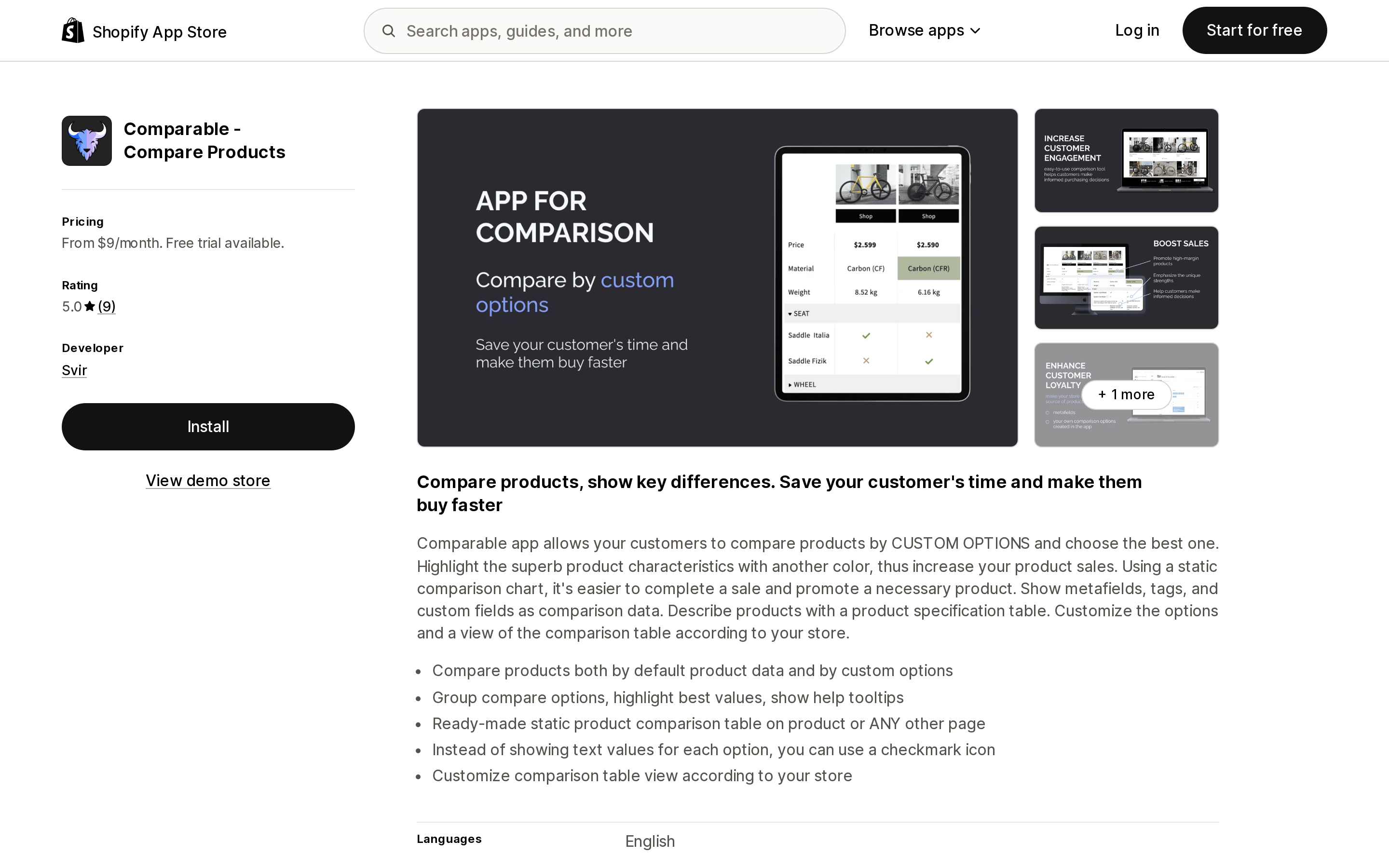
Source: Shopify App Store (Comparable ‑ Compare Products), retrieved September 8, 2026
The only app here priced against catalogue size: $9/month for up to 1,000 products with compare options, $19/month for up to 5,000, with a 21-day trial and no free plan. No Built for Shopify badge. It produces static comparison tables placeable on a product page or any other page, and supports metafields, tags, and custom fields. An August 10, 2026 review from a US merchant describes support "walking me through the metafield variable imports," which is a fair signal of the setup effort involved.
Iconic Product Comparison
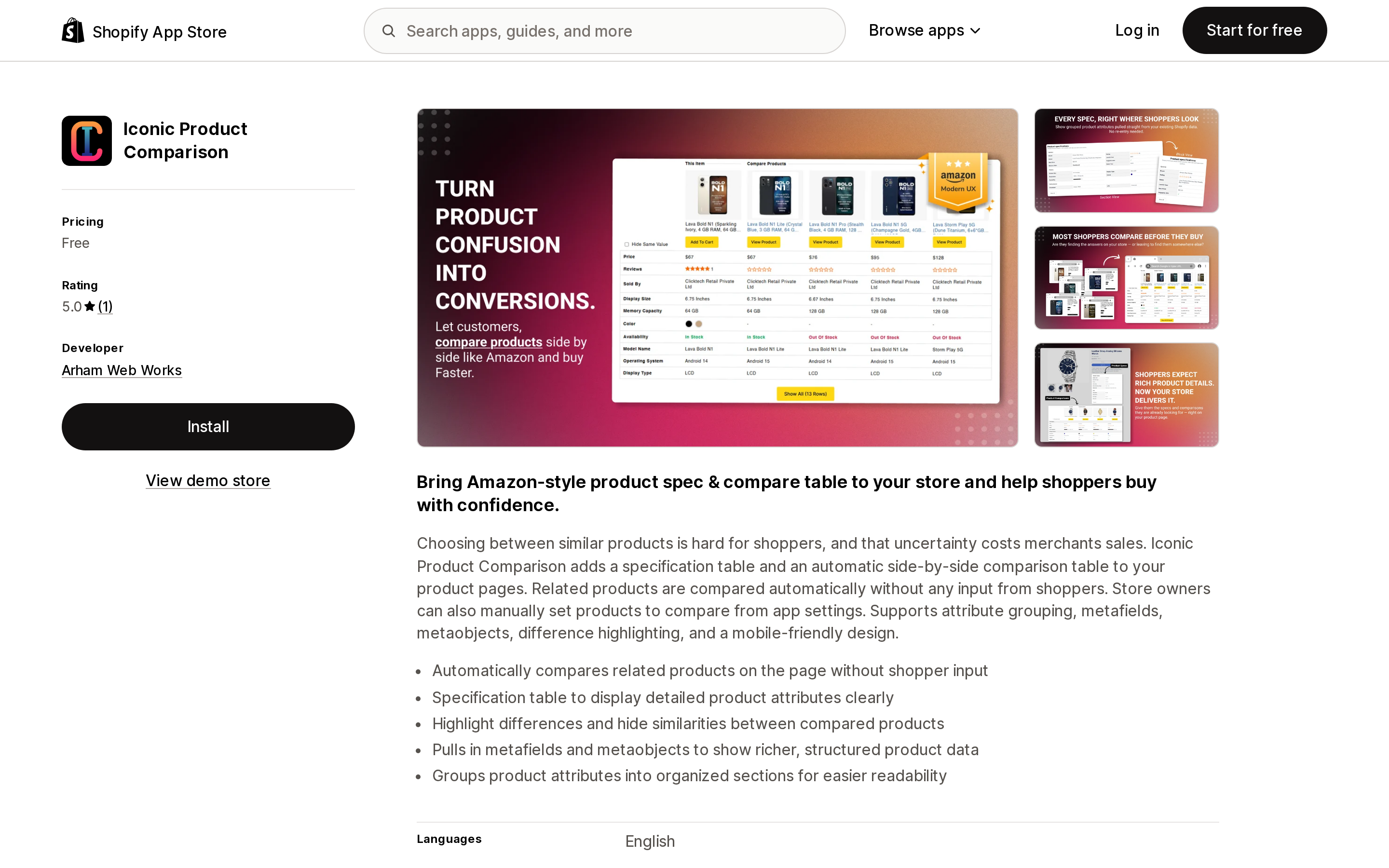
Source: Shopify App Store (Iconic Product Comparison), retrieved September 8, 2026
Launched April 15, 2026 and currently free with every listed feature included: specification tables, comparison tables, attribute grouping, metafields and metaobjects, difference highlighting, and priority support. Its distinguishing behaviour is automatic comparison of related products with no shopper input. The caveats are the obvious ones — one review, five months on the App Store, no Built for Shopify badge — and its pricing block carries a "See all pricing options" link, so treat "free" as the current state rather than a permanent commitment.
CN Comparison Tables
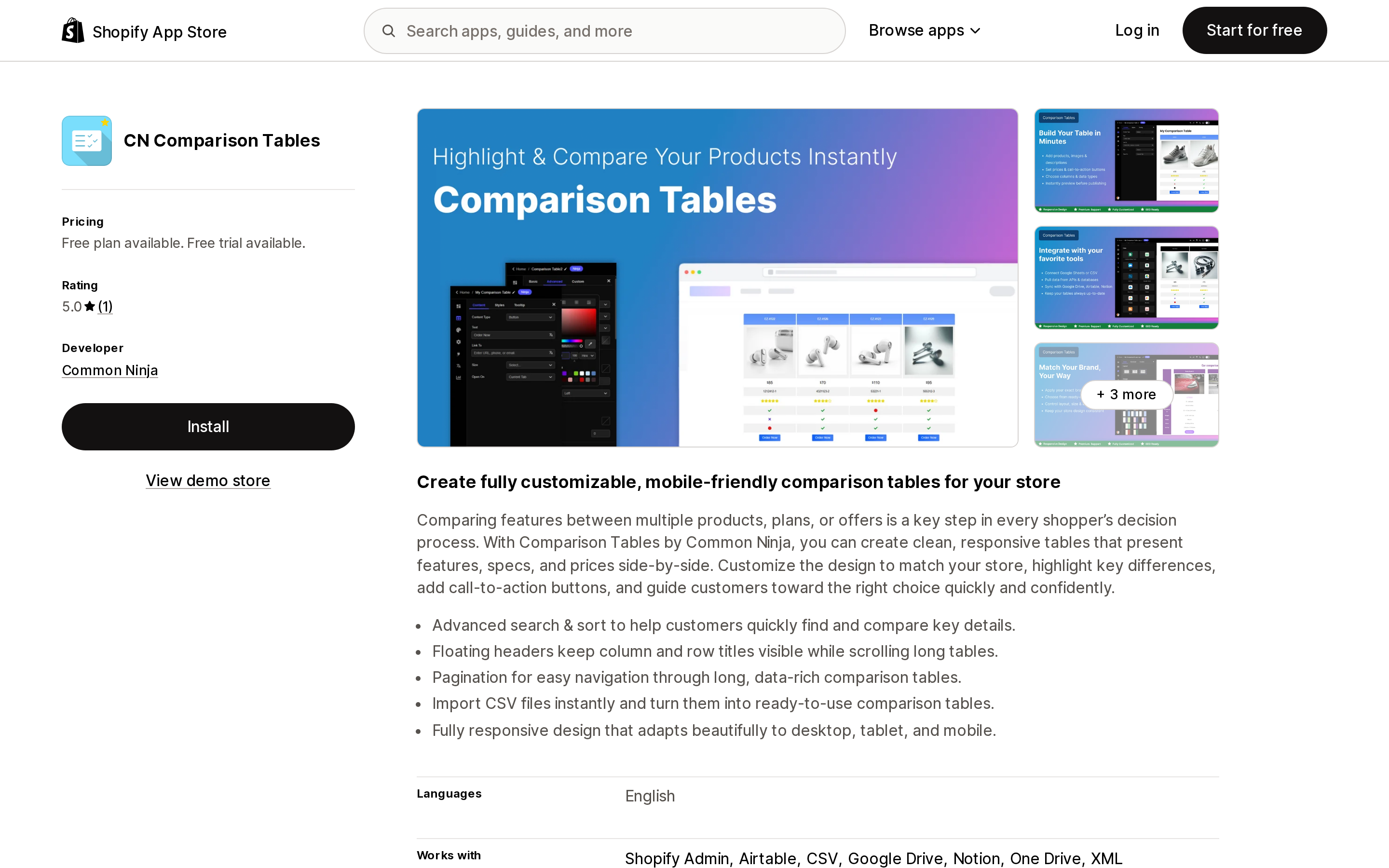
Source: Shopify App Store (CN Comparison Tables), retrieved September 8, 2026
This one is in a different business. Common Ninja builds cross-platform widgets, and its integrations here are Airtable, CSV, Google Drive, Notion, OneDrive, and XML — not your product catalogue. Its listed comparison features are comparison page, comparison table, filter and sort, and images; there is no entry for variants, specifications, or metafields. You type or import the data, and the table does not change when your catalogue does.
The plans are metered on views, tables, rows, and columns: Free gives 300 views, 2 tables, 10 rows and 6 columns; $5 gives 2,000 views; $10 gives 100,000; $15 gives 3,000,000. The listing does not state the period these view counts cover. "Ads Removal" is listed as a feature of all three paid plans, which means the free plan does not remove them — the listing does not describe what they look like. Its single review is dated January 22, 2024.
How to choose
- You sell one product and want to show why it wins. A merchant-authored table. Tably at $6.99 flat, or Iconic at $0 if you are willing to accept a five-month-old app.
- You sell many similar products and want shoppers to pick. Shopper-driven. Snap Compare's free tier (3 products) to validate demand, then $4.99. Compareder if you prefer a five-year track record, budgeting $8.99 for metafields.
- Your specifications already live in metafields. Check the metafield paywall before the headline price. The gap between $0 and $9 for the same capability is the widest variance in this category.
- Your specs are in a spreadsheet and not in Shopify. CN Comparison Tables is the only app built for that. Accept that the table is a document, not a view of your catalogue.
- Your catalogue exceeds 5,000 products. Comparable's published tiers stop there; ask before you commit.
- You are on a development store. Equate's free plan is genuinely free — that is precisely and only what it covers.
One category-wide caution. Comparison tables render on the product page and depend on Shopify's APIs continuing to behave. The Bear Specs & Compare review describing a competitor that broke on an API change and went unanswered is a single merchant's account, but it names a failure mode worth checking for: look at how recent each app's reviews are and whether the developer replies to them. Note too that in this category, high star ratings frequently sit on very small review counts — 5.0 from one review and 5.0 from ninety are not the same signal.
Sources
- Shopify App Store — Product comparison category
- Shopify App Store — search results for "product comparison"
- App Store listings for Tably Comparison & Spec Tables, Bear Specs & Compare, Snap Compare, Compareder, Equate, Comparable, Iconic Product Comparison, CN Comparison Tables, Comparely, TableAI ‑ comparison table
- Shopify.dev — Liquid
metafieldobject - Shopify.dev — Liquid
productobject - Shopify/dawn on GitHub (theme_version 16.0.0)
- Shopify/horizon on GitHub (theme_version 4.1.5)
All App Store listings, prices, ratings, and review counts verified September 8, 2026. Theme source read at the same date from the current main branch of each repository.
Shopify added a Bin name column to the inventory CSV on August 25, 2025. It holds one bin per variant per location, it is created only by CSV import, and it prints on Order Printer pick lists. What it does not do is leave Shopify. Shopify staff confirmed on the developer forum in October 2025 and again in January 2026 that there is no public API access to the field, and the developer forum was still reporting the gap in June 2026. That single fact shapes the whole category: EasyScan and iPacky store bins in metafields, Bins-USA and ShelfPilot store them in their own databases, and a free app called Simple Bin Locations copies metafield bins into order notes so packing slips can show them. Shopify's own multi-bin model, with per-bin quantities and an unbinnedQuantity field, exists today only as a feature preview on development stores. Pricing, plan gates, and where each app keeps the bin data, verified on the Shopify App Store, the Shopify Help Center, shopify.dev, and the Shopify community forums on September 18, 2026.