
What you will learn
On this pageContentsCloseOpen
If you ship to customers in the EU from a Shopify store, a new obligation may already apply to you. The core duties of the EU PPWR (Packaging and Packaging Waste Regulation, EU Regulation 2025/40) took effect on August 12, 2026, and merchants shipping into Germany, France, Italy, and Spain now need to register their packaging and report its weight.
The uncomfortable part is that "we're too small to be in scope" doesn't hold up. Germany's LUCID (the central packaging register) has no minimum volume threshold — shipping even a single packaged item to a German consumer in a year can trigger a registration duty. France's Citeo and Italy's CONAI don't offer a blanket small-business exemption either. And Shopify has no native feature that addresses any of this.
This article checks, against primary sources, which stores are in scope for PPWR/EPR (Extended Producer Responsibility), from when, and how far the obligation reaches. Then it compares 5 real Shopify App Store apps on the same set of criteria. Researched September 4, 2026.
The short version
If you ship to EU consumers, assume you may be in scope regardless of your size. Germany's LUCID registration has no minimum volume threshold, and France and Italy offer no blanket small-business exemption. "We're too small" doesn't work as a defense here.
As of August 12, 2026, producers not established in the EU must appoint an authorized representative in every member state where they place packaging on the market. This obligation comes from Article 45(3) of PPWR. If you ship to 8 member states, that can mean 8 separate representatives. As of this article's publish date, that effective date has already passed.
Shopify's admin, Markets, and metafields have no feature for recording packaging material or weight in a format EPR schemes can accept. Searching help.shopify.com turns up no official documentation on PPWR, EPR, LUCID, or VerpackG.
Of the 5 apps compared here, only one has real customer reviews. The other four have zero reviews, and all five launched between late 2025 and July 2026. Treat this as a category where a wave of new apps has appeared quickly in response to a new regulation, not a mature market.
Every one of these apps' listings states, in some form, that it is not legal advice. These are configuration and documentation tools that automate registration and filing work — not a substitute for consulting a lawyer or a local environmental compliance specialist.
What PPWR is, and why this matters now
PPWR (EU Regulation 2025/40) entered into force in 2025 and replaces the older Packaging and Packaging Waste Directive (94/62/EC). Multiple law firm analyses agree that its core obligations — packaging minimization, recyclability requirements, an EU Declaration of Conformity, and EPR registration — apply from August 12, 2026. That date has already passed as of today.
The definition of "producer" matters here. Under PPWR, the producer is whoever first places packaging on a given member state's market — and that isn't automatically the manufacturer. Several cross-border e-commerce law analyses point out that for direct-to-consumer sales, the non-EU seller itself can be treated as the producer. In other words, a Shopify store shipping directly from Japan or the US to EU consumers can be the party this regulation targets.
Article 45(3) of PPWR requires producers not established in the EU to appoint an EPR authorized representative in every member state where they first place packaging on the market. This obligation also took effect on August 12, 2026. Sell into multiple member states, and you can need one representative per country.
The rules differ meaningfully by country
Checking primary sources country by country shows the thresholds are not consistent.
Germany (LUCID / VerpackG). According to the LUCID Packaging Register's own registration guidance, there is no minimum volume for registration. Whether you ship hundreds of thousands of units a year or a single handmade item, the registration duty applies the same way. As of August 12, 2026, LUCID registration also became a duty each business must fulfill under its own name — merchants who previously relied on a German fulfillment provider's LUCID ID in place of their own registration can no longer do so.
France (Citeo). There's no blanket small-business exemption. However, Citeo's own guidance describes a simplified declaration route for sellers whose packaged product volume stays under 500,000 UVC (unit de vente au consommateur — a consumer sales unit, i.e., one product a consumer can buy separately) per year.
Italy (CONAI). Registration is still required, but companies with total revenue at or below €500,000 in the last fiscal year can join CONAI through a category association as a simplified alternative to standard registration. This is a simplified process, not an exemption.
Spain (Ecoembes). Spain runs a comparable EPR scheme to Germany, France, and Italy.
Because thresholds and simplified routes differ by country, being exempt (or eligible for a simplified process) in one country doesn't mean the same applies elsewhere.
Checking Shopify's native capabilities
The finding here is straightforward. Shopify's admin, Shopify Markets, and metafields have no feature that records a product's packaging material and weight and exports it in a format that an EPR scheme like LUCID or Citeo would accept. Searching help.shopify.com for PPWR, EPR, LUCID, or VerpackG returns no official documentation. With no native path, this moves to a comparison of real apps.
Comparing 5 real apps
All five of the following are confirmed live on the Shopify App Store as of September 2026. They differ substantially in which schemes they cover, how they price, and how much review history they have.
| App | Countries / schemes covered | Pricing | Reviews | Notable |
|---|---|---|---|---|
| Packify: PPWR & EPR Compliance | Shows LUCID / Citeo / CONAI / Ecoembes requirements based on selected EU countries | Free / Pro $7/month | 0 | Focused on obligation checks plus CSV/PDF export |
| PackPilot EPR | LUCID/VerpackG (DE), Citeo (FR), CONAI (IT), Ecoembes (ES), ARA (AT) | Free | 0 | 5 UI languages, fee forecasting, Triman label generation |
| EPR Pack Report | LUCID/VerpackG (DE), CONAI (IT), Citeo (FR, more coming) | $179/year (1 country) to $249/year (all countries) | 0 | Automatic per-order packaging weight tracking, unlimited products/orders |
| EPR Insights | Packaging plus batteries, electronics, and single-use plastics | $15/month (400 orders) to $59/month (4,500 orders), plus $0.05/order over the limit | 5.0 (3) | The only app here with real reviews; scope extends beyond packaging |
| EPR One | Germany's VerpackG only | Free / $13.99–$119/month | 0 | Germany-only specialist, explicitly states EU hosting (Frankfurt) |
Pricing and review counts reflect the Shopify App Store listings as of September 4, 2026.
The apps in detail
Packify: PPWR & EPR Compliance
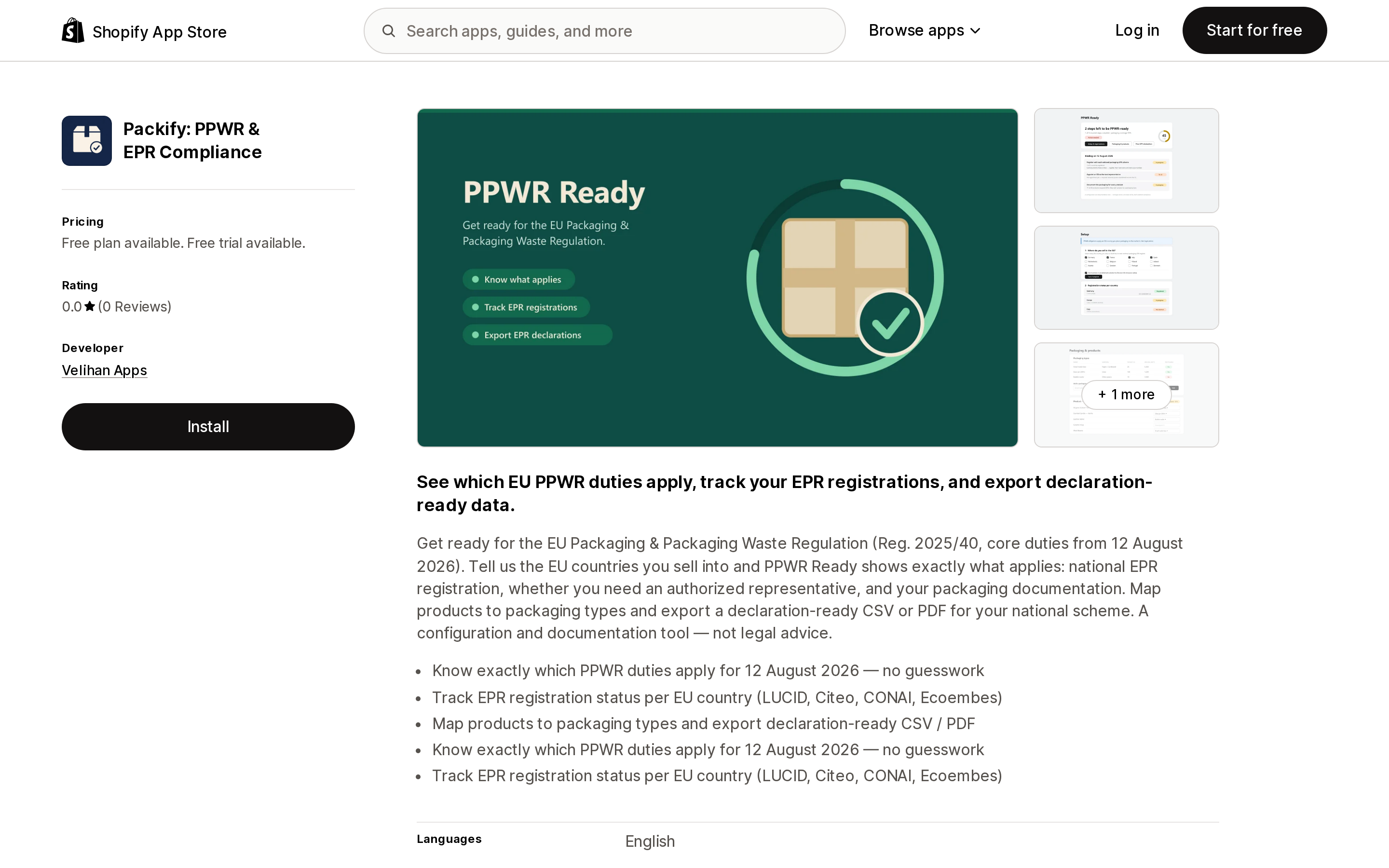
Source: Shopify App Store (Packify: PPWR & EPR Compliance), retrieved September 4, 2026.
Developed by Velihan Apps (Antalya, Turkey), launched July 28, 2026, with zero reviews so far. You select which EU countries you sell into, and the app shows which national EPR registrations and authorized-representative requirements apply, along with documentation needs. It maps products to packaging types and exports declaration-ready data as CSV or PDF for the schemes it lists — LUCID, Citeo, CONAI, and Ecoembes. Pricing is a two-tier Free plan and a Pro plan at $7/month.
The listing includes the line "A configuration and documentation tool — not legal advice," making its positioning explicit: it's a configuration and documentation aid, not a substitute for legal counsel.
PackPilot EPR
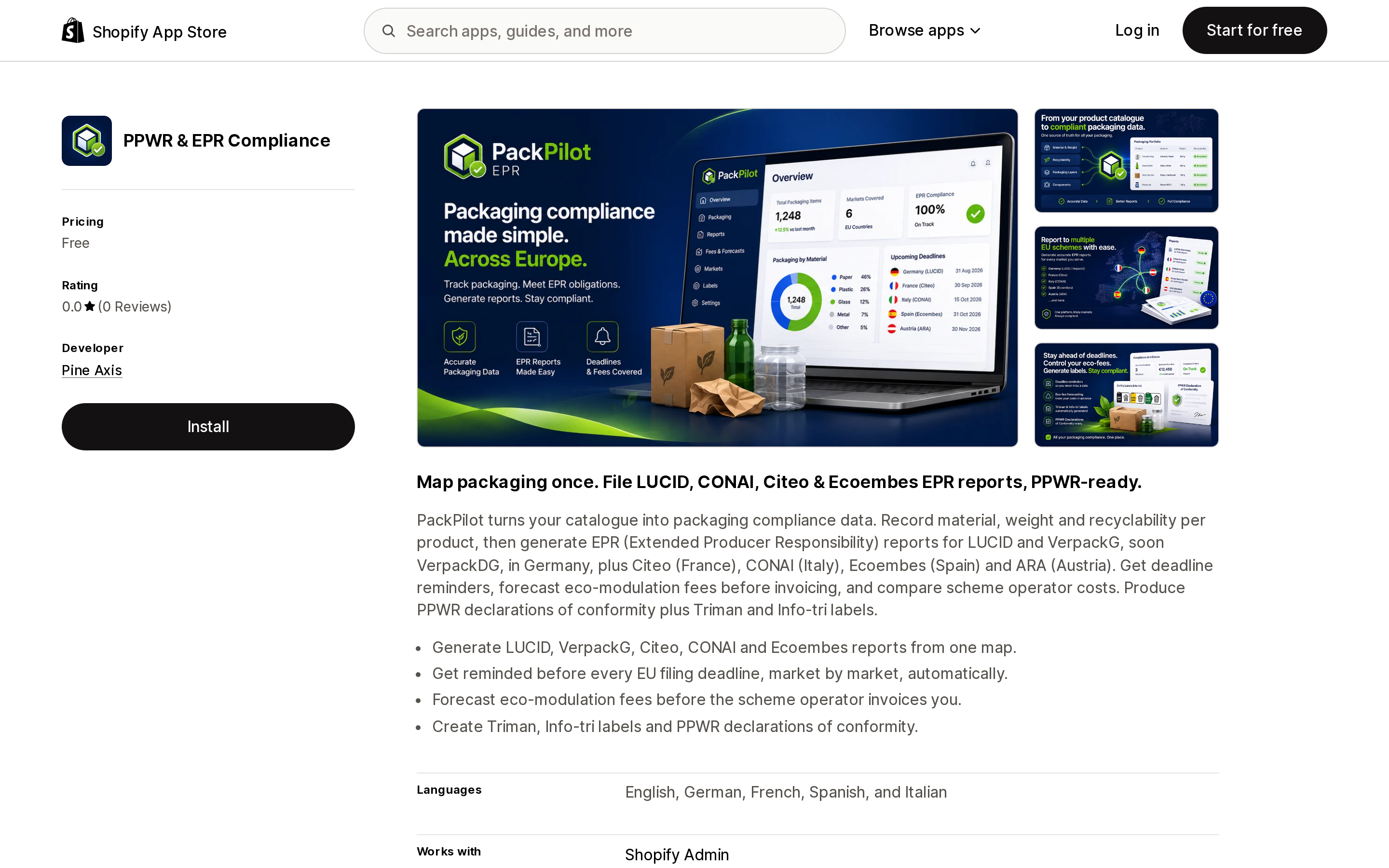
Source: Shopify App Store (PackPilot EPR), retrieved September 4, 2026.
Developed by Pine Axis (Lahore, Pakistan), launched July 24, 2026, with zero reviews. It's the only one of the five with a 5-language UI (English, German, French, Spanish, Italian). It records material, weight, and recyclability per product, then generates reports for LUCID/VerpackG (with VerpackDG support listed as coming soon) in Germany, plus Citeo (France), CONAI (Italy), Ecoembes (Spain), and ARA (Austria). It also offers deadline reminders, eco-modulation fee forecasting before the scheme operator invoices you, cost comparisons across scheme operators, and generation of France's Triman and Info-tri labels plus PPWR declarations of conformity. Pricing is listed simply as free to install.
Its data access covers customer data, 60 days of order history, and Shopify Markets settings. Of the five, it covers the broadest set of schemes.
EPR Pack Report
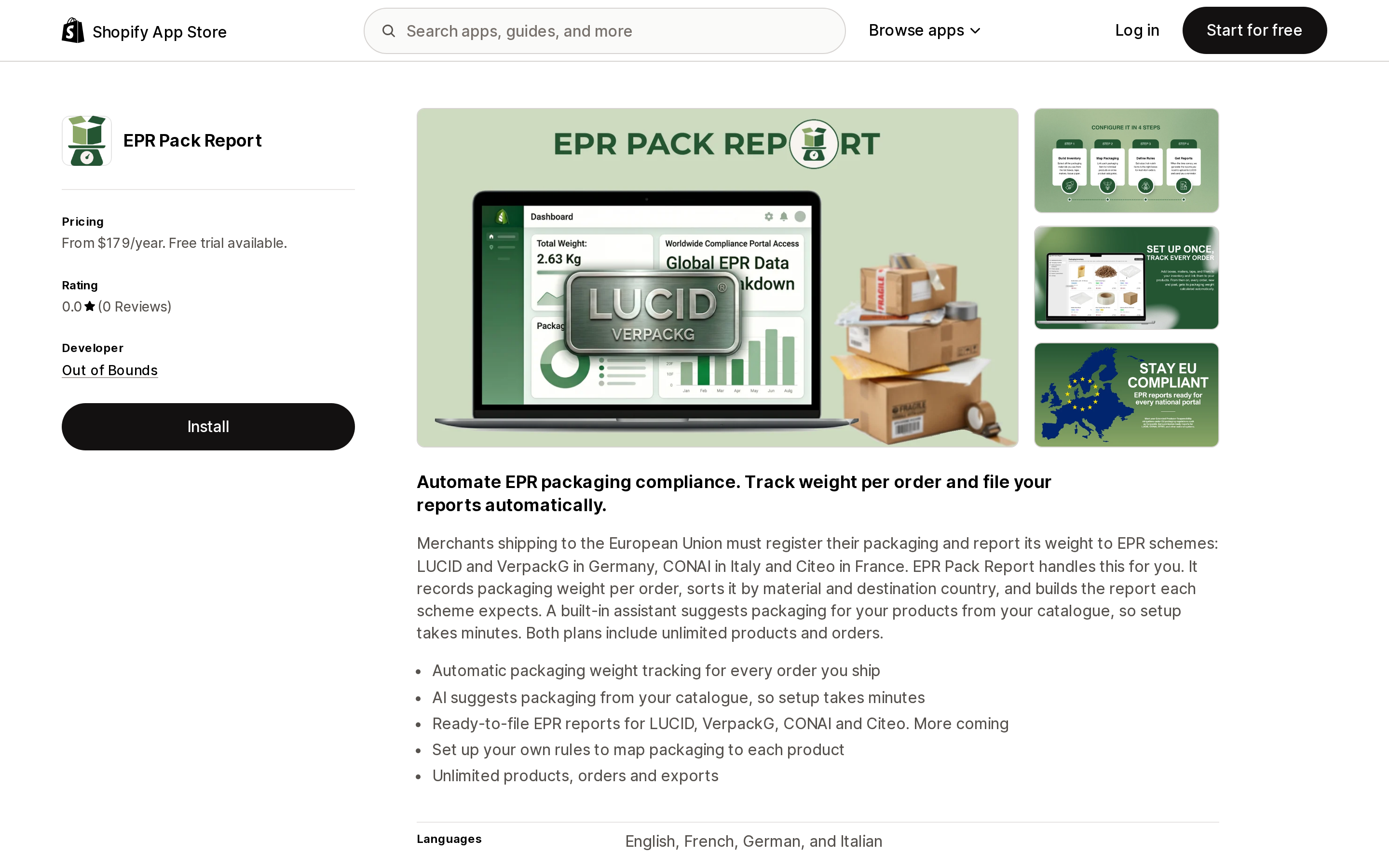
Source: Shopify App Store (EPR Pack Report), retrieved September 4, 2026.
Developed by Out of Bounds (Naples, Italy), launched June 15, 2026, with zero reviews. Unlike the other four, which are free or priced monthly, this app is annual-billing only. The Basic plan covers one country for $179/year, with each additional export country billed at $49/year; the Unlimited plan covers all available countries for $249/year. Both include a 7-day free trial.
It automatically tracks packaging weight per order, sorted by material and destination country. A built-in AI assistant suggests packaging for your products from your catalogue, so the listing describes setup as taking minutes. Supported schemes are LUCID (VerpackG), CONAI, and Citeo, with the listing noting "More coming." Both plans include unlimited products, orders, and exports.
If you export to only one country, the $179/year Basic plan is the cheaper option. If you ship to several, the $49/year per-country add-on adds up quickly, so it's worth calculating the break-even point against the $249/year Unlimited plan before committing.
EPR Insights
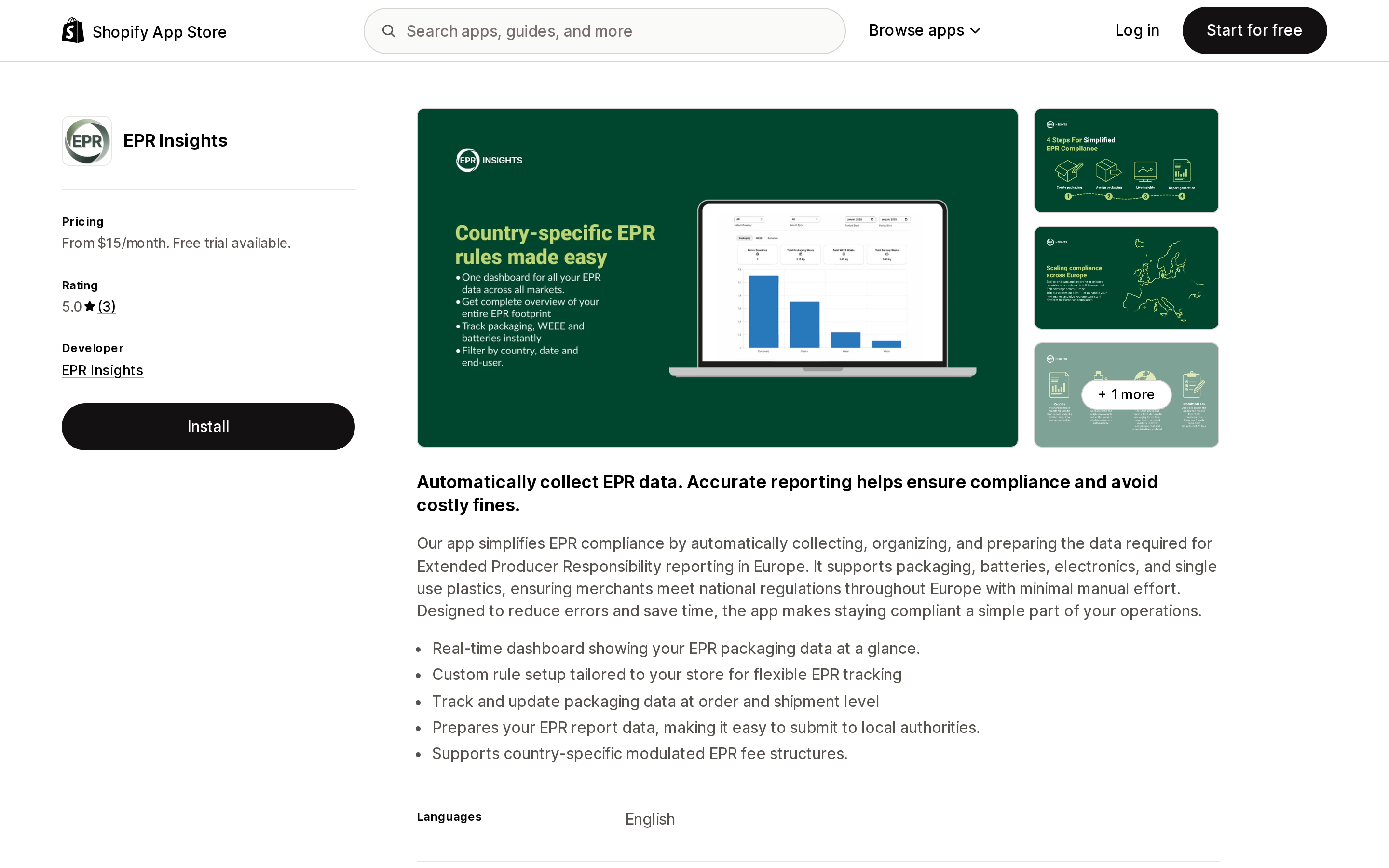
Source: Shopify App Store (EPR Insights), retrieved September 4, 2026.
Developed by EPR Insights (Aarhus, Denmark), launched August 26, 2025 — the earliest launch date and the longest track record of the five. It's also the only one of the five with actual customer reviews: a 5.0 rating from 3 reviews, from PetiteKnit in Denmark (7 months using the app, posted May 2026), Cupcakedozen.nl in the Netherlands (2 months using the app, posted January 2026), and Hobbydrivhuse in Denmark (27 days using the app, posted November 2025). Comments mention it solving "the tracking problem with the new packaging tax," an onboarding issue the team resolved, and responsive support. Three reviews is too small a sample to generalize from, but given that the other four apps have zero reviews, having any real deployment evidence at all is a data point worth weighing.
Pricing scales with monthly order volume: Basic at $15/month (up to 400 orders, then $0.05/order over), Advanced at $29/month (up to 1,500 orders), and Pro at $59/month (up to 4,500 orders), all with overage billed at $0.05/order and a 7-day free trial. A Custom enterprise plan is also available.
The key functional difference is scope. Where the other four apps focus specifically on packaging, EPR Insights' listing states it also covers EPR obligations for batteries, electronics, and single-use plastics. For stores that carry products in those categories, that's coverage none of the other four apps claim.
EPR One
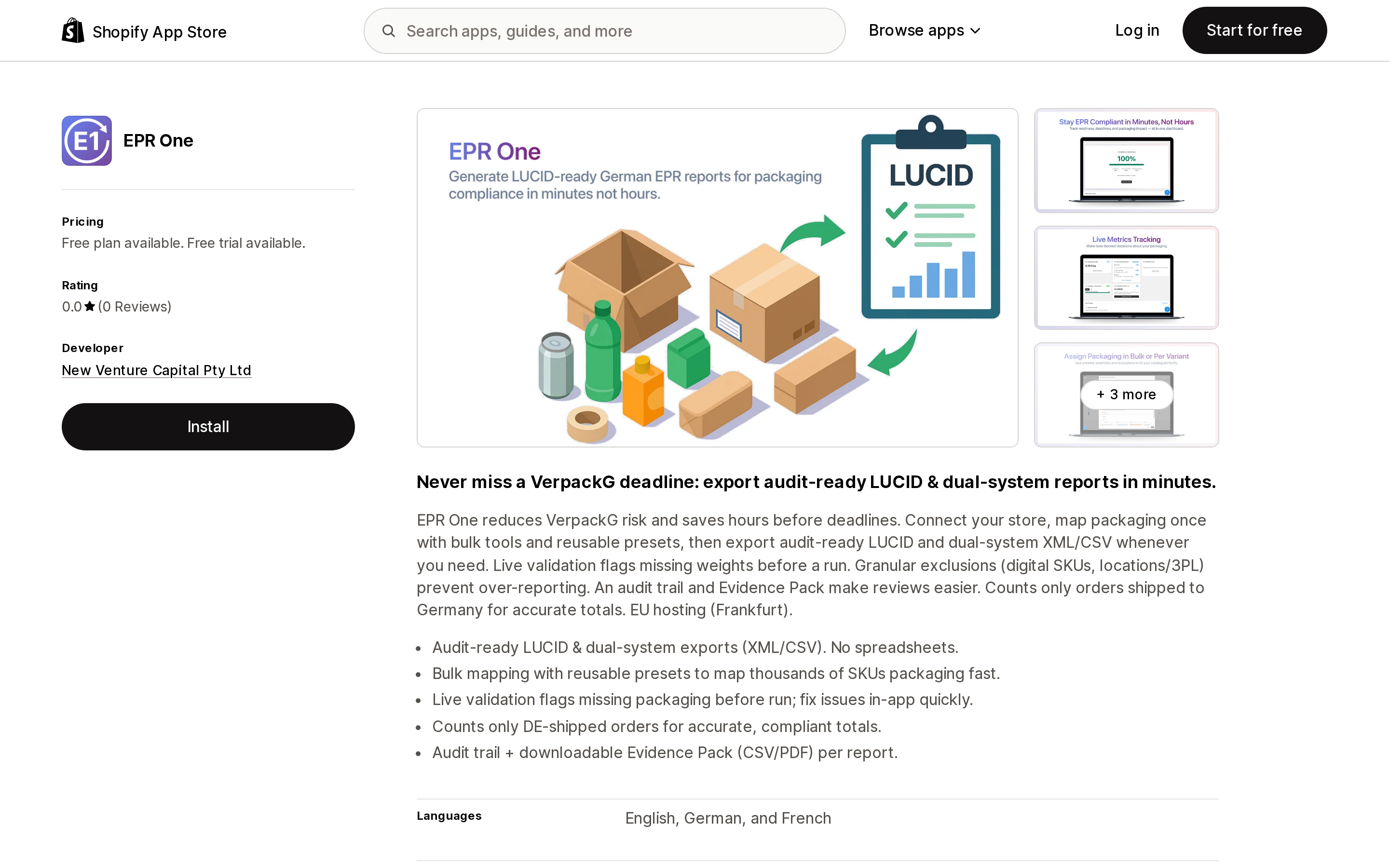
Source: Shopify App Store (EPR One), retrieved September 4, 2026.
Developed by New Venture Capital Pty Ltd (Queensland, Australia), launched September 5, 2025, with zero reviews. Where the other four cover multiple countries, EPR One is built specifically as a Germany VerpackG specialist. It focuses on generating audit-ready LUCID and dual-system XML/CSV reports, with live validation that flags products missing a weight before you run a report. It supports granular exclusions — digital SKUs, specific locations or 3PLs — and produces an audit trail plus a downloadable Evidence Pack (CSV/PDF). The listing states it "counts only orders shipped to Germany," addressing the concern that orders to other countries might get counted by mistake.
Pricing runs four tiers: Free (setup and a sample report preview only), Founder/Beta at $13.99/month ($139/year, unlimited orders with no overage), Pro at $59/month (up to 200 Germany-bound orders/month, 3,000 total orders/month), and Plus at $119/month (up to 1,000 Germany-bound orders/month, 12,000 total orders/month), each with a 7-day free trial. It's also the only one of the five to explicitly state EU hosting (Frankfurt) in its listing.
It's a poor fit if most of your EU shipments go outside Germany, but for stores whose EU shipping is Germany-heavy and that want a tight audit trail, its specialization is a real advantage.
Which to choose, by situation
Not sure where to start. Begin with Packify, PackPilot EPR, or EPR One's free tier to map out which countries and schemes you're actually in scope for. Understanding the full picture on a free plan before committing to a paid one is a reasonable first step.
Germany-heavy shipping, and you want a tight audit trail. EPR One's Germany-only design and Evidence Pack feature are worth a look. Just be clear that it stops being the right fit if your shipping mix shifts toward other countries.
Shipping into multiple countries, and scheme coverage is the priority. PackPilot EPR (5-language UI, 5 schemes) or Packify (4 schemes) are the candidates. Both currently have zero reviews, so validate them against your real data on the free plan before going into production.
You also sell products with battery, electronics, or single-use plastics obligations. Of these five, only EPR Insights covers EPR duties beyond packaging — and it's also the only one with real customer reviews.
High order volume, and you want to lock in a fixed annual cost. EPR Pack Report's annual pricing ($179–$249/year) tends to work out cheaper than the monthly, volume-based apps as order counts grow. Just run the math first, since the per-country add-on can add up if you ship to several markets.
Pre-launch checklist
- Inventory every EU country you currently ship to, one by one
- If even one shipment goes to Germany, check LUCID registration first — there's no minimum threshold
- For France and Italy, check whether you qualify for the simplified declaration/registration routes (UVC volume, annual revenue) before assuming you don't
- If you ship to multiple member states, confirm whether you now need an authorized representative in each one under the August 12, 2026 obligation
- Understand that every app here positions itself as "not legal advice," and consult a local specialist separately where needed
- Confirm each candidate app actually covers the specific countries and schemes you ship into — don't assume broad coverage
- If you're considering an app with zero reviews, verify its behavior against your real order data during the free trial
- Check whether pricing is monthly/volume-based or annual/flat, and run the math against your own order count and country mix before signing up
Summary
The core obligations of EU PPWR took effect on August 12, 2026 — the "getting ready for this" window has already closed. Germany's LUCID registration has no minimum threshold, and neither France nor Italy offers a blanket small-business exemption, so any Shopify store shipping into the EU should assume it may be in scope regardless of size. Shopify has no native feature addressing any of this, and most of the apps that do exist only appeared between late 2025 and July 2026 — of the five compared here, only one has real customer reviews.
The decision sequence breaks down into three steps:
- Inventory which EU countries you ship to, and check Germany first given its zero threshold
- Use a free plan to understand the full scope of your obligations, and confirm the scheme and country coverage matches your actual shipping footprint
- Given how thin the review history is across this category, validate any app against real order data during a free trial before going into production
These apps are configuration and filing tools, not a substitute for legal advice. If you're unsure whether registration applies to you, combine what you learn here with a check against each scheme's own official channels or a local specialist.
Pricing, features, and scheme coverage are subject to change. Before adopting any of these apps, check its current Shopify App Store listing and the official guidance for LUCID, Citeo, CONAI, and Ecoembes directly.
Sources
Shopify's free link-in-bio page, Linkpop, retired on July 7, 2025 — linkpop.com now redirects to shopify.com. On August 15, 2026 Shopify's Help Center began saying the $5 Starter plan, the plan built around sharing product links on social, isn't available to new stores. And Shopify's own July 21, 2026 blog post on link-in-bio tools links to exactly two Shopify App Store listings: LinkShop, and Linktree — an app in the Marketplaces category, billed outside your Shopify invoice, rated 3.6 across 18 reviews. We priced seven link-in-bio apps on September 18, 2026. The dimension that matters isn't the monthly fee, which runs from $0 to $15. It's where the page lives: four apps serve it from your own storefront through a Shopify app proxy, which means it sits behind your store password — and on the new $0 Agentic plan, that password never comes off. Verified against the Shopify Help Center, shopify.dev, the Shopify App Store, and live store pages.