
What you will learn
On this pageContentsCloseOpen
Search the Shopify App Store for an ERP integration and you get three kinds of price card. One says From $199.92/month. One says $24,000/year. Most say Free to install.
They are not three price points on a spectrum. They are three different things being sold, and the Free to install ones are frequently the most expensive. Every one of those listings carries a line most people scroll past: External charges may be billed by {Developer} separately from your Shopify invoice.
Before any of that, one correction. There is no Shopify-built NetSuite connector. The App Store listing is called NetSuite ERP Connector and its Developer field reads Oracle NetSuite, Austin, TX. Shopify runs a certification program; it does not write these integrations.
What Shopify actually covers without an ERP app
Shopify's own Help Center classifies external integration into three approaches: direct integrations (vendor connectors on the App Store), integration-as-a-service providers (iPaaS), and custom APIs, which it describes as "more resource intensive than the other options." Useful framing, and it implies a fourth option Shopify does not name: not integrating anything.
Natively you already have:
- Multi-location inventory with per-location stock, allocation, and automatic assignment through order routing rules.
- Inventory CSV import and export, including
On hand,Bin name,HS Code, and country of origin. The importer validatesOn hand (current)againstOn hand (new)to prevent overwrite accidents. 15 MB file limit. - Shopify Flow, free, for trigger-condition-action automation. The
Send HTTP Requestaction — the one that turns Flow into a lightweight integration tool — requires Grow, Advanced, or Plus. It is not available on Basic. - Shopify B2B with companies, catalogs, payment terms from Net 7 to Net 90, quantity rules, volume pricing, and PO numbers. Shopify's documentation now states "Shopify B2B is available on all plans."
- Admin API, webhooks, and the B2B API if you are building it yourself.
What is genuinely absent: the general ledger, AP and AR, purchase orders, landed cost, manufacturing BOMs, and demand forecasting. That list is the actual boundary. If nothing on it is your problem, you do not need an ERP app.
Two plan limits shape the decision. Active locations cap at 10 on Basic, Grow, and Advanced, and at 200 on Plus. B2B catalogs cap at 3 active catalogs across all B2B markets below Plus. Customer-specific deposits and partial payments on B2B orders are Plus-only.
But no ERP app on this list requires Shopify Plus. None of the thirteen listings we checked states a Plus requirement. If you have been budgeting for a Plus upgrade because "ERP integration needs Plus," that premise is wrong as of September 2026.
The certification program is five apps
Shopify's Global ERP Program is a certification, and it currently contains exactly five apps: NetSuite, Dynamics 365 Business Central, Brightpearl by Sage, Acumatica, and the Infor eCommerce Connector. Article headlines about "154 Shopify ERP apps" are counting the whole category, which includes inventory tools, WMS, and middleware. The certified set is small, and being outside it is not disqualifying — Fulfil, Pipe17 and Cin7 are not in it and are better fits for many stores.
Also worth stating: none of the thirteen apps we examined carries a Built for Shopify badge. In most categories that badge is a useful filter. Here it filters out everything, so you have to read something else.
The three tiers, and what the price card is actually telling you
All figures below are quoted from the US App Store listing on September 3, 2026, and were identical on the Japanese locale listing. All charges billed in USD.
| App | Tier | Developer | Price as listed | Metered on | Rating (reviews) |
|---|---|---|---|---|---|
| NetSuite ERP Connector | Vendor connector | Oracle NetSuite | From $199.92/month | Feature set (B2C / POS / B2B) | 4.4 (6) |
| Robust NetSuite Integrator | Third-party connector | WebBee eSolutions Pvt Ltd. | From $80/month | Feature set, plus $2,000 onboarding addon | 4.2 (76) |
| Dynamics 365 Business Central | Vendor connector | Microsoft | Free to install | ERP license only | 2.3 (23) |
| Brightpearl by Sage | Retail operating system | Brightpearl | Free to install | Not published | 4.6 (53) |
| Patchworks | iPaaS | Patchworks Media Ltd | Free to install; billing activates after a discussion | Not published | 0.0 (0) |
| Alloy Automation | iPaaS | Alloy Automation | $2,500/month | Actions — 100,000/month | 5.0 (5) |
| Pipe17 | OMS + iPaaS | Pipe17 Inc. Partner Account | $24,000/year | 4,000 orders/month, 5 connectors, 1 ERP | 4.9 (21) |
| Fulfil | Ecommerce ERP | Fulfil.IO Inc. | Free to install; demo for total cost | Not published | 4.9 (30) |
| Cin7 Core Inventory Management | ERP-lite | Cin7 Americas Inc. | From $349/month | 6,000 sale orders/year, 5 users, 2 integrations | 4.6 (49) |
| SKUSavvy Mobile WMS | WMS | SKUSavvy | Free to install. Usage charges apply. | Per order, including POs, POS and transfers | 4.7 (5) |
Tier 1: you already own an ERP
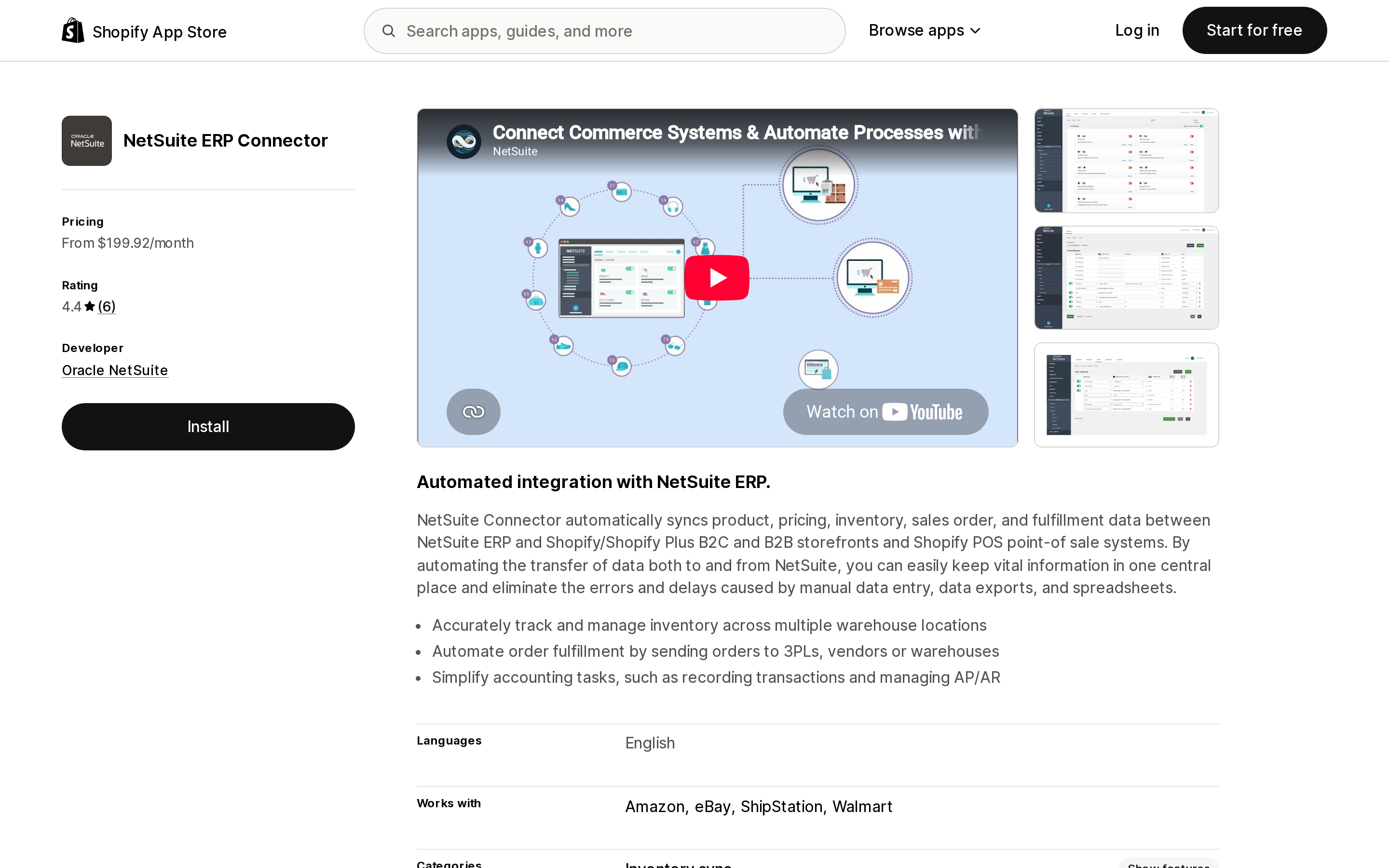
Source: Shopify App Store (NetSuite ERP Connector), retrieved September 3, 2026
The NetSuite ERP Connector publishes four tiers, and they are priced by feature set rather than volume: B2C Standard at $199.92/month, POS at $249.92, a third tier at $249.92, and B2B at $916.58. The B2B jump is the number to plan around — if wholesale is in scope, this is a four-and-a-half-times price difference, not a small upgrade.
Two costs sit outside that card. Oracle's own documentation states: "To create a NetSuite Connector account, you need a valid license. To purchase a license, contact your NetSuite account manager." You also have to enable SuiteCloud features on the NetSuite side — Custom Records, Client and Server SuiteScript, SOAP and REST Web Services, and Token-Based Authentication. Neither is billed through Shopify.
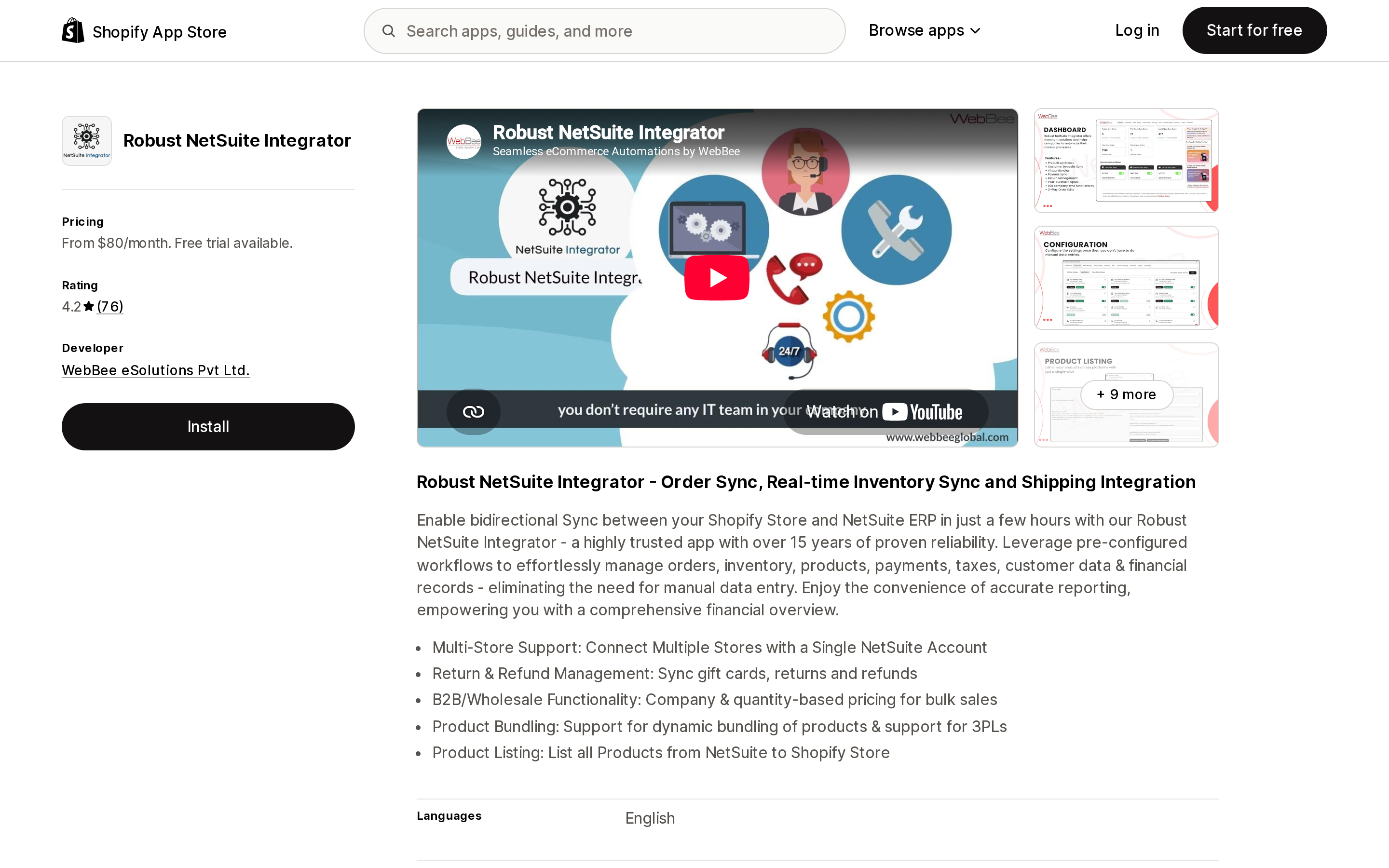
Source: Shopify App Store (Robust NetSuite Integrator), retrieved September 3, 2026
Robust NetSuite Integrator by WebBee eSolutions is the third-party alternative at From $80/month, running $80, $199.99, $300, and $500 across its tiers with a 30-day trial. It is also one of the few listings in this entire category that publishes an implementation fee: the Enterprise plan description names a Project and onboarding addon for $2000 and an Amazon MCF addon for $50. 4.2 from 76 reviews — the largest review base among NetSuite connectors by a wide margin.
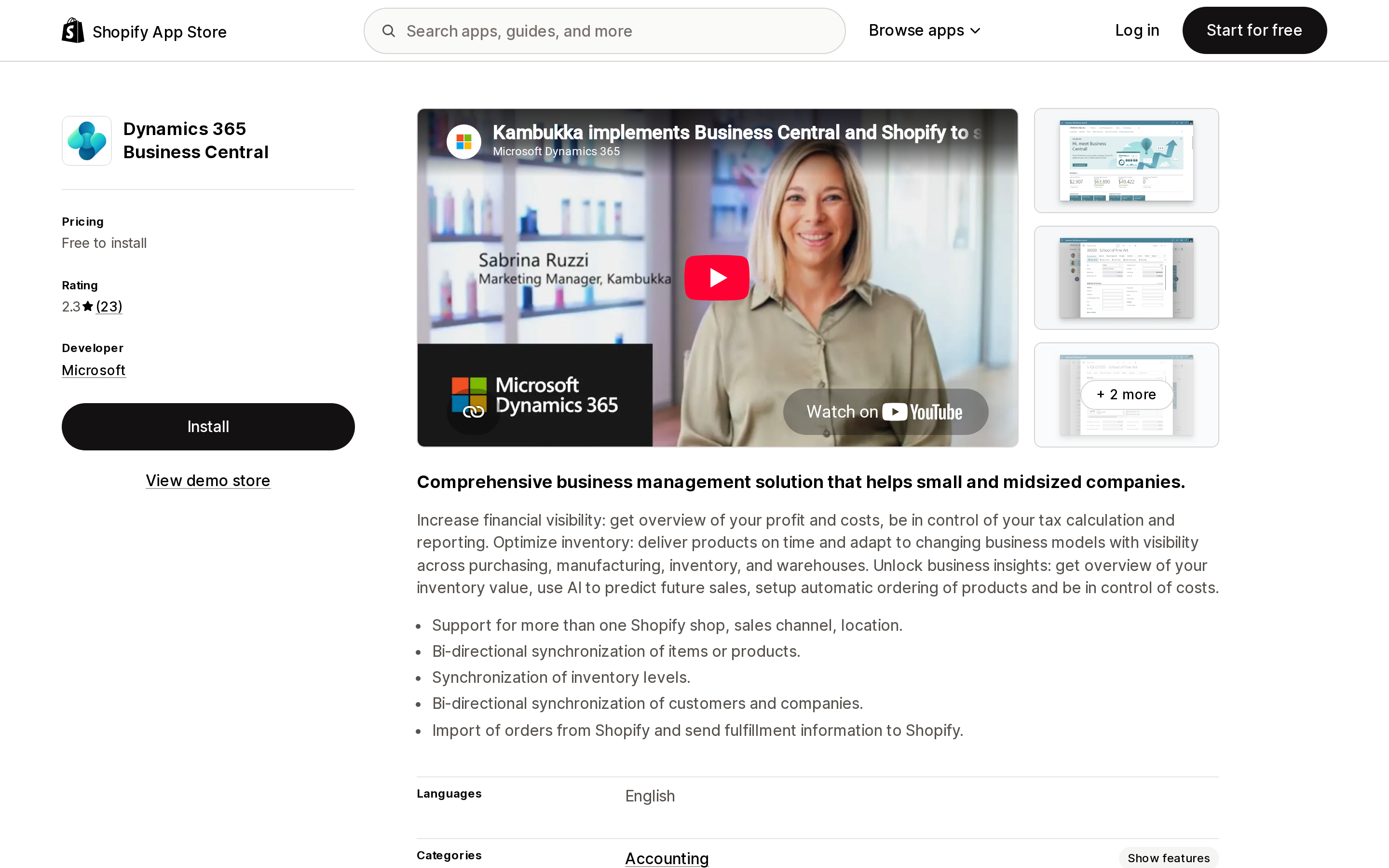
Source: Shopify App Store (Dynamics 365 Business Central), retrieved September 3, 2026
Microsoft's Business Central connector is Free to install, with the external-charges notice naming Microsoft. The connector genuinely costs nothing; you are paying for Business Central licensing and, almost always, a Microsoft partner to implement it.
Its rating is 2.3 from 23 reviews, the lowest of the ten apps in the table above, and it is one of five that cost nothing to install. That is not a coincidence to wave away — a free connector attracts merchants who install it expecting a product and find a toolkit. Read the low reviews before your kickoff meeting and turn them into test cases.
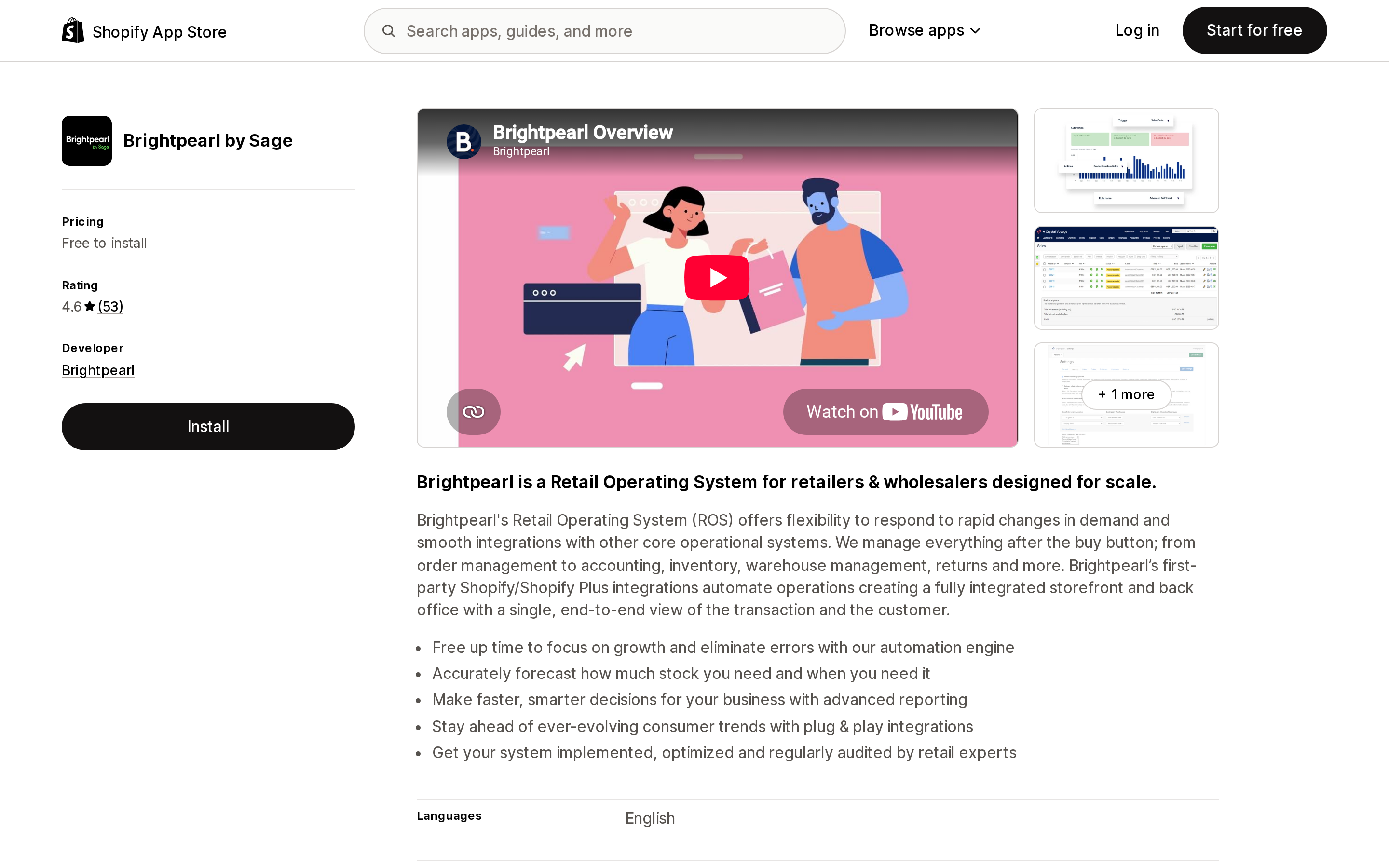
Source: Shopify App Store (Brightpearl by Sage), retrieved September 3, 2026
Brightpearl by Sage is also Free to install with external billing by Brightpearl, and it sits differently from the others: it is a retail operating system rather than a connector to an ERP you already run. 4.6 from 53 reviews, by far the largest review base among the certified five.
Tier 2: you are connecting more than one system
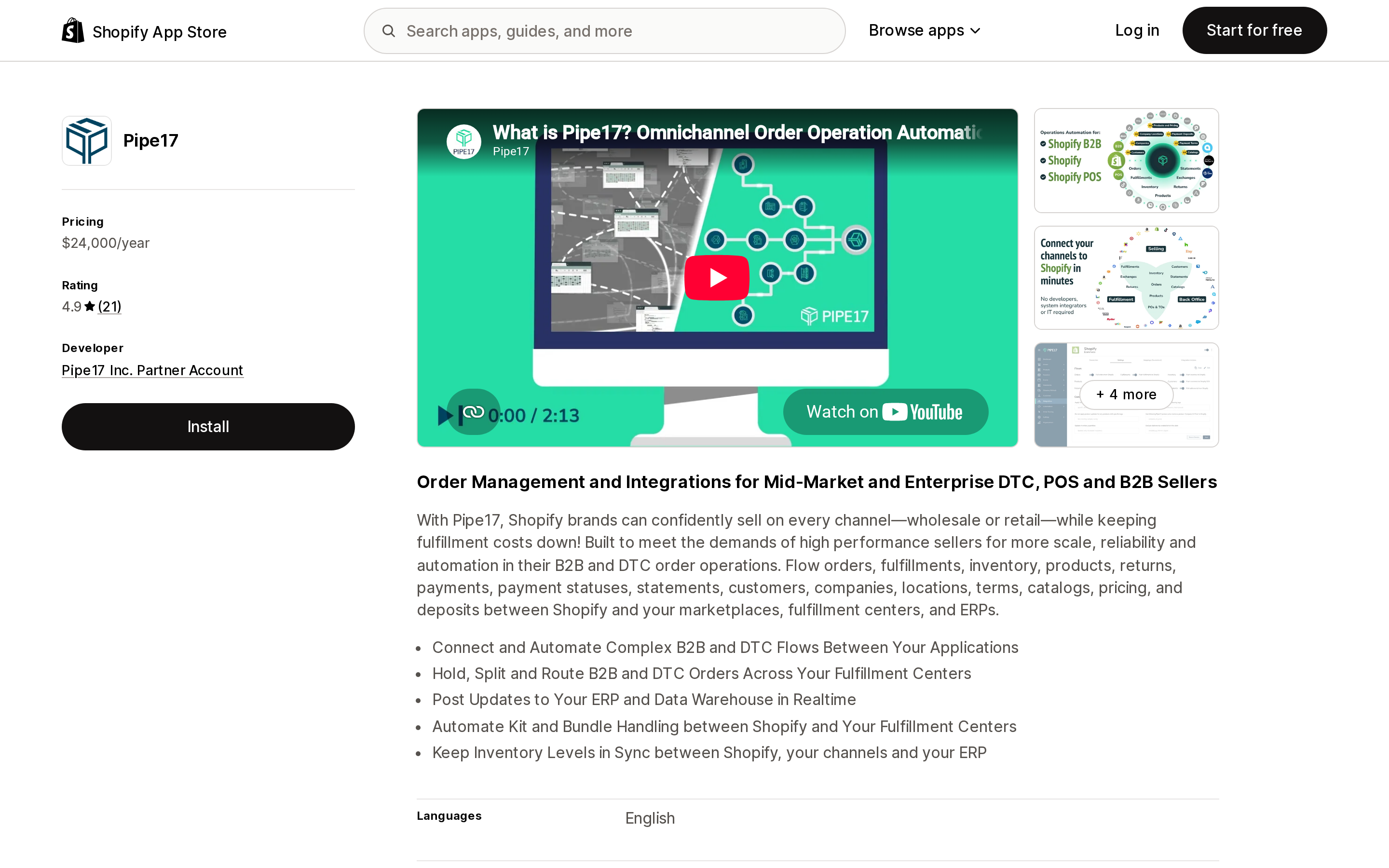
Source: Shopify App Store (Pipe17), retrieved September 3, 2026
Pipe17 publishes the most legible enterprise price in the category: $24,000/year for 4,000 orders per month, 5 connectors, 1 ERP connection, purchase order and transfer support, and standard support. Every variable is named. If your volume is 12,000 orders a month, you know immediately that this card is not your price and you can ask the right question on the call. 4.9 from 21 reviews.
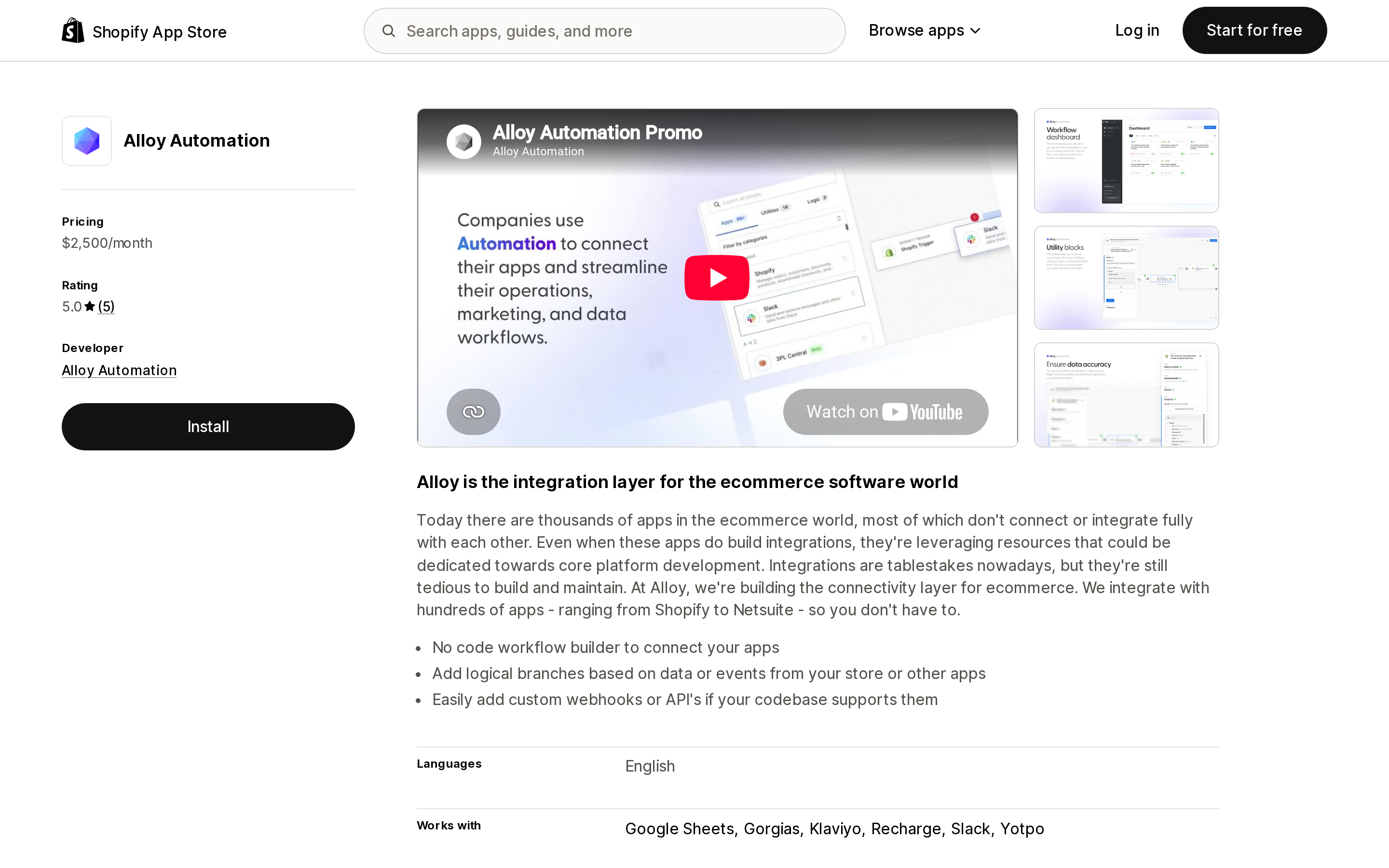
Source: Shopify App Store (Alloy Automation), retrieved September 3, 2026
Alloy Automation lists a single Business plan at $2,500/month for 100,000 actions a month, unlimited active workflows, one-minute polling, webhooks and API calls, a team workspace, and dedicated support. The listing states outright that pricing varies with the monthly action count you need.
Before you price this: Alloy is workflow automation, and Shopify Flow is free. If the requirement is "when X happens in Shopify, do Y," check whether Flow plus Send HTTP Request covers it on Grow or above. Alloy earns its price when the workflows span systems Shopify cannot see. Its five reviews all date from 2022.
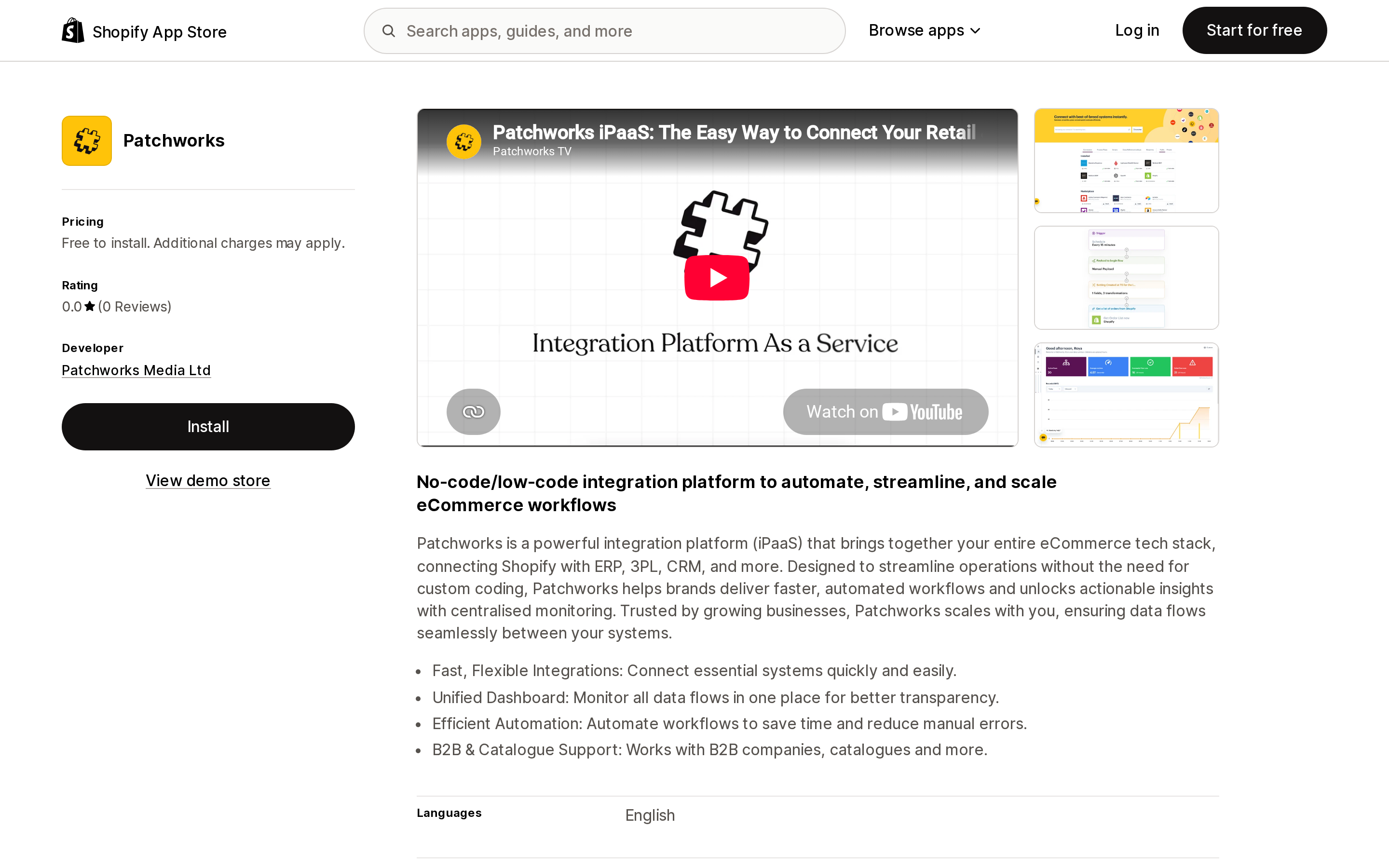
Source: Shopify App Store (Patchworks), retrieved September 3, 2026
Patchworks is refreshingly blunt: Free to install during trial; billing activates after a discussion with Patchworks. No published number, no pretense of one. Zero reviews on the App Store listing.
One more name belongs in this tier and cannot be screenshotted, because it is not on the App Store at all. Celigo has no Shopify App Store listing — apps.shopify.com/celigo returns 404 and its partner page shows zero apps. Its Shopify–NetSuite integration is deployed through integrator.io and the NetSuite SuiteApp, and Celigo's own pricing page publishes no USD figures, quoting instead by endpoints and flows. If a comparison article shows you a Celigo App Store listing, it is not describing something that exists.
Tier 3: you do not have an ERP and may not need one
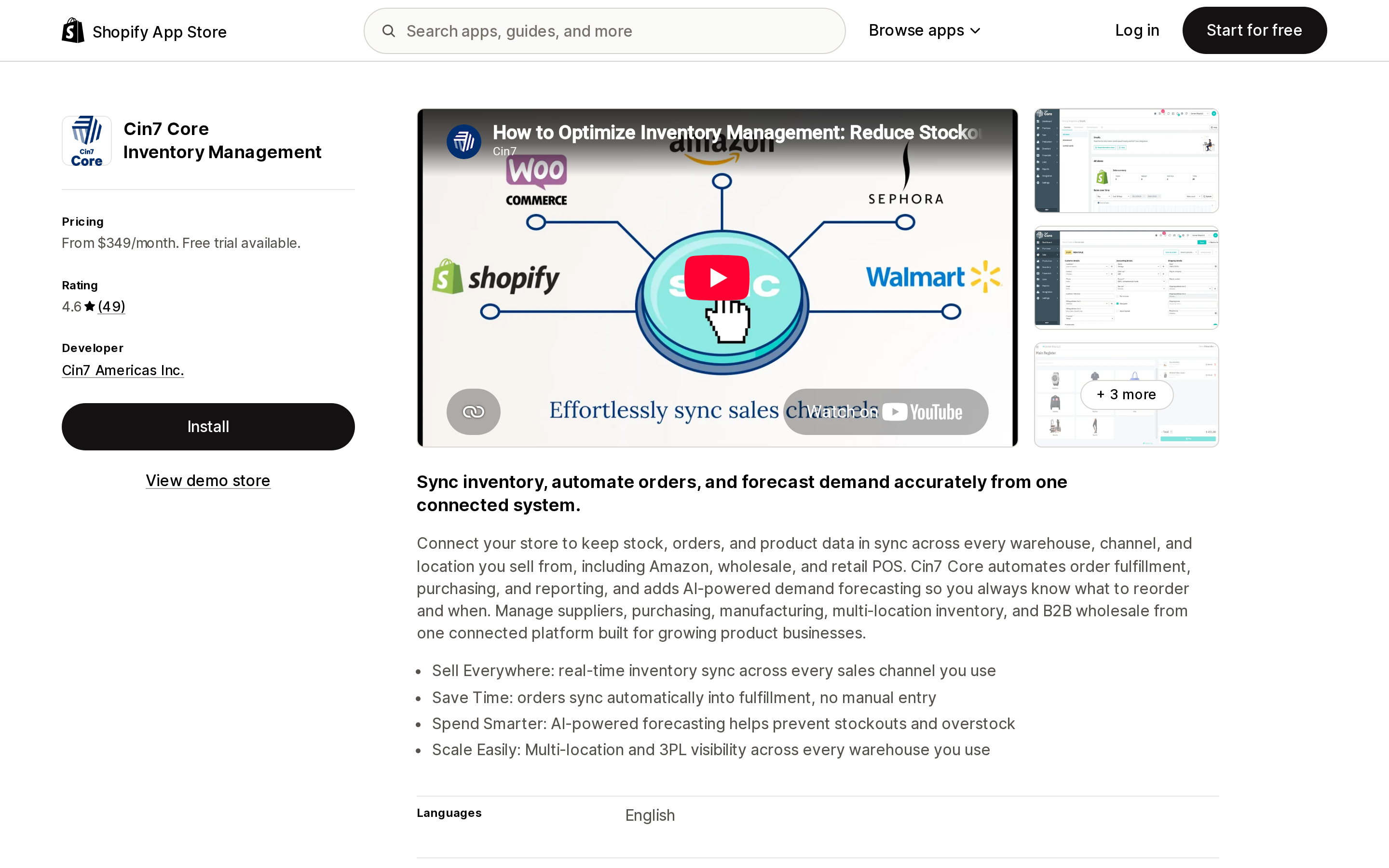
Source: Shopify App Store (Cin7 Core Inventory Management), retrieved September 3, 2026
Cin7 Core starts at From $349/month — Standard at $349 or $3,839/year for an 8% saving, Pro at $599, and Advanced at $1,199. The Standard plan includes 5 users, 2 app integrations, 6,000 sale orders per year, and unlimited inventory locations, with additional users, integrations, API access, and POS register portals billed as monthly add-ons. 4.6 from 49 reviews, 14-day trial.
The metering unit deserves attention: annual sale order volume, not monthly. Six thousand a year is 500 a month averaged, and averages are exactly what a seasonal business does not have.
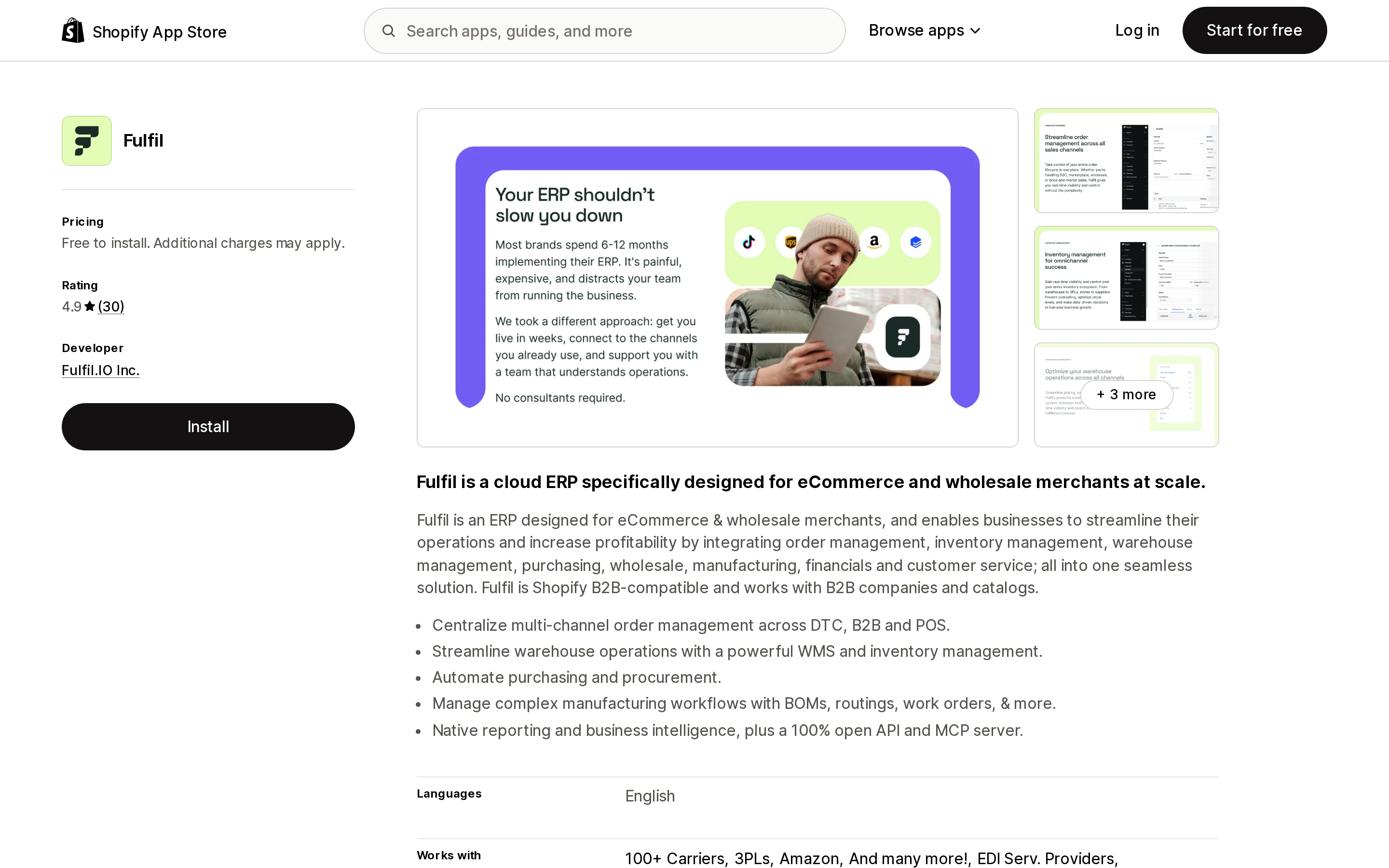
Source: Shopify App Store (Fulfil), retrieved September 3, 2026
Fulfil is Free to install and tells you why there is no number: "Click schedule a demo to better understand the total software & implementation cost of a Fulfil solution." That phrasing — software and implementation — is the most honest sentence on any of these listings, and it is the shape of the real bill for every quote-only vendor here. 4.9 from 30 reviews, the strongest rating in this comparison among apps with more than 20 reviews.
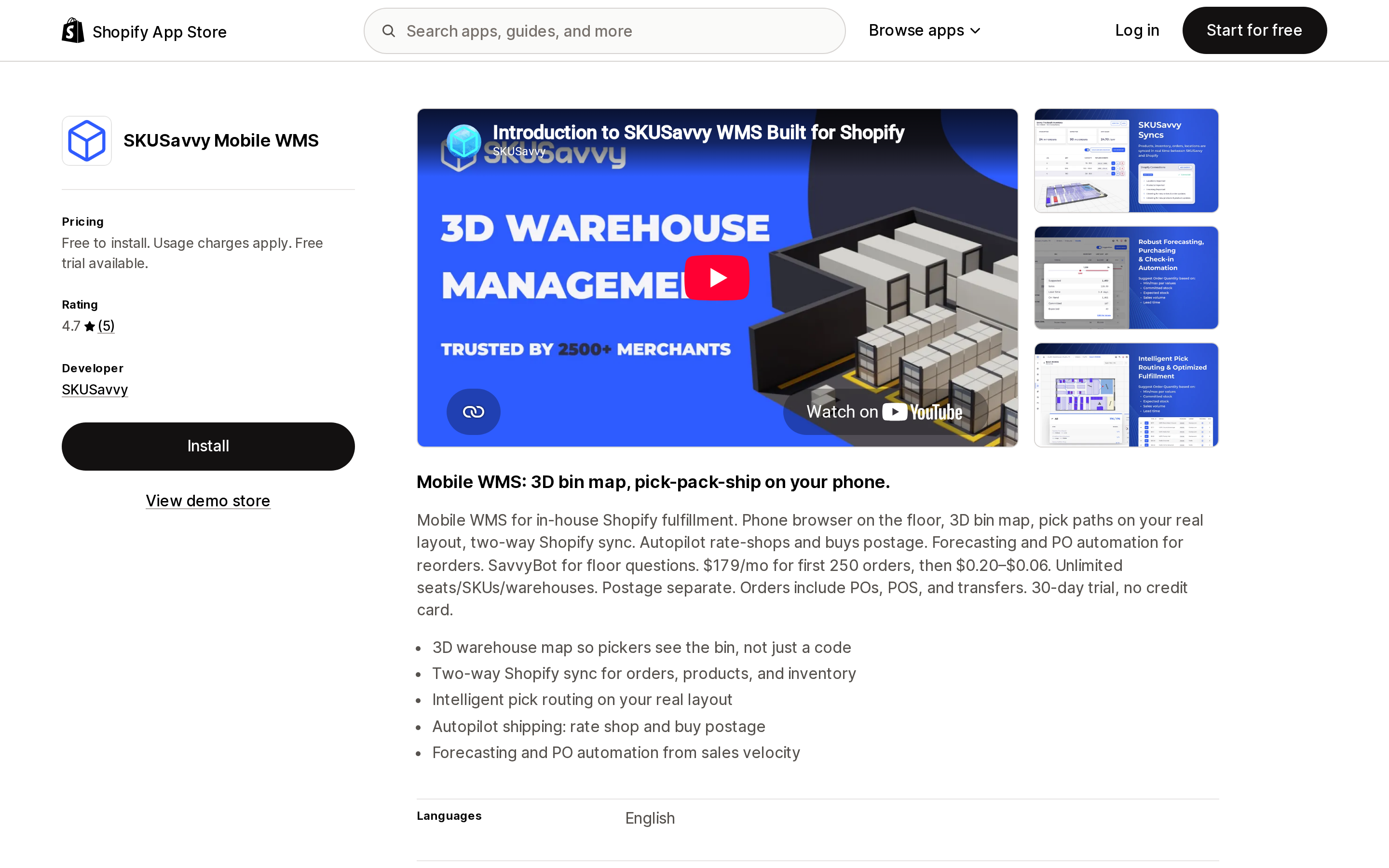
Source: Shopify App Store (SKUSavvy Mobile WMS), retrieved September 3, 2026
SKUSavvy is Free to install. Usage charges apply. and its listing carries an interactive estimator — you set a monthly order count and it returns your rate. The entry plan reads First 250 Orders — $179/month; above that, per-order pricing runs from about $0.20 down to $0.06 as volume rises across tiers.
The detail to catch: SKUSavvy counts purchase orders, POS transactions, and inventory transfers as orders. If your operation moves a lot of stock internally, your billable order count is not your Shopify order count. 4.7 from 5 reviews, 30-day trial.
This tier is where most merchants searching "Shopify ERP app" should actually start. If picking accuracy, purchasing, or wholesale operations are what broke, a warehouse or inventory system solves it for a fraction of a connector project — and does not require you to buy an ERP first.
Ask about the metering unit before anything else
The single hardest thing about comparing these apps is that no two of them count the same thing:
| Vendor | Billable unit |
|---|---|
| NetSuite ERP Connector | Feature set (B2C / POS / B2B) |
| Robust NetSuite Integrator | Feature set, plus a named onboarding fee |
| Alloy Automation | Actions per month |
| Pipe17 | Orders per month, connectors, ERP connections |
| Celigo | Endpoints and flows |
| Cin7 Core | Sale orders per year, users, integrations |
| SKUSavvy | Orders, counting POs, POS and transfers |
You cannot rank these on monthly price. You can only ask what happens to each number in your peak week, which is a different and more useful conversation.
Two more observations from the review data. Price does not predict satisfaction here. The free Business Central connector rates 2.3, Cin7 Omni at $749/month rates 1.9, while Fulfil rates 4.9 and Brightpearl 4.6. What separates them is the implementation and support model, not the license fee. And published price does not predict total cost, because implementation is where the money goes and exactly one listing in this comparison names a figure for it.
Decide in this order
- Is your problem in the missing list? General ledger, AP and AR, purchase orders, landed cost, BOMs, forecasting. If not, you do not need an ERP app.
- Do you already own an ERP? If yes, go to your vendor's connector first: NetSuite ERP Connector, Dynamics 365 Business Central, Acumatica Cloud ERP, or the Infor connector. Budget the ERP-side license and the partner implementation separately from the App Store price.
- No ERP, but operations are breaking? Start in tier 3. Cin7 Core at $349/month if the problem is inventory, purchasing, and wholesale. SKUSavvy if the problem is picking accuracy in your own warehouse. Fulfil if you want one system and are willing to take a demo.
- More than one system to connect — marketplaces, 3PLs, WMS, PIM? That is iPaaS. Pipe17 if order routing at volume is the core, Patchworks or Celigo if you want to own the field mapping, Alloy if it really is workflow automation — after you have checked whether Shopify Flow does it free.
- Chasing a cheap ERP app? They exist — SAP Business One Integration by eShopSync lists at $99/month — but check the scope first. That one syncs Item Groups and Items one-way from SAP B1 to Shopify. The low price is the narrow scope, stated plainly.
- Do you need Shopify Plus? For the app, no. You need Plus for more than 10 locations, more than 3 B2B catalogs, B2B deposits and partial payments, or Flow tasks from custom partner apps. Not for ERP integration itself.
- On the demo call, ask five things: the implementation fee and who performs it, the ERP-side license, the overage rate on whatever unit they meter, who owns field mapping after go-live, and what the support model is once the implementation team leaves.
The App Store price card in this category is a deposit, not a price. Read it as the part Shopify bills you, and assume the rest of the number is on the call.
Sources
- Shopify Help Center: Locations, Setting up locations, Inventory CSV, Shopify Flow, B2B features, B2B external integrations
- Oracle NetSuite documentation on NetSuite Connector licensing and required SuiteCloud features
- Celigo pricing page and Shopify App Store partner page (verified: no App Store listing), retrieved September 3, 2026
- Shopify App Store listings, pricing tabs, and public reviews for all apps named, retrieved September 3, 2026
Sidekick app extensions went generally available on June 17, 2026, and Shopify's merchant-facing guide lists 18 apps that use them. The platform cap is 20 apps per user on a store, so supply is the constraint, not the cap. This article reads the developer documentation for what merchants actually get: app data extensions are read-only, app actions navigate you to a pre-filled page and stage the change — Shopify's own walkthrough ends with \"Click Save in the form. The change is committed by your app, not by Sidekick.\" App actions are also limited to 13 declared intent types, and an unsupported type fails at deploy with no silent fallback. Four of those types — FAQ, quote, ticket, shipment — have no matching app on Shopify's list. Three build requirements explain the short list: existing MCP servers can't be reused, legacy OAuth installs are excluded, and each app gets 5 intents, 20 tools, and a 4,000-token response budget. Two of the guide's own cards show only \"Free trial available\" for apps that list at $49.99 and $299 a month. And no app listing shows a Sidekick badge at all: Seguno had to put \"Sidekick-able\" into its 62-character tagline. Ratings, pricing, and the app list verified on the Shopify App Store on September 8, 2026.