
What you will learn
On this pageContentsCloseOpen
Shopify's checkout settings have a section called Marketing opt-in. It offers three channels: Email, SMS, and WhatsApp. There is no fourth checkbox for phone calls, and no call-consent field on the customer record to go with it.
That gap is the whole story of this app category. The fastest-growing pitch among Shopify AI voice agents is not "answer your support line" — it is "call the shopper who abandoned checkout." Shopify will hand an app the phone number. It will not hand it permission to dial.
Below: what Shopify actually does natively, five real apps compared on the unit each one bills against, a worked cost example at the same call volume, and the US calling rules that apply to an AI voice specifically. Verified against primary sources on September 11, 2026.
What Shopify does natively, and where it stops
Shopify has no voice channel. Not in the admin, not in Shopify Inbox, not in Shopify Messaging — the Help Center describes Shopify Messaging as a tool to "send email and SMS campaigns and automations directly to your subscriber list, including abandoned checkout recovery." Email and SMS. No calls.
Abandoned checkout recovery is email-first and documented as such: "A recovery email is not sent for an abandoned checkout" under a list of conditions, one of which is worth reading twice:
If you allow customers to enter a phone number instead of an email address at checkout, and the customer chooses to enter a phone number, then the email can't be sent.
So Shopify's own documentation describes a class of abandoned checkout that native recovery structurally cannot reach: the shopper who gave you a phone number and nothing else. That is the single clearest case for a voice app, and it is much narrower than the category's marketing implies. Two other native boundaries matter for sizing the problem: a checkout counts as abandoned only after it sits incomplete for ten minutes, and abandoned checkouts older than three months are deleted from the admin automatically.
On the consent side, Shopify's model is explicit about which channels it covers. The Help Center's instructions for collecting phone numbers tell you to add "an SMS or WhatsApp marketing sign-up checkbox to your checkout." In the Admin GraphQL API the matching record is CustomerSmsMarketingConsentState, documented as "the record of when a customer consented to receive marketing material by SMS." There is no equivalent object for voice calls.
This means a voice app cannot inherit consent from Shopify. Whatever permission it relies on, it either collects and stores itself or infers from something that was never a permission to call. Before you evaluate features, ask the vendor which one it is.
Five apps, three billing units, two of them unquantified
Every app here is live on the Shopify App Store and every figure below comes from its listing, read in en locale on September 11, 2026.
| App | Developer | Billing unit | Entry price | Built for Shopify | Reviews | Launched |
|---|---|---|---|---|---|---|
| Ava AI ‑ AI Phone Agents | Ava AI Nexus LLC | Included minutes + per-minute overage | $29/month | No | 5 | Sep 16, 2025 |
| CallFlows ‑ AI Phone Agent | Call Flows Ltd. | Included minutes + per-minute overage | $39/month | Yes | 14 | May 6, 2025 |
| Phone Call & AI Voice ‑ CONSIO | Consio AI Inc. | Included minutes + per-minute overage | Free plan, then $30/month | No | 40 | Oct 21, 2024 |
| Loop ‑ AI Voice Agents | Loop Voice LLC | Credits | Free plan, then $119/month | No | 10 | Nov 21, 2025 |
| Shoplabs: AI Calling Assistant | Shoplabs AI | "Usage charges", rate not published | Free to install | No | 2 | Jan 5, 2026 |
Three observations before the numbers.
The whole category is young. The oldest app here launched in October 2024, three of the five launched in the last twelve months, and the review counts run from 2 to 40. Compare that with the helpdesk apps these merchants already run, which carry hundreds or thousands. There is not yet enough public review volume to tell you how any of these behave under load, and you should not treat a 5.0 rating built on five reviews as a quality signal.
The App Store's own filters will not help you find them. Filtering the Helpdesk category by the Phone feature returns 243 apps — almost all of them chat and email helpdesks that happen to log a phone channel. The tag does not mean "AI voice agent."
And the one app here that carries the Built for Shopify badge is also the most expensive per minute. The badge certifies performance, design, and integration quality. It says nothing about the rate card.
The same call volume, priced five ways
Take a store running 1,500 billable minutes a month — roughly 300 inbound support calls at three minutes each, plus 400 outbound recovery calls at ninety seconds. Apply each listing's published rates.
| App and plan | Included | Overage | Cost at 1,500 min |
|---|---|---|---|
| Ava AI — Support ($29) | 100 min | $0.10/min | $169 (inbound only) |
| Ava AI — Recover ($99) | 400 min | $0.08/min | $187 |
| Ava AI — Scale ($499) | 1,500 min | $0.07/min | $499 |
| CallFlows — Basic ($39) | 100 min | $0.19/min | $305 |
| CallFlows — Advanced ($119) | 450 min | $0.16/min | $287 |
| CallFlows — Pro ($349) | 1,600 min | $0.14/min | $349 |
| Consio — $30 / $60 / $120 plans | 100 / 400 / 1,000 min | $0.10/min | $170 on all three |
| Loop — Growth ($399) / Scale ($975) | 500 / 1,500 credits | not stated | not calculable |
| Shoplabs — Free to install | — | not published | not calculable |
Four things fall out of that table that no listing tells you directly.
Inside a single app, the tier you pick can cost 2.7x. Ava AI's Scale plan includes exactly 1,500 minutes for $499. Its Recover plan, at the identical 1,500 minutes, costs $99 plus 1,100 overage minutes at $0.08 — $187. Scale buys you up to 5 AI agents and 20 phone numbers, and if you need those, it is the plan. If you are buying minutes, the higher tier is a worse deal at its own headline volume.
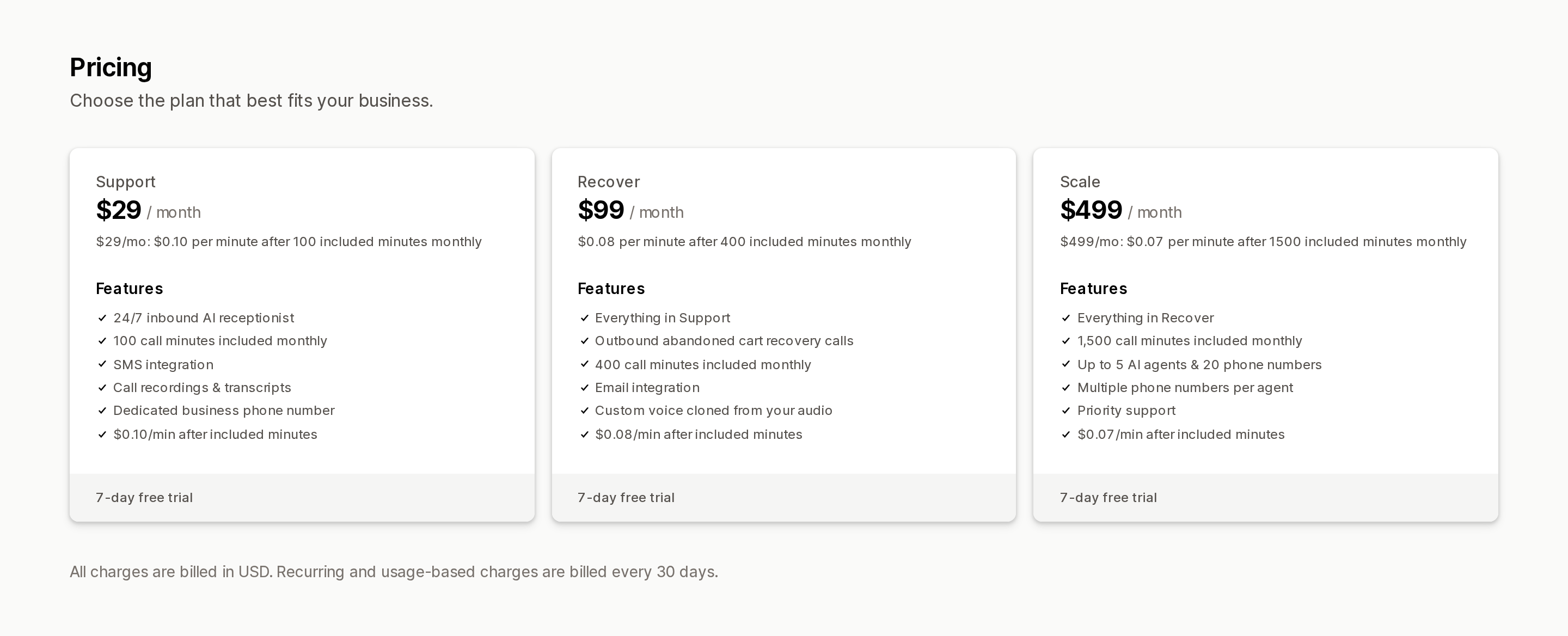
Source: Shopify App Store (Ava AI ‑ AI Phone Agents), retrieved September 11, 2026
Consio's plans converge. Work the arithmetic on all three paid tiers and they reduce to the same formula — about $20 a month plus $0.10 a minute — which is why every one of them lands on $170 at 1,500 minutes. Below your included allowance the higher plans simply cost more for the same usage. Start on the $30 plan and move up only when you are consistently over 100 minutes.
Outbound is a paid upgrade, not a default. Ava AI puts "Outbound abandoned cart recovery calls" on Recover and above, so the $29 plan is an inbound receptionist only. CallFlows' listing describes simultaneous incoming calls and does not advertise outbound campaigns at all. If cart recovery is why you are here, the entry price is not the price.
Two of five apps cannot be priced from their listings. Loop sells credits — 120, 500, or 1,500 a month — and the listing translates them into "3–6 conversations per day" and "10–25 conversations per day" rather than minutes. A conversation of unknown length is not a unit you can forecast against. Shoplabs is blunter: its entire pricing section reads "Free to install" and "Usage charges," with no rate.
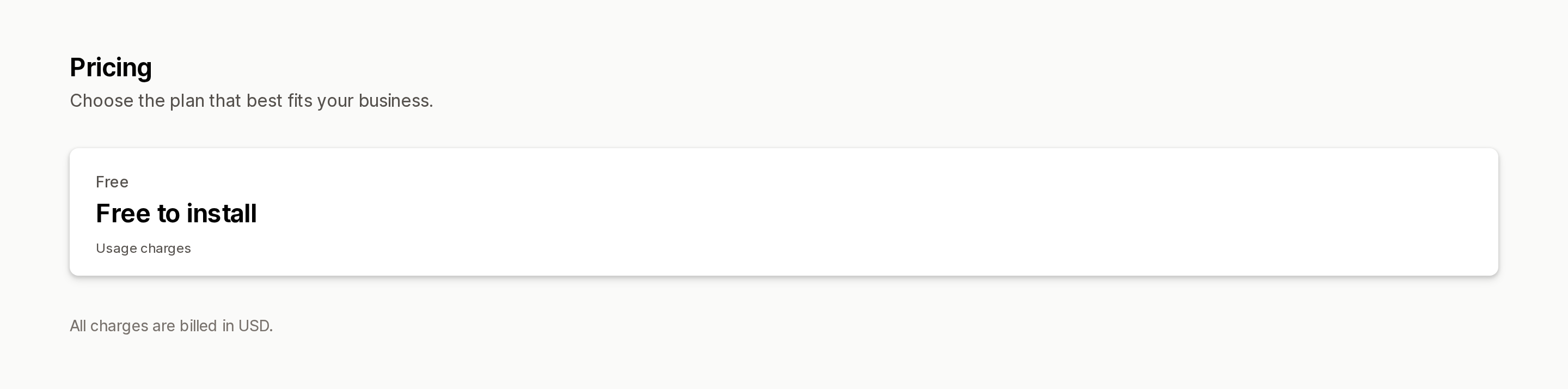
Source: Shopify App Store (Shoplabs: AI Calling Assistant), retrieved September 11, 2026
Neither is disqualifying. Both are reasons to get the rate in writing before install, because Shopify's usage-based billing will charge whatever the app declares.
What each agent is allowed to do to your store
The comparison almost nobody runs on this category is the Data access block at the bottom of each listing. These apps differ more in write permissions than in features.
Ava AI requests Edit orders — "All order history, order edits" — and Edit discounts. Its description matches: the agent "can process refunds while the shopper is on the line" and "texts discount links." An AI that can refund an order mid-call is a real capability and a real blast radius.
CallFlows requests the widest set of the five: Edit products (inventory, products, collections), Edit orders (60 days of history, merchant-managed fulfillment, shipping information, third-party fulfillment, returns), plus view access to discounts, gift cards, Shopify Functions delivery customizations, Online Store pages, and legal policies. Its Agent Skills feature list includes placing an order, so the scopes are consistent with the pitch.
Loop requests Edit discounts and view access to customers, products, 60 days of orders, and the checkout page — narrower, matching an outbound recovery tool that issues codes but does not touch orders.
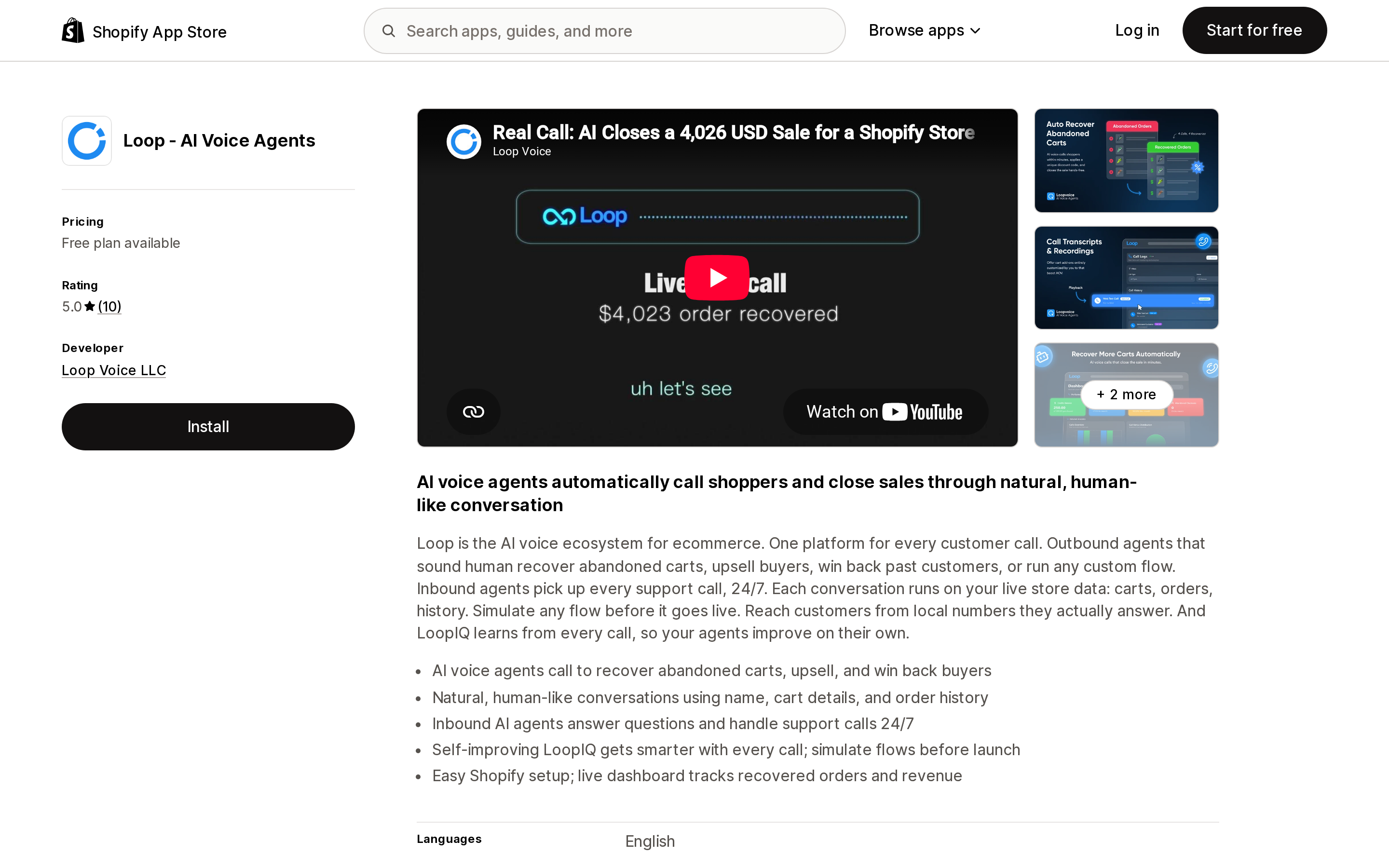
Source: Shopify App Store (Loop ‑ AI Voice Agents), retrieved September 11, 2026
Shoplabs requests view access only across customers, products, orders, discounts, Online Store pages and policies. It is the only app of the five that cannot change anything in your store. For a merchant who wants an agent that answers questions and escalates rather than acts, that is a feature.
Consio's listing does not display a Data access block, so its scopes are not stated on the App Store page and should be confirmed at install.
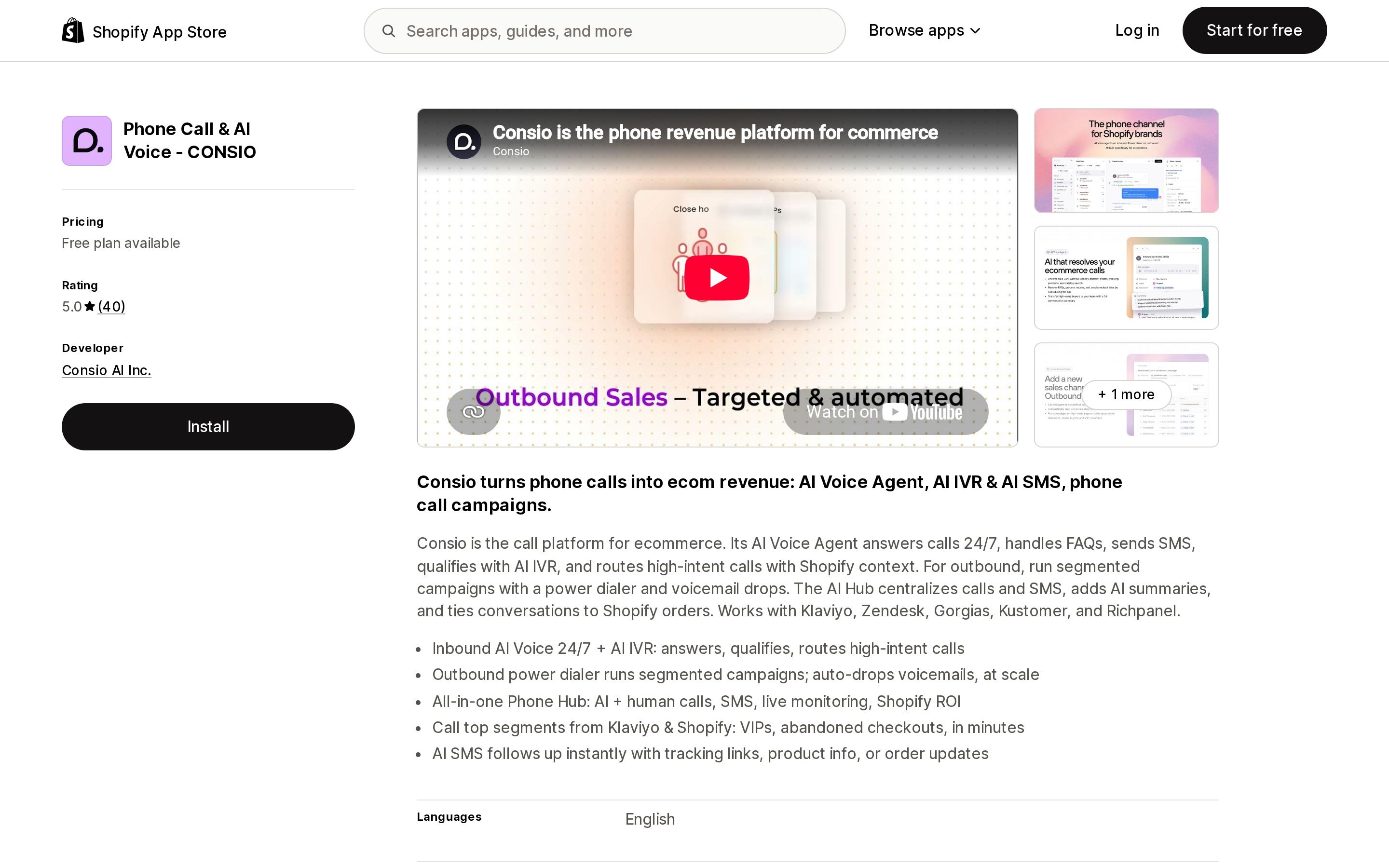
Source: Shopify App Store (Phone Call & AI Voice ‑ CONSIO), retrieved September 11, 2026
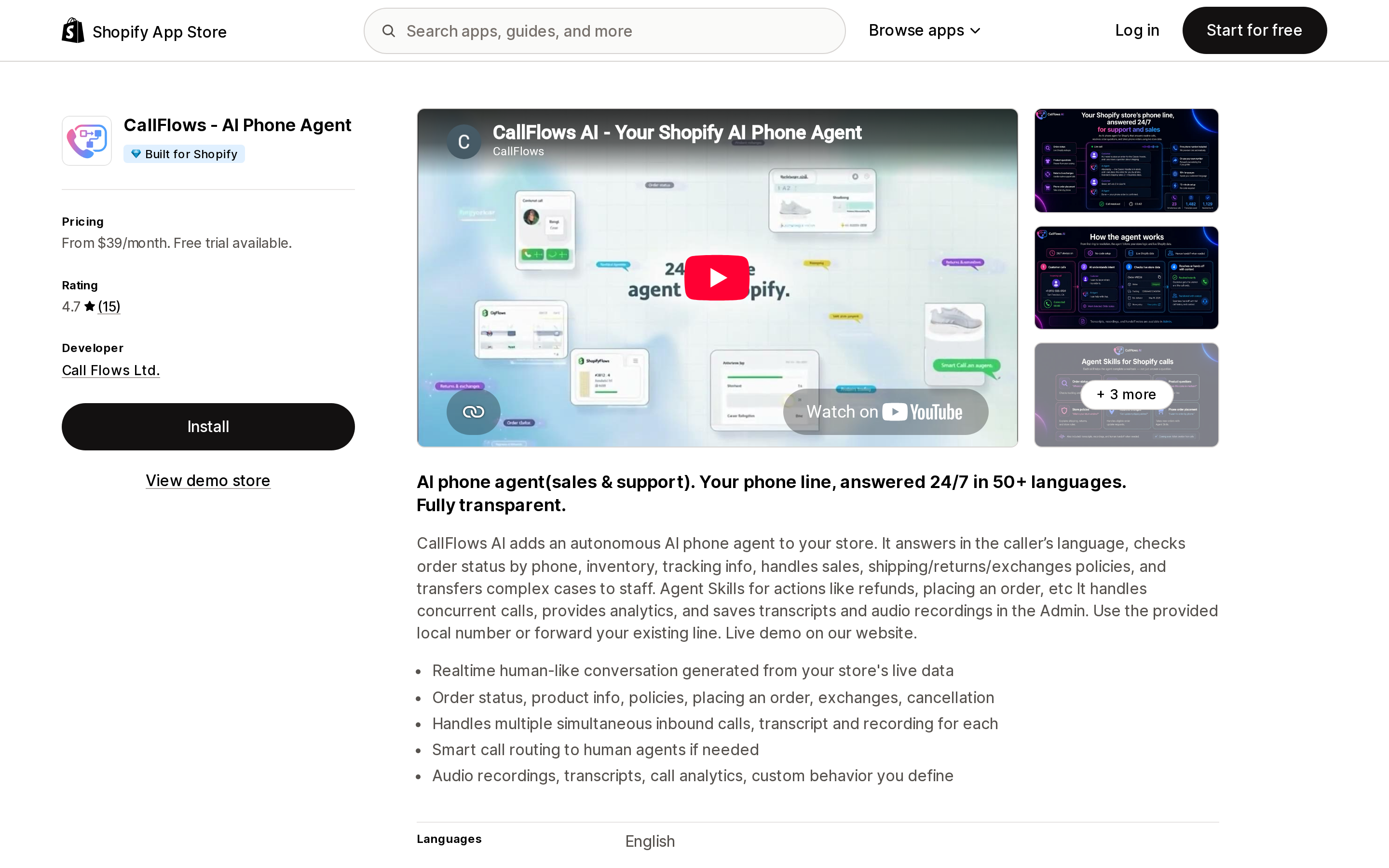
Source: Shopify App Store (CallFlows ‑ AI Phone Agent), retrieved September 11, 2026
Inbound and outbound are not the same product
An inbound agent answers a number a customer chose to dial. An outbound agent dials a US consumer with an AI voice. In American telecom law those are different activities, and the second one is regulated.
On February 8, 2024, the FCC adopted a Declaratory Ruling recognising that "calls made with AI-generated voices are 'artificial' under the Telephone Consumer Protection Act." The Commission's own announcement states the consequence plainly: FCC rules "require telemarketers to obtain prior express written consent from consumers before robocalling them," and "this Declaratory Ruling ensures AI-generated voices in calls are also held to those same standards."
That routes AI voice calls into 47 CFR 64.1200, which sets out requirements including:
- Prior express written consent for any call using an artificial or prerecorded voice that "includes or introduces an advertisement or constitutes telemarketing" to a cell phone or residential line — defined in the rule as a signed written agreement, electronic signature acceptable, that names the number and discloses that consent is not a condition of purchase.
- Identification at the start of the call: artificial-voice messages must "at the beginning of the message, state clearly the identity of the business" under its registered name, and state a callback number.
- An automated opt-out mechanism offered within two seconds of that identification, which must record the number to your do-not-call list and end the call.
- Revocation honoured within ten business days, by any reasonable method — and you "may not designate an exclusive means" of opting out.
- Calling hours of 8 a.m. to 9 p.m. local time at the called party's location, and the national do-not-call registry for telephone solicitations.
Two practical consequences for a Shopify merchant. First, a cart-recovery call that opens with a discount offer is telemarketing, and the SMS checkbox at your checkout is not written consent to place it — Shopify's own record is scoped to SMS. Second, the calling-hours rule is local to the customer, which is a routing requirement your app has to implement across US time zones, not a setting you can approximate from your own.
An inbound-only deployment sidesteps nearly all of this, which is a reasonable argument for starting there. None of the above is legal advice, and state rules add further requirements; this is the federal text your vendor's answers should be measured against.
How to choose
Your native recovery already works and you just want the phone answered after hours. Start with an inbound-only plan and avoid the outbound question entirely. Ava AI's $29 Support tier is the cheapest published entry; CallFlows carries the Built for Shopify badge and handles simultaneous inbound calls, but comes out about 1.7x higher in the 1,500-minute model above.
You are over 1,000 minutes a month and want predictable pricing. Consio's effective $20 + $0.10/min, and Ava AI's Recover tier at $0.08 overage, are the two lowest published rates at volume. Model your own minutes before picking a tier — the headline plan is rarely the cheapest one at your usage.
You want an agent that resolves cases, not just answers them. Ava AI and CallFlows hold the write scopes to act on orders. Decide deliberately whether you want an AI issuing refunds unattended, and check what audit trail you get — both listings state that calls are recorded and transcribed.
You want the smallest possible permission footprint. Shoplabs is view-only. Get its usage rate in writing first.
Outbound cart recovery is the entire reason you are shopping. Treat consent as the first evaluation criterion, not the last. Ask the vendor: where is written consent captured, where is it stored, how are revocations processed within ten business days, how is the 8 a.m.–9 p.m. local window enforced, and what does the agent say in its first two seconds. A vendor who cannot answer those from documentation is selling you the call and leaving you the liability.
None of the above applies to you yet. Shopify's native abandoned checkout email is free and already running. The narrow, defensible case for adding voice is the checkout Shopify documents as unreachable — phone number given, no email — plus an inbound line you are currently letting ring out.
Sources
- Shopify Help Center — Collecting customer contact information
- Shopify Help Center — Recovering abandoned checkouts
- Shopify Help Center — Setting up marketing in Shopify
- Shopify.dev — CustomerSmsMarketingConsentState
- FCC — FCC Makes AI-Generated Voices in Robocalls Illegal (February 8, 2024)
- eCFR — 47 CFR 64.1200, Delivery restrictions
- Shopify App Store listings for Ava AI ‑ AI Phone Agents, CallFlows ‑ AI Phone Agent, Phone Call & AI Voice ‑ CONSIO, Loop ‑ AI Voice Agents, and Shoplabs: AI Calling Assistant, all read in
enlocale on September 11, 2026
Related reading
Shopify added a Bin name column to the inventory CSV on August 25, 2025. It holds one bin per variant per location, it is created only by CSV import, and it prints on Order Printer pick lists. What it does not do is leave Shopify. Shopify staff confirmed on the developer forum in October 2025 and again in January 2026 that there is no public API access to the field, and the developer forum was still reporting the gap in June 2026. That single fact shapes the whole category: EasyScan and iPacky store bins in metafields, Bins-USA and ShelfPilot store them in their own databases, and a free app called Simple Bin Locations copies metafield bins into order notes so packing slips can show them. Shopify's own multi-bin model, with per-bin quantities and an unbinnedQuantity field, exists today only as a feature preview on development stores. Pricing, plan gates, and where each app keeps the bin data, verified on the Shopify App Store, the Shopify Help Center, shopify.dev, and the Shopify community forums on September 18, 2026.