What you will learn
On this pageContentsCloseOpen
A shopper on an auto parts store picks 2015, then Toyota, then Corolla. The page returns a brake pad that fits a 2015 Honda Civic and a 2020 Toyota Corolla — and fits neither of the things she selected. Nothing is broken. The filters did exactly what Shopify's filters do.
This is the failure mode nobody warns you about before you try to build a parts finder out of Search & Discovery, and it is not a configuration mistake. It is what happens when you ask a faceted filter to hold a relationship it was never designed to hold.
The short version
- Shopify has no vehicle fitment data model. There is no native Year/Make/Model selector, no vehicle record, no compatibility table, and nothing in the Standard Product Taxonomy that expresses "this part fits that vehicle."
- Storefront filters are independent facets. Shopify's own documentation: choosing values from different filters is an and condition; choosing values from the same filter is, by default, an or condition. Neither of those is a tuple, which is what a fitment record is.
- The list limits stop you before the logic does. A list metafield holds a maximum of 128 items; metaobject references go to 1,024. Product tags cap at 250 per product on non-Plus plans.
- The Auto Care Association's VCdb publishes 175,500+ vehicle applications and 2.4 million+ vehicle system configurations. Your filter can display 100 values.
- Collections over 5,000 products display no filters at all. A parts catalog is the exact shape of catalog that crosses that line first.
- Seven real fitment apps, six incompatible pricing meters. YMM rows, YMM combinations, fitment lookups counted for the lifetime of the account, product count, product-fitment assignments, and — on one app — no published limit of any kind.
- The shelf is much newer than it looks. Of the seven, one has 164 reviews and the Built for Shopify badge, two have real multi-year track records, and three have zero reviews. Two of the three launched on the same day: June 24, 2026.
- The real dividing line isn't price. It's where the fitment data comes from. One app in this set ingests ACES/PIES; the rest expect you to arrive with a CSV.
All pricing, ratings, review counts, and launch dates verified on the Shopify App Store in the en-US locale on September 9, 2026.
Why three dropdowns is not the same thing as fitment
A fitment record is a tuple. (2015, Toyota, Corolla) is one indivisible fact about one vehicle, and a part carries a set of those tuples — often hundreds of them.
Shopify filters do not store tuples. They store independent attribute values, and they combine them with fixed boolean rules. From the Help Center, verbatim:
Choosing filter values from different filters is an and condition that can decrease the number of products displayed.
By default, choosing filter values from the same filter is an or condition that can increase the number of results.
So if you build Year, Make, and Model as three filters and tag a brake pad with 2015, 2020, Honda, Toyota, Civic, and Corolla, that pad matches 2015 AND Toyota AND Corolla. Every term is present on the product. The fact that they were never present together on the same vehicle is information the filter never had.
The values do narrow as the shopper clicks — Shopify only displays "filter values that apply to products of a collection or search result." But the narrowing is by product co-occurrence, not by vehicle record. Selecting Make = Toyota leaves Civic visible in the Model list, because a product in the result set carries that value. That is the whole bug, and no amount of filter configuration fixes it.
Shopify does offer an escape hatch that gets you one step closer: for product tag, metafield list, and metaobject reference list filters, you can switch the within-filter logic from or to and. That lets you encode the tuple as a single compound value — one tag or one list entry per vehicle, written as 2015-toyota-corolla. Now the match is exact.
And now you have a counting problem.
What the limits do to a parts catalog
Encoding one value per vehicle means a part that fits 400 vehicles needs 400 values on that product. Here is what Shopify permits, and each of these is published:
| Limit | Value | Source |
|---|---|---|
| Items in a list metafield | 128 | shopify.dev |
Items in a list.metaobject_reference | 1,024 | shopify.dev |
| Predefined choices, single line text | 128 | shopify.dev |
| Product tags per product | 250 (unlimited on Plus) | Help Center |
| Characters per tag | 255 | Help Center |
| Filters per store | 25 | Help Center |
| Filter values displayed on the storefront | 100 | Help Center |
| Unique values in a filter group | 200 | Help Center |
| Filter groups per store | 1,000 | Help Center |
| Unique tag values indexed for the tag filter | 5,000 | Help Center |
| Products in a collection before filters disappear | 5,000 | Help Center |
| Search results before filters disappear | 100,000 | Help Center |
Read those against the size of the actual problem. The Auto Care Association's Vehicle Configuration database — the VCdb, the table ACES fitment is written against — publishes, in its own figures, 175.5+ thousand vehicle applications, 2.4+ million vehicle system configurations, and 16.5+ thousand off-highway vehicles and equipment, covering the USA, Canada, Mexico, and Latin America, republished monthly for manual download and daily through the API.
Against that: a hundred displayed filter values, and a hundred and twenty-eight list items per product.
Two of these limits deserve special attention because merchants hit them without understanding why. The 25-filter-per-store cap is a store-wide budget, and each source can only be used once — Year, Make, Model, Submodel, and Engine is five of your twenty-five before you have added a single filter for brand, price, or part type. And the 5,000-product collection rule is not a soft degradation. Filters do not shrink or paginate; they stop appearing. A catalog that grows past 5,000 items in one collection loses its filter UI entirely, which we covered in more depth in the full list of Search & Discovery limits.
There is one narrow case where native filters genuinely work: a store with a small, clean catalog where every product fits exactly one vehicle family and the sets never overlap. Universal floor mats sold per model, say. If two products in your catalog share a Make but not a Model, you are already in false-positive territory.
The shelf is much newer than it looks
Search the App Store for "year make model" and you get a full page of results, which reads as a mature category. The launch dates and review counts say otherwise.
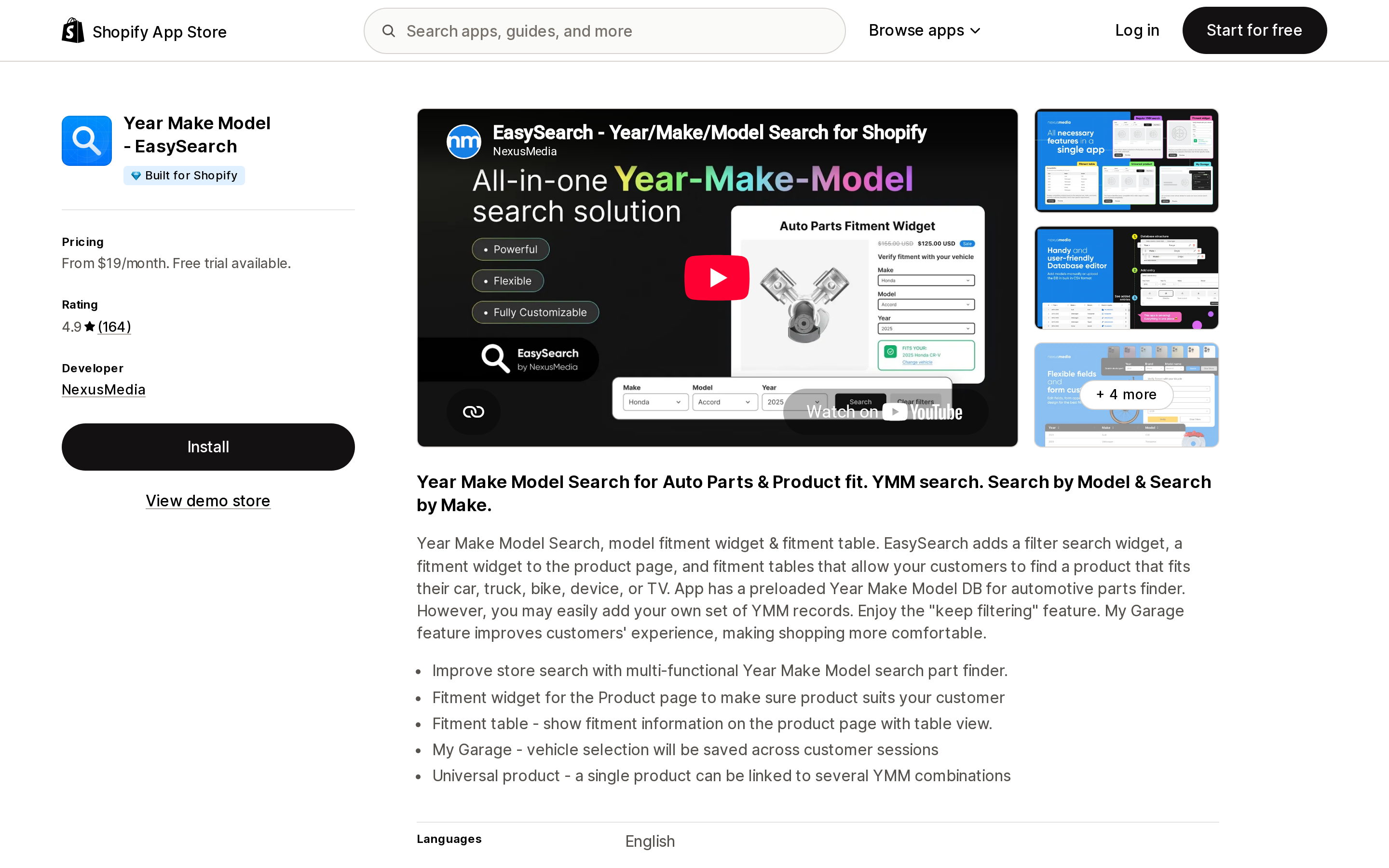
Year Make Model ‑ EasySearch by NexusMedia is the anchor: launched April 12, 2016, 4.9 stars across 164 reviews, and the only app in this set carrying the Built for Shopify badge. It ships a preloaded YMM database, a fitment widget for the product page, fitment tables, My Garage, and named integrations with Turn 14 Distribution and Slingshot Automotive. Basic is $19/month; Premium is $75/month.
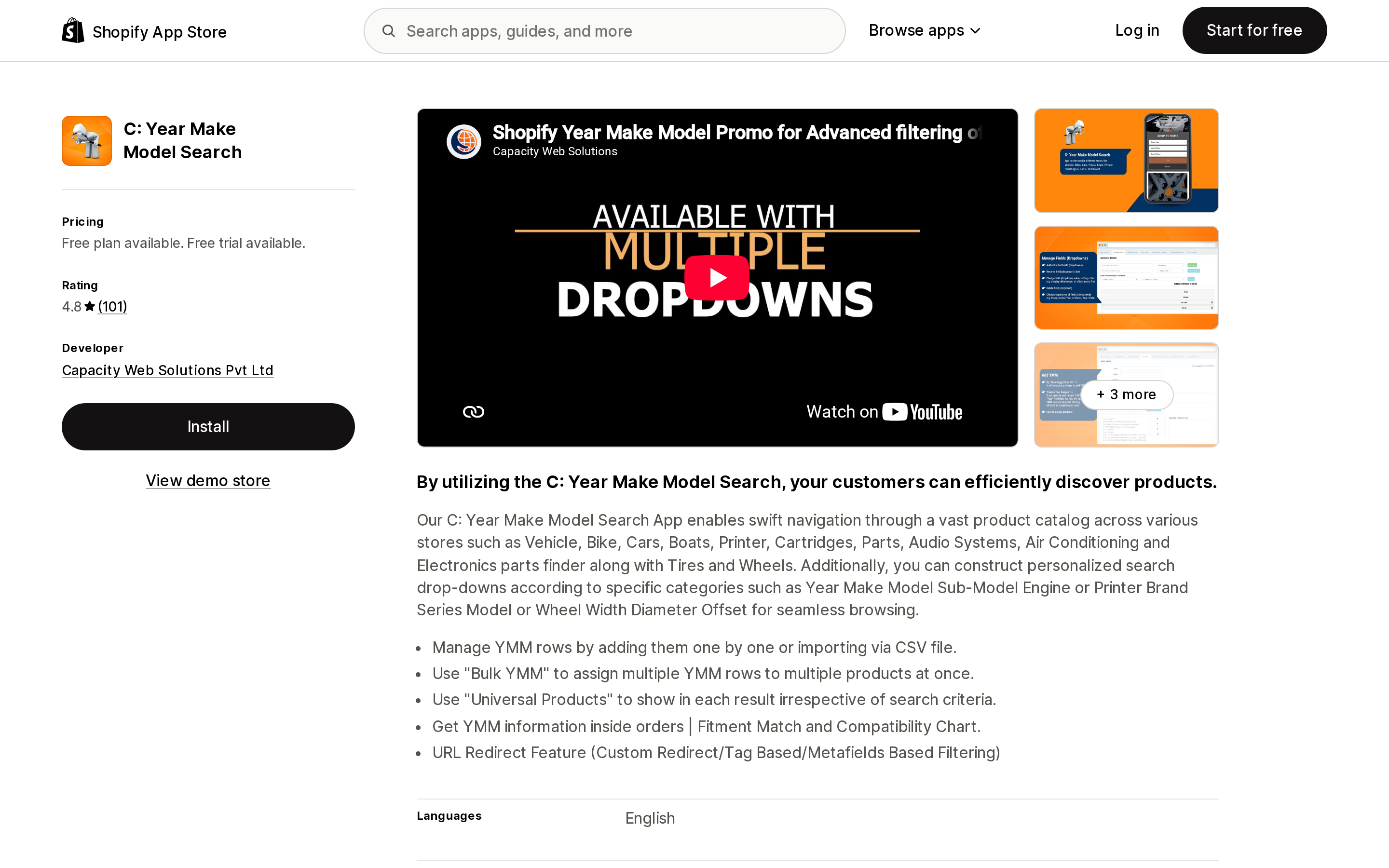
C: Year Make Model Search by Capacity Web Solutions Pvt Ltd launched January 5, 2017 and sits at 4.8 across 101 reviews. It is the most configurable of the group — custom search levels beyond Y/M/M, universal products, a compatibility chart, YMM data written into the order.
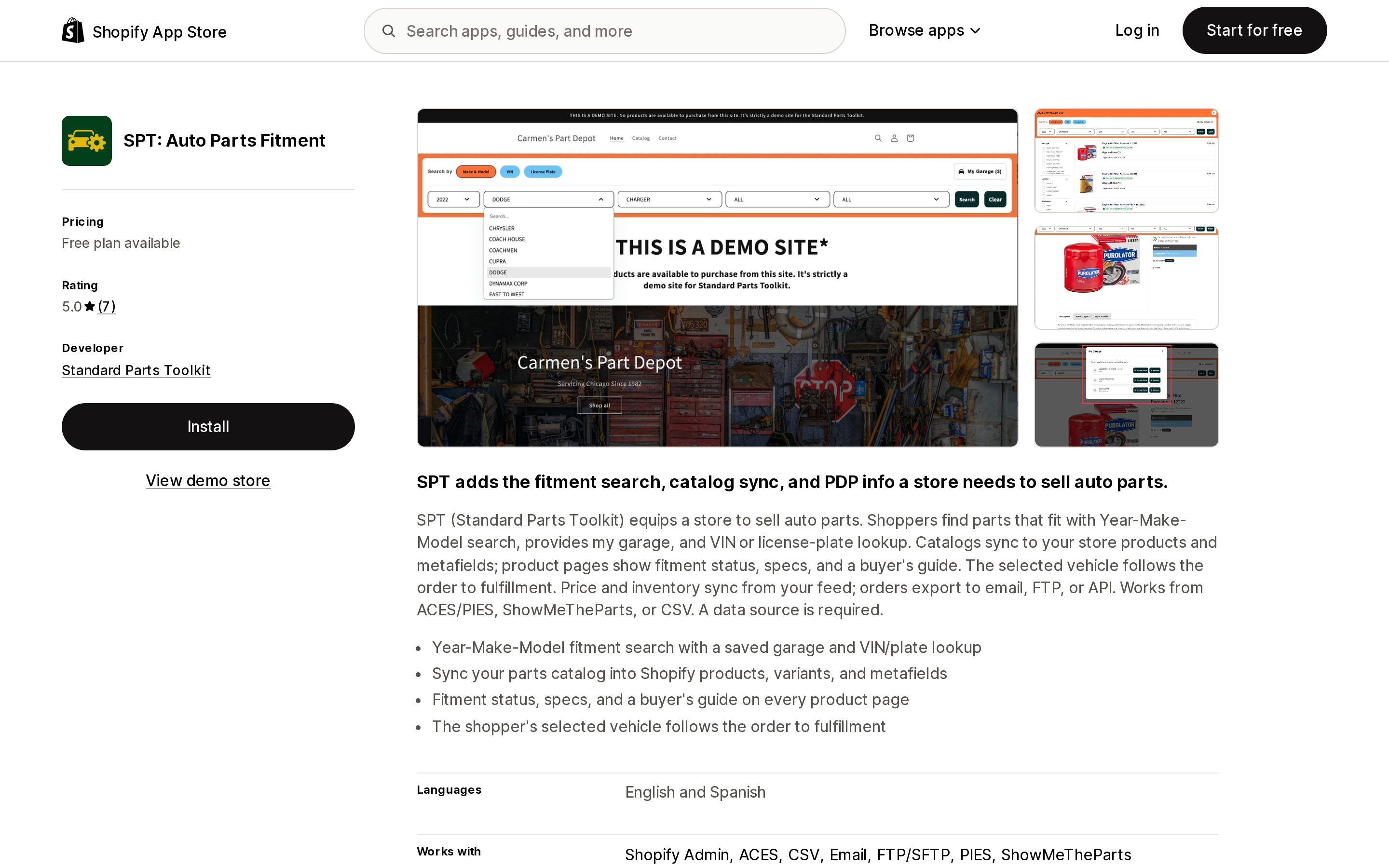
SPT: Auto Parts Fitment by Standard Parts Toolkit (Chicago, IL) launched October 13, 2022, 5.0 across 7 reviews — and those reviews are from US and Canadian parts sellers describing two- and three-year relationships, which is a different signal than seven anonymous five-stars. It is also the only app here built around industry data rather than spreadsheets.
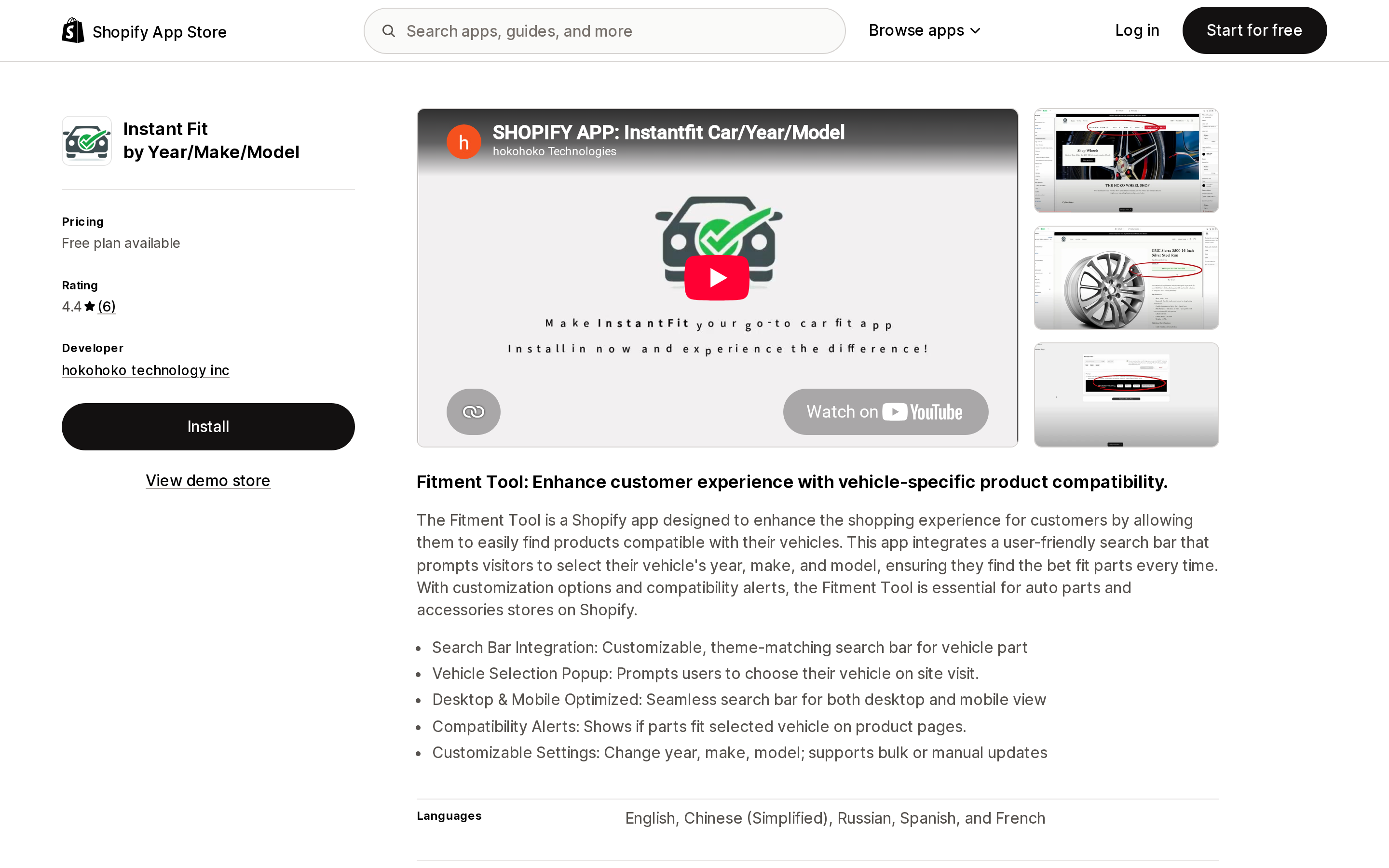
Instant Fit by Year/Make/Model by hokohoko technology inc launched July 26, 2024 and sits at 4.4 across 6 reviews — five five-stars and one one-star. The reviews displayed on the listing come from Australia and New Zealand.
Then the new arrivals, all three with zero reviews as of September 9, 2026:
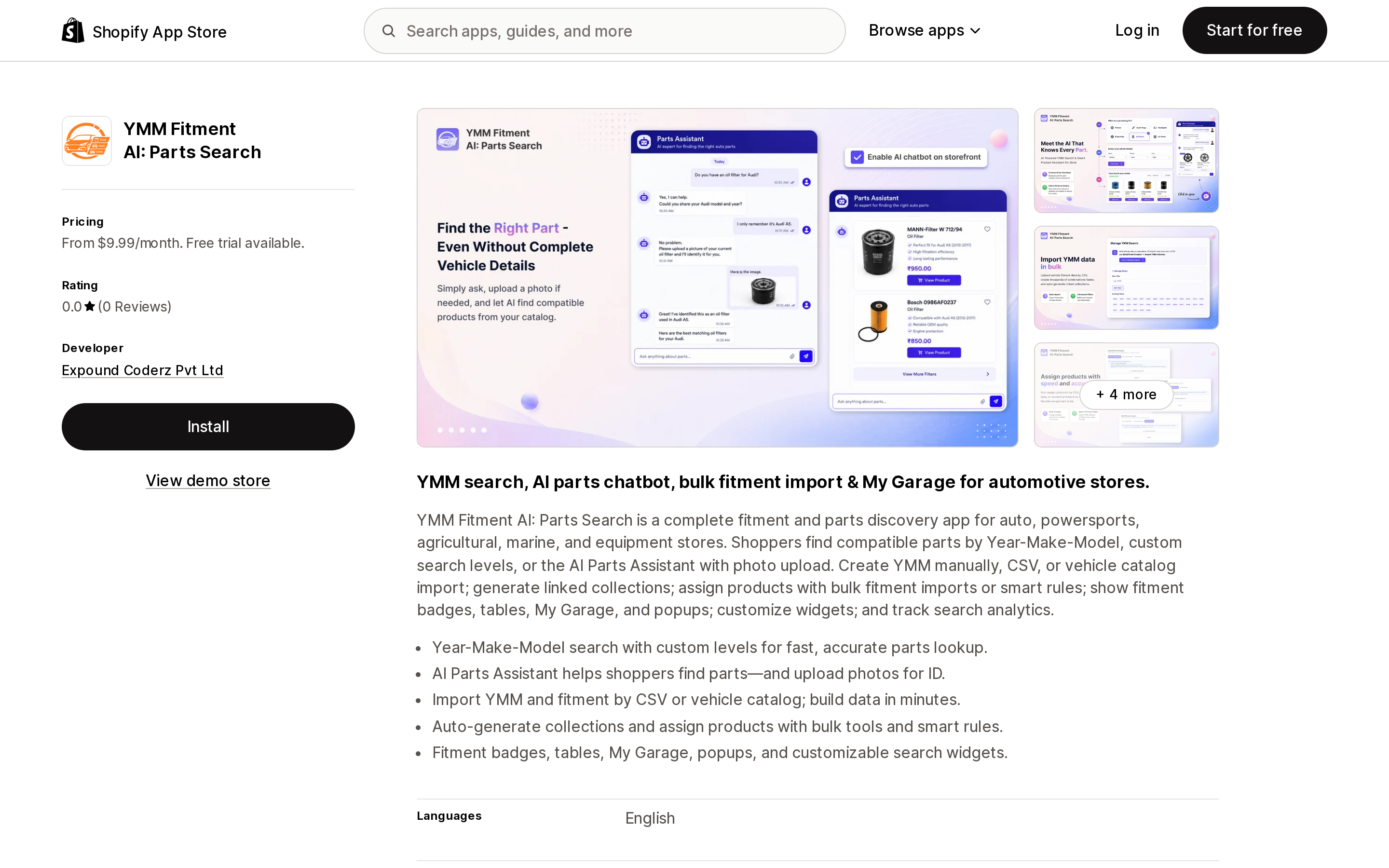
YMM Fitment AI: Parts Search by Expound Coderz Pvt Ltd, launched September 3, 2025. The listing was previously titled ESTS‑ AutoFit YMM Search, and the old name is still visible in the app's own promotional image.
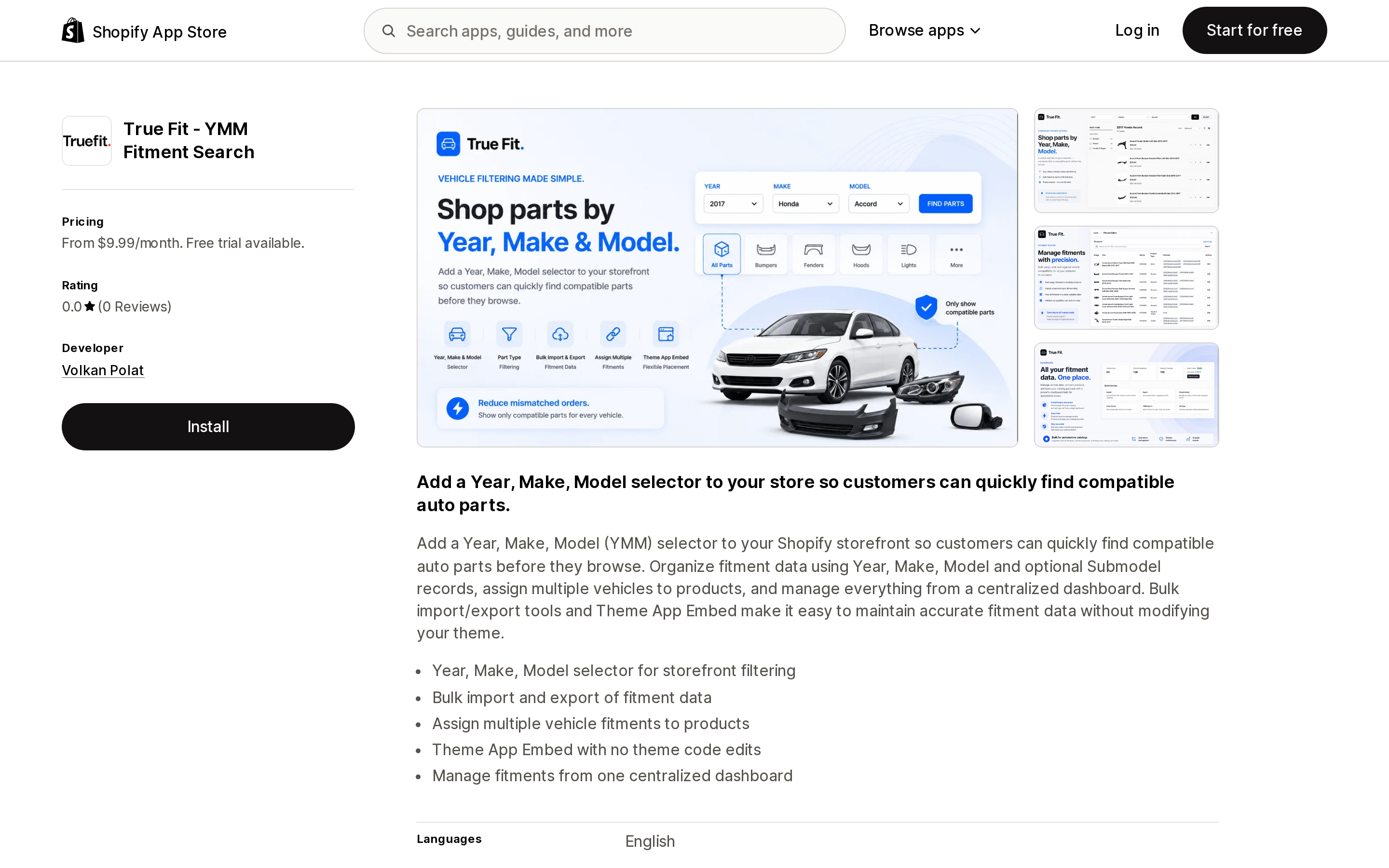
True Fit ‑ YMM Fitment Search by Volkan Polat (Linden, NJ), launched June 24, 2026.
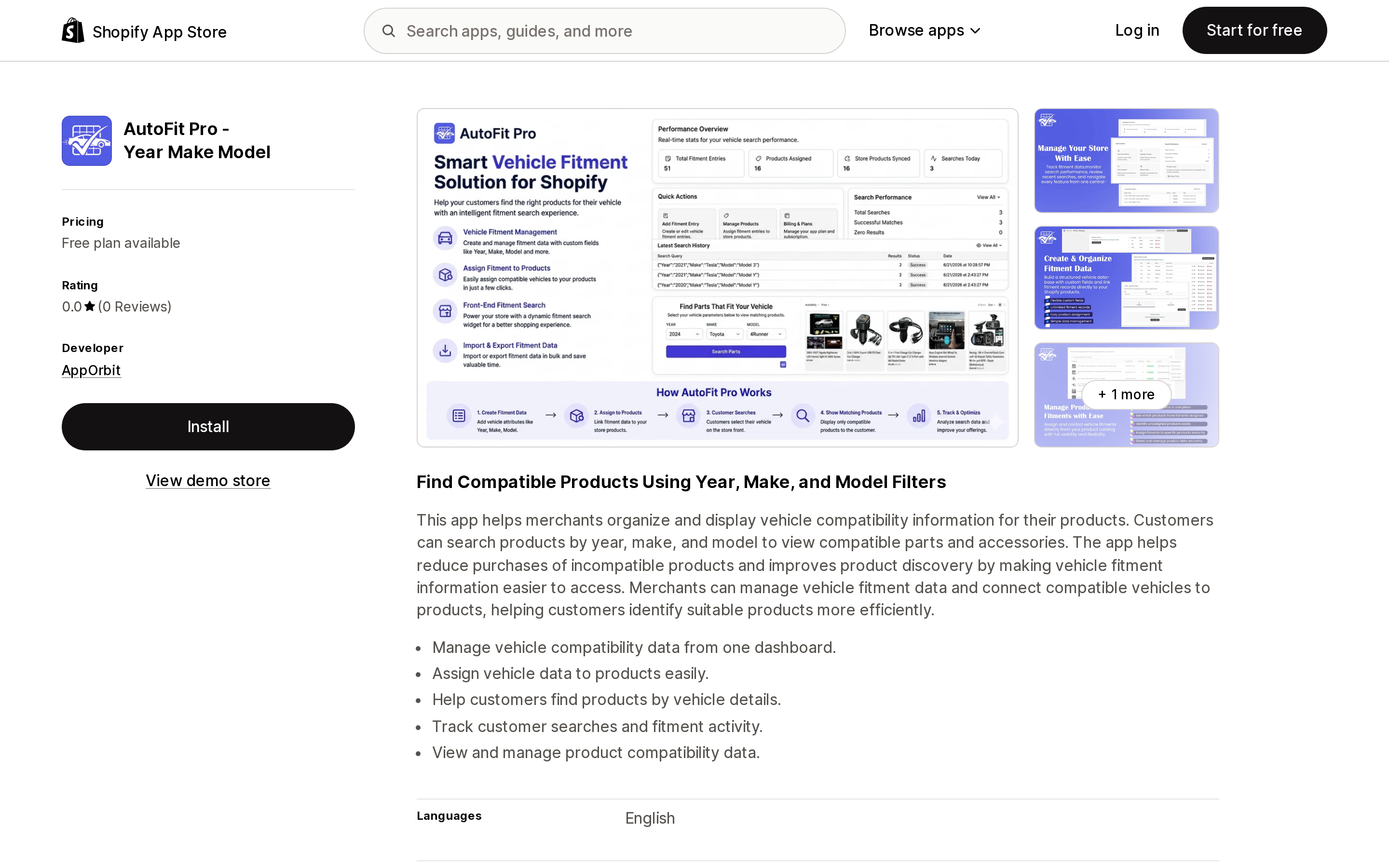
AutoFit Pro ‑ Year Make Model by AppOrbit (Dhaka), launched June 24, 2026 — the same day.
Zero reviews is not a verdict. It is an absence of evidence, and in a category where the cost of being wrong is a customer bolting the wrong part to a car, absence of evidence is worth pricing in. Our guide to reading App Store trust signals covers what a review count does and doesn't tell you.
Seven apps, six meters
Nothing in this category bills on the same unit, which makes the listing prices uncomparable.
| App | Entry price | Top tier | What gets metered |
|---|---|---|---|
| Year Make Model ‑ EasySearch | $19/month | $75/month | Nothing. "Unlimited: fields, rows, users & product" |
| C: Year Make Model Search | $10/month | $75/month | YMM rows — 1,000,000 on Basic and Pro, 1,500,000 on Premium |
| SPT: Auto Parts Fitment | Free | $300/month | Fitment lookup searches — 100 for the lifetime of the free account |
| Instant Fit by Year/Make/Model | Free | $50/month | Products and fitments — 500 products / 30,000 fitments at the top |
| YMM Fitment AI: Parts Search | $9.99/month | $49.99/month | YMM combinations — 5,000 / 20,000 / 80,000, plus AI chat messages |
| AutoFit Pro ‑ Year Make Model | Free | $9.99/month | Fitment rows and product-fitment assignments — 10 / 20 on free |
| True Fit ‑ YMM Fitment Search | $9.99/month | $99.99/month | Not published on the listing |
Four numbers in that table decide most purchases.
Instant Fit caps products, not just fitments. The $50/month Business plan allows 500 products. Not 500 fitments — 500 products. Any parts catalog worth installing a fitment app for is larger than that, and the ceiling is on the most expensive plan, so there is nowhere to grow into.
SPT's free plan counts lifetime, not monthly. "100 Lifetime Fitment Lookup Searches" is a demo, not a tier. The real product is $300/month — three times the next-highest plan in this set.
C: Year Make Model Search's free plan doesn't work on a paid Shopify plan. The listing carries a "Free plan available" badge; the plan itself is labelled Development Store (No Paid Shopify Plan) and states outright that it "Won't work with paid Shopify plan." It is a developer sandbox wearing a free-plan badge, and the badge is what shows up in App Store search results — the same gap between listing label and usable tier we found when we priced the free tiers of the search and filter category.
True Fit publishes no limits at all. Basic is $9.99 and Advanced is $99.99, a tenfold jump with no stated difference on the listing. The trial lengths differ too: 30 days on Basic, 7 days on Advanced.
The features that aren't in the entry plan
Three things merchants assume are table stakes are, in practice, upgrade triggers.
My Garage — saving the shopper's vehicle across sessions — is Premium-only on EasySearch ($75), Pro-only on C: Year Make Model Search ($50), and unavailable on Instant Fit's free tier. It is included at every paid tier on YMM Fitment AI.
Fitment tables and compatibility charts on the product page are Premium on EasySearch and Pro on C: Year Make Model Search. On the entry plans of both, the shopper gets a search widget and no published list of what else the part fits.
Vehicle data written into the order is rarer still. C: Year Make Model Search puts YMM information inside orders on the Pro plan. SPT states that "the selected vehicle follows the order to fulfillment." For a store handling returns on wrong-fit parts, that field is the difference between a five-minute investigation and a guess — and it sits behind an upgrade on the one app that publishes it as a feature.
Where your fitment data comes from decides everything
This is the axis that actually splits the category, and it barely shows up in the listings' pricing tables.
SPT: Auto Parts Fitment works from ACES/PIES, ShowMeTheParts, or CSV, and its listing says plainly: "A data source is required." ACES is the Auto Care Association's application standard; PIES is the product information standard; both are written against subscription databases (VCdb, PCdb, PAdb, Qdb, and the Brand Table). If your suppliers already send you ACES XML, this is the only app in the set that speaks the language, and $300/month buys you out of maintaining fitment by hand.
EasySearch ships a preloaded YMM database and named supplier integrations (Turn 14 Distribution, Slingshot Automotive), which is the middle path: real vehicle data without an ACES subscription.
Everything else expects a CSV. True Fit, AutoFit Pro, Instant Fit, YMM Fitment AI, and C: Year Make Model Search all import fitment from spreadsheets you assemble. That is fine for a store with a few hundred SKUs and a supplier who publishes clean application data. It is a permanent part-time job for a store with fifty thousand.
Ask the question in this order: where does my fitment data come from, and who updates it when the 2027 models ship? The answer eliminates most of this list before price enters the conversation.
One permission worth checking before October 1
The data access panel on YMM Fitment AI: Parts Search requests "Edit Online Store script tags."
Script tags are on a published retirement schedule. As of October 1, 2026, scriptTagCreate and scriptTagUpdate return a user error and the REST ScriptTag resource rejects POST and PUT — and Shopify states the deprecation "applies to all API versions, including older ones, so pinning won't defer it." On March 1, 2027, Shopify stops injecting script tags into storefronts entirely. The replacement is an app embed block shipped in a theme app extension, which the merchant activates in the theme editor.
By contrast, EasySearch and C: Year Make Model Search request theme access, True Fit's listing names Theme App Embed explicitly, and Instant Fit and AutoFit Pro request nothing beyond products and collections. A script tag scope on a storefront widget in September 2026 is not proof the app will break — it may be legacy scope, and scriptTags queries and scriptTagDelete keep working — but it is a reasonable question to put to a vendor before you install. We walked through the earlier stage of this shutdown, and how to audit your own store, in the Order status page script tag sunset.
How to choose
Skip the app entirely only if every product fits exactly one vehicle family, no two products share a Make without sharing a Model, and no collection approaches 5,000 products. Encode the vehicle as one compound value in a single-line-text list metafield, switch the filter logic to and, and stay under 128 entries per product. This is a real answer for a small accessories catalog. It is not an answer for parts.
If your suppliers send ACES/PIES data, SPT: Auto Parts Fitment is the only app in this set that ingests it, and the $300/month is buying data maintenance, not a widget.
If you want the safest general-purpose choice, Year Make Model ‑ EasySearch at $19/month has the badge, the longest track record, the largest review base, and a preloaded vehicle database. Budget for $75 if you need My Garage or fitment tables on the product page.
If you need search levels beyond Year/Make/Model — submodel, engine, wheel offset, printer series — C: Year Make Model Search at $10/month is the most flexible schema here, and $50 buys the compatibility chart and vehicle data on the order. Ignore the free plan; it only runs on development stores.
If your catalog is under a few hundred SKUs and you are testing whether a parts finder moves anything, AutoFit Pro's free tier (10 fitment rows, 20 assignments) or Instant Fit's free tier (50 products, 500 fitments) will tell you cheaply. Confirm the ceiling before you build data on top of them — Instant Fit's ceiling is 500 products on its most expensive plan.
Whichever you pick, ask three questions before installing: who maintains the vehicle data when new model years ship, does the selected vehicle reach the order record, and — for anything launched in 2026 — what happens to the storefront widget after March 1, 2027.
Primary sources
- Adding filters with Shopify Search & Discovery — Shopify Help Center
- Metafield limits — shopify.dev
- Tag formats — Shopify Help Center
- Script tags are deprecated and will stop running on March 1, 2027 — Shopify developer changelog, August 24, 2026
- Vehicle Configuration database (VCdb) — Auto Care Association
- Shopify App Store listings for EasySearch, C: Year Make Model Search, SPT: Auto Parts Fitment, Instant Fit, YMM Fitment AI, True Fit, AutoFit Pro — all checked September 9, 2026
Shopify's free link-in-bio page, Linkpop, retired on July 7, 2025 — linkpop.com now redirects to shopify.com. On August 15, 2026 Shopify's Help Center began saying the $5 Starter plan, the plan built around sharing product links on social, isn't available to new stores. And Shopify's own July 21, 2026 blog post on link-in-bio tools links to exactly two Shopify App Store listings: LinkShop, and Linktree — an app in the Marketplaces category, billed outside your Shopify invoice, rated 3.6 across 18 reviews. We priced seven link-in-bio apps on September 18, 2026. The dimension that matters isn't the monthly fee, which runs from $0 to $15. It's where the page lives: four apps serve it from your own storefront through a Shopify app proxy, which means it sits behind your store password — and on the new $0 Agentic plan, that password never comes off. Verified against the Shopify Help Center, shopify.dev, the Shopify App Store, and live store pages.