
What you will learn
On this pageContentsCloseOpen
You install the SMS app on Monday. The plan is to text your list on Friday, ahead of the weekend promotion. On Thursday you open the app to schedule the campaign and find a banner telling you your number is still pending carrier review.
There is nothing you can do about it. There is no support ticket that fixes it, no plan upgrade that skips it, and no setting you missed.
The gate nobody puts on the listing page
All four apps compared below show "Free to install" on their App Store listings. That is true, and it is also beside the point. Installing the app does not give you the ability to send a text message in the United States or Canada. What gives you that ability is a wireless carrier deciding your business is real.
The mechanism is called toll-free number (TFN) verification. Your app assigns you a 10-digit number beginning with 800, 888, 877, 866, 855, 844 or 833, then submits your business details to the carriers through its messaging provider. Until they approve, the number is inert.
Here is what the four providers publish about how long that takes.
| App | Published verification window | Can you send while pending? |
|---|---|---|
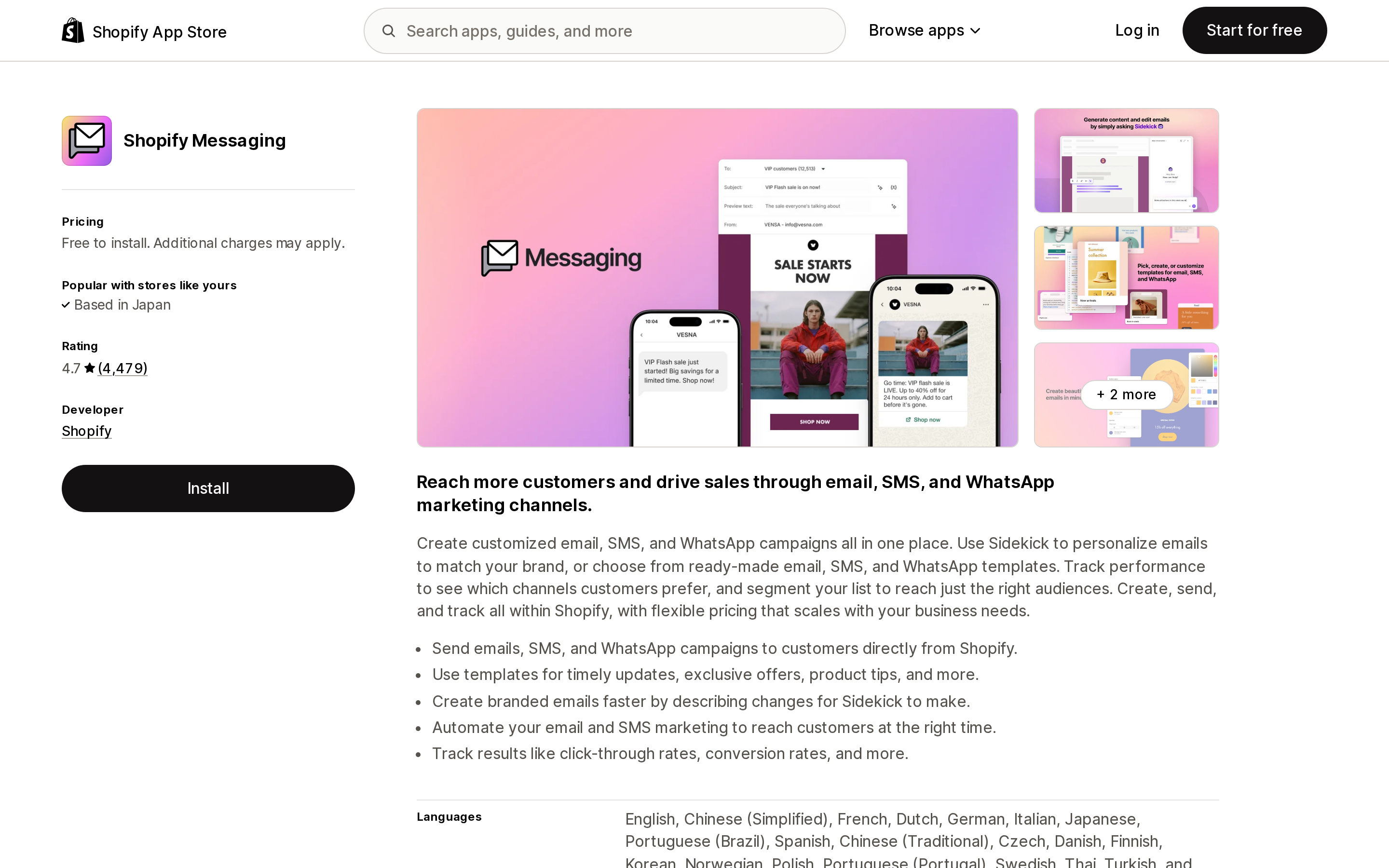
| Shopify Messaging | 2 to 5 business days | No |
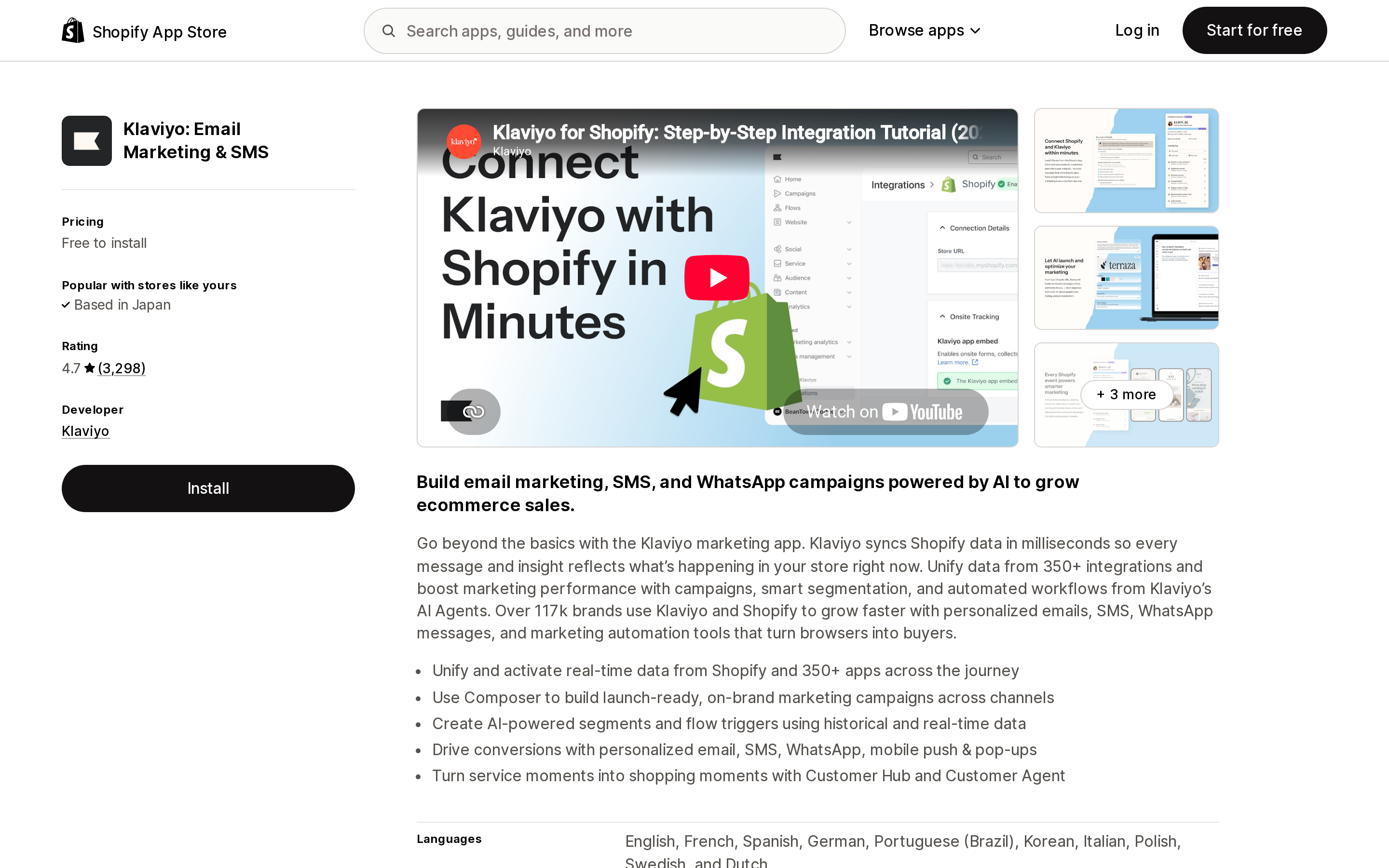
| Klaviyo: Email Marketing & SMS | 2 to 5 business days | Not recommended; carriers heavily filter unverified numbers |
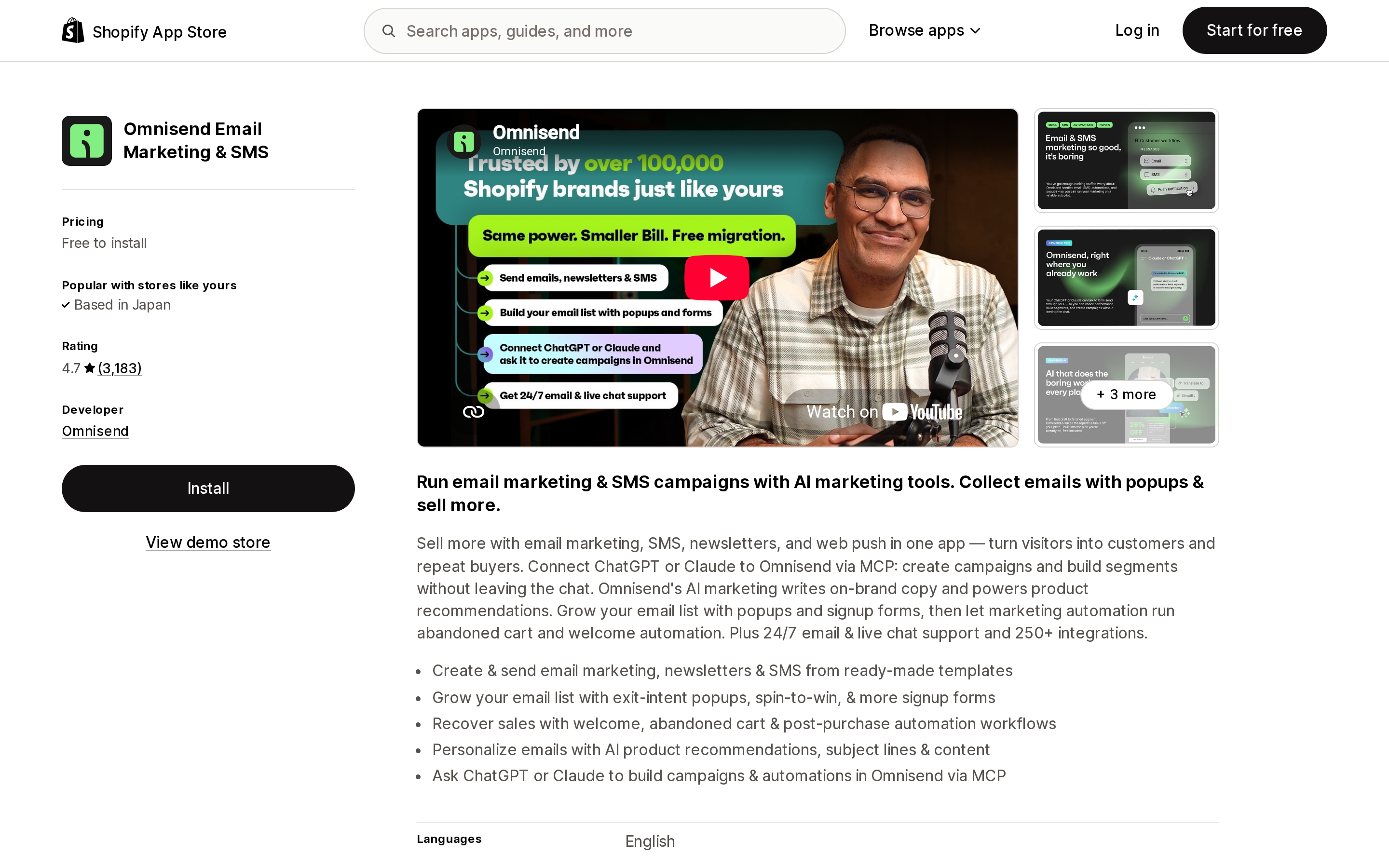
| Omnisend Email Marketing & SMS | ~5 business days, up to 2 weeks | No |
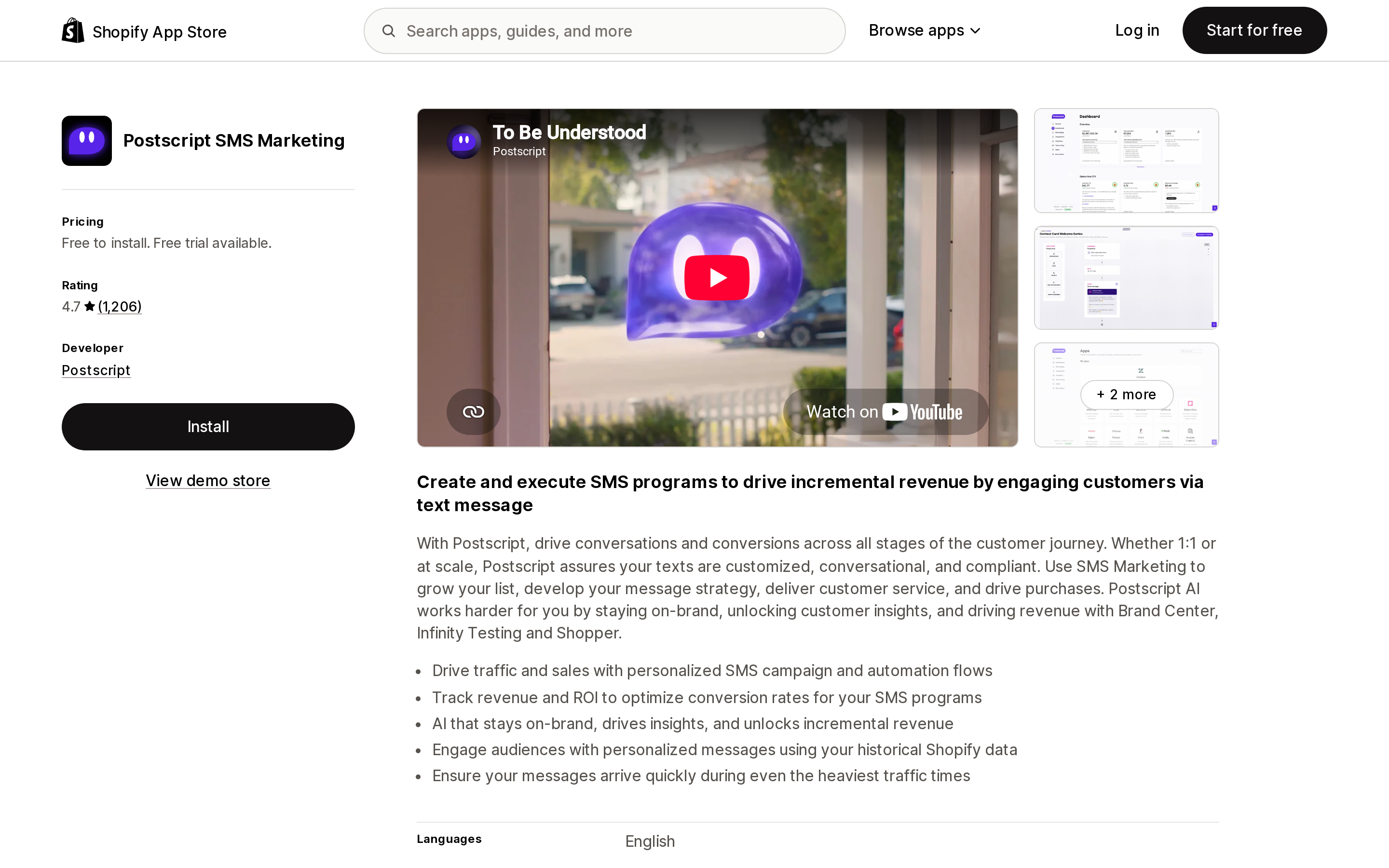
| Postscript SMS Marketing | ~3 to 10 business days | No — sending is entirely blocked |
Omnisend is the most direct about it: "There is no expedited verification option. Plan your SMS campaigns with this timeline in mind – do not rely on same-day or next-day verification."
Postscript, which reviews your site manually before submitting to carriers, recommends installing ten days before you turn off your previous provider.
Toll-free verification, not 10DLC
If you have researched US business texting, you have run into 10DLC — the registration regime for ordinary 10-digit local numbers, with its brand registration fees and per-campaign monthly charges. It is worth being clear that this is usually not what applies to you.
All four apps above put US and Canadian ecommerce senders on a toll-free number by default, and toll-free numbers go through TFN verification, which is a different process from 10DLC campaign registration. Klaviyo's sending-number table lists toll-free numbers and short codes as the US options and does not offer a US long code at all. Klaviyo also states that toll-free numbers, branded sender IDs and long codes are included free of charge; only short codes and vanity short codes carry an additional monthly cost.
So the question for most Shopify merchants is not "how much does 10DLC registration cost." It is "how long until the carriers clear my store, and what will they reject me for."
The expensive part: you can't grow the list either
This is the detail that turns a scheduling annoyance into lost revenue.
Yotpo's SMS documentation states the rule and its consequence in one place: under US and Canadian regulations, every customer joining a recurring SMS marketing program must receive a message confirming their subscription when they opt in, and that confirmation has to be sent before any campaign or flow message. Because of that ordering, Yotpo writes, you cannot collect US or Canadian subscribers until your number is verified.
That confirmation is itself an SMS. It has to leave your number. And your number cannot send.
Postscript says the same thing from the other direction: unverified toll-free numbers are blocked from sending text messages "including Double Opt-In 'reply Y' messages, impacting subscriber list growth."
Shopify's pricing page confirms the confirmation message is billable traffic, not a free system message. Shopify charges per SMS for confirmation messages sent to new subscribers, double opt-in messages when activated, and replies to customer keywords such as "INFO" or "HELP."
The practical consequence: if you launch a popup, a footer signup or a checkout SMS opt-in on the same day you install the app, every phone number collected during the verification window sits in your list without a confirmation. You have not built a week of list growth. You have built a week of compliance debt.
Source: Shopify App Store (Postscript SMS Marketing), retrieved September 15, 2026
What actually gets you rejected
Three of the four providers publish their rejection reasons. Read together, they describe a review that is looking at your storefront, not your app settings.
A checkbox is not an age gate. Shopify's rejection table lists "Age verification" as a common error for stores selling alcohol or other restricted items, and is specific about what does not count: an age verification app must "either require users to enter their full date of birth (MM/DD/YYYY) or use a third-party age verification service. A simple checkbox or confirmation button isn't accepted." Omnisend lists "Age Gate is needed" as its own rejection reason.
Your consent language has to match one purpose. Omnisend's most-repeated rejection is "Clear and Explicit Consent Needed," and the cause is usually not a missing checkbox. It is opt-in text covering several purposes at once. Omnisend's guidance: if your form says "order updates, shipping notifications, and promotional offers" but you submitted for marketing, that ambiguity fails. Use separate checkboxes for transactional and marketing consent.
The checkbox must be unchecked, and optional. Omnisend requires the submitted screenshot to show an unchecked SMS consent checkbox, and lists "Messaging Consent Must Be Optional" separately — consent cannot be a condition of using your store.
Your privacy policy can sink it. Omnisend lists "Sharing User Data with Third Parties Not Allowed": if your privacy policy or terms of service say you share or sell opt-in data, verification fails even when the form itself is correct. Shopify separately requires your privacy policy to explain how you collect phone numbers and who you share data with, including SMS service providers, and your terms of service to state message frequency, that data rates may apply, opt-out instructions and support contact details.
Generic business details fail. Shopify rejects contacts named "Admin" or "Support" under "Contact must be a business representative," and rejects free email domains under "Business email requires an official domain" unless that address is shown on your store as an official contact method. Klaviyo requires a business registration number and an address in the country where the business is registered. Postscript collects an EIN from US entities, and a Company Number or equivalent from businesses outside the US.
Your store has to be live. Every provider says this. Klaviyo: "Your website must be live in order to be approved for verification." Postscript: password-protected shops cannot be verified, and the site must stay live for the full 3–10 business days. Omnisend fails submissions where the URL is password-protected, a staging environment, or behind a login.
This last one catches pre-launch stores hardest. If you are building toward a launch date behind a password, you cannot get verified first and open second.
Source: Shopify App Store (Omnisend Email Marketing & SMS), retrieved September 15, 2026
Rejection restarts the clock, and there is a deadline on fixing it
A rejection does not pause your timeline. It resets it.
Omnisend gives you seven days to edit and resubmit. Miss that window and the reason code becomes "Edit time expired," and review time "will be similar to a new submission." Postscript says resubmitted applications go back for carrier review that typically takes up to five business days. Shopify displays the reason in your admin and by email, and requires you to resubmit the form after fixing it.
Two rejections on a two-week runway is how a Black Friday SMS program becomes a Black Friday email program.
Some categories never get approved
Verification is not only about paperwork. Whole product categories are excluded.
Postscript's position is unambiguous: "At this time, Postscript cannot support brands that sell merchandise that falls in any SHAFT category" — sex, hate, alcohol, firearms and tobacco, with CBD included. Omnisend states SHAFT accounts will not be verified. Klaviyo notes that not all industries qualify, and that businesses falling under its prohibited content categories cannot send with Klaviyo at all.
Shopify Messaging publishes the longest list — fourteen prohibited content categories, including alcohol, firearms, fireworks, gambling, illegal substances (cannabis, CBD, tobacco, vaping), high-risk financial services (including cryptocurrency), multi-level marketing, political content and third-party lead generation.
Source: Shopify App Store (Shopify Messaging), retrieved September 15, 2026
If you sell in one of these categories, the decision is not which app to choose. It is whether SMS marketing is available to you at all, and that is worth resolving before you build a signup flow around it.
Getting verified is not the end of the obligation
Klaviyo publishes a rule that most merchants never encounter until it hurts them: send within a month of verification.
"Carriers expect SMS programs to be active and consistently messaging subscribers once their toll-free number is verified. If there's a long pause (multiple weeks) between when a number is verified and you first send a message, carriers may change the status back to unverified, not inform Klaviyo, and then heavily filter your message."
Klaviyo also separates two things merchants tend to conflate: "Verification is not allowlisting." A verified number still gets filtered by individual carriers. What verification buys you is fewer false-positive blocks and a faster path to resolving deliverability problems — not delivery.
So verifying early and sitting on the number for a quarter is its own failure mode. Verify when you are ready to send.
Source: Shopify App Store (Klaviyo: Email Marketing & SMS), retrieved September 15, 2026
Two dates on the calendar
October 1, 2026. Postscript's carrier fee documentation notes that Verizon's fee changes from $0.0045 to $0.0050 for outbound SMS on both short codes and toll-free numbers, and for outbound RCS Rich. Verizon MMS and all inbound pricing are unchanged. Postscript bills these as a line item separate from the app's own usage charge — its documentation says shops "see two separate, transparent charges: one for the usage activity and one for the related carrier fees." Carrier fees are not part of any app's advertised per-message price.
January 1, 2027. Omnisend documents that merchants sending to Canada can continue using a long virtual number until the end of 2026, and should have a verified toll-free number in place before January 1, 2027. If you send to Canada and have been relying on an LVN, the verification you have been deferring has a deadline attached.
Switching apps is worse than starting fresh
If you already run SMS and are shopping for a different app, the migration math is different from the install math.
Omnisend distinguishes the two paths clearly. Generating a new toll-free number takes around 5 business days and is recommended for speed. Transferring your existing number takes up to two weeks — and elsewhere the same article puts verification and transfer at up to three weeks — during which you cannot send at all. Postscript's documentation likewise assumes you may be "bringing your existing number with you when migrating to Postscript," and publishes a separate guide for transferring a toll-free number from Klaviyo.
The choice is between keeping the sender identity your subscribers recognize, at the cost of a longer blackout, or starting on a new number and sending sooner. Neither option is instant.
What to do with this
Install the SMS app first, build the campaign second. The verification clock starts when you submit, so submit before you need it. Two weeks of margin is reasonable; two days is not.
Fix the storefront before you submit, not after. Reviewers look at your live site. Before you submit: a dedicated, unchecked, optional SMS consent checkbox with marketing-only language; a privacy policy that explains phone number collection and does not mention sharing or selling opt-in data; terms of service covering message frequency, data rates, opt-out and support contact; a business-domain email; a real person's full name as contact; and an age gate that captures a full date of birth if you sell restricted products.
Don't run SMS signup forms during the verification window. Numbers collected before verification cannot receive their confirmation message, and confirmation has to come first.
Check your category before anything else. SHAFT and the wider prohibited lists are hard stops, not paperwork problems.
Budget carrier fees separately. They are not in the per-message price on any pricing page, and at least one of them changes on October 1, 2026.
The app you pick matters far less than most comparison articles suggest. Shopify Messaging, Klaviyo, Omnisend and Postscript all route US and Canadian marketing traffic through the same carrier verification, with published timelines within a few business days of each other. What varies is how much work each one does on your behalf, how clearly it tells you why you were rejected, and how long you are dark if you migrate a number instead of starting a new one.
Sources
- Shopify Help Center — Setting up SMS marketing with Shopify Messaging
- Shopify Help Center — Requirements and guidelines for sending SMS marketing campaigns
- Shopify Help Center — Pricing and billing for SMS marketing campaigns
- Klaviyo Help Center — Understanding toll-free number verification
- Klaviyo Help Center — Understanding SMS sending numbers
- Postscript Help Center — Guide to the Toll-Free Number (TFN) Verification Process
- Postscript Help Center — Understanding Carrier Fees
- Omnisend Help Center — Verify Your Toll-Free Number for SMS
- Yotpo Support — Verifying Toll-Free Numbers for the US and Canada
- Shopify App Store listings for Shopify Messaging, Postscript SMS Marketing, Klaviyo: Email Marketing & SMS and Omnisend Email Marketing & SMS, en-US, retrieved September 15, 2026
Shopify's free link-in-bio page, Linkpop, retired on July 7, 2025 — linkpop.com now redirects to shopify.com. On August 15, 2026 Shopify's Help Center began saying the $5 Starter plan, the plan built around sharing product links on social, isn't available to new stores. And Shopify's own July 21, 2026 blog post on link-in-bio tools links to exactly two Shopify App Store listings: LinkShop, and Linktree — an app in the Marketplaces category, billed outside your Shopify invoice, rated 3.6 across 18 reviews. We priced seven link-in-bio apps on September 18, 2026. The dimension that matters isn't the monthly fee, which runs from $0 to $15. It's where the page lives: four apps serve it from your own storefront through a Shopify app proxy, which means it sits behind your store password — and on the new $0 Agentic plan, that password never comes off. Verified against the Shopify Help Center, shopify.dev, the Shopify App Store, and live store pages.