
What you will learn
On this pageContentsCloseOpen
When a shopper asks ChatGPT whether your store takes returns, you are not the one writing the answer. Shopify is.
There is exactly one place you can edit that answer: Shopify Knowledge Base, a free first-party app. It rates 3.6 across 29 reviews — seventeen five-star ratings on one side, five one-star and four two-star ratings on the other, and zero four-star ratings in between. That is not a mediocre app. That is a split one.
Below: what this layer actually returns on four live stores, what you can and cannot edit, and where the free first-party app stops and the paid ones begin. Verified September 13, 2026.
The short version
None of these FAQs appear on your storefront. Shopify's own wording: "Your FAQs aren't displayed directly on your storefront - instead, they serve as a trusted data source for AI platforms." This is not an app for building an FAQ page.
The answers are assembled from settings, not from your policy pages. Language settings, customer account settings, shipping and delivery settings, return rules. Leave those blank and the agent has nothing.
Three of the four live stores we tested could not state a return window. Their entire return answer was one line telling the shopper to contact the merchant.
You cannot delete an auto-generated FAQ. You can override the answer, or fix the underlying setting. Only FAQs you created by hand can be deleted.
Agent builders are told not to fill the gaps. From shopify.dev: "Use only the provided answer to form your response. Don't include external information that might be inaccurate." Errors in this layer reach the shopper by design.
It does not make you more discoverable. Shopify says so directly: it "doesn't affect how often your store appears in AI platform results." Accuracy only.
Which endpoint is actually being read
Every Shopify-hosted storefront exposes an MCP server at https://{shop}.myshopify.com/api/mcp, and the documentation states plainly that "Storefront MCP servers don't require authentication." One of its tools is search_shop_policies_and_faqs, described as answering "questions about the store's policies, products, and services."
That tool's output is what the Knowledge Base app edits. Shopify draws the connection itself on the same documentation page, in a note recommending "the Knowledge Base app to configure store policies."
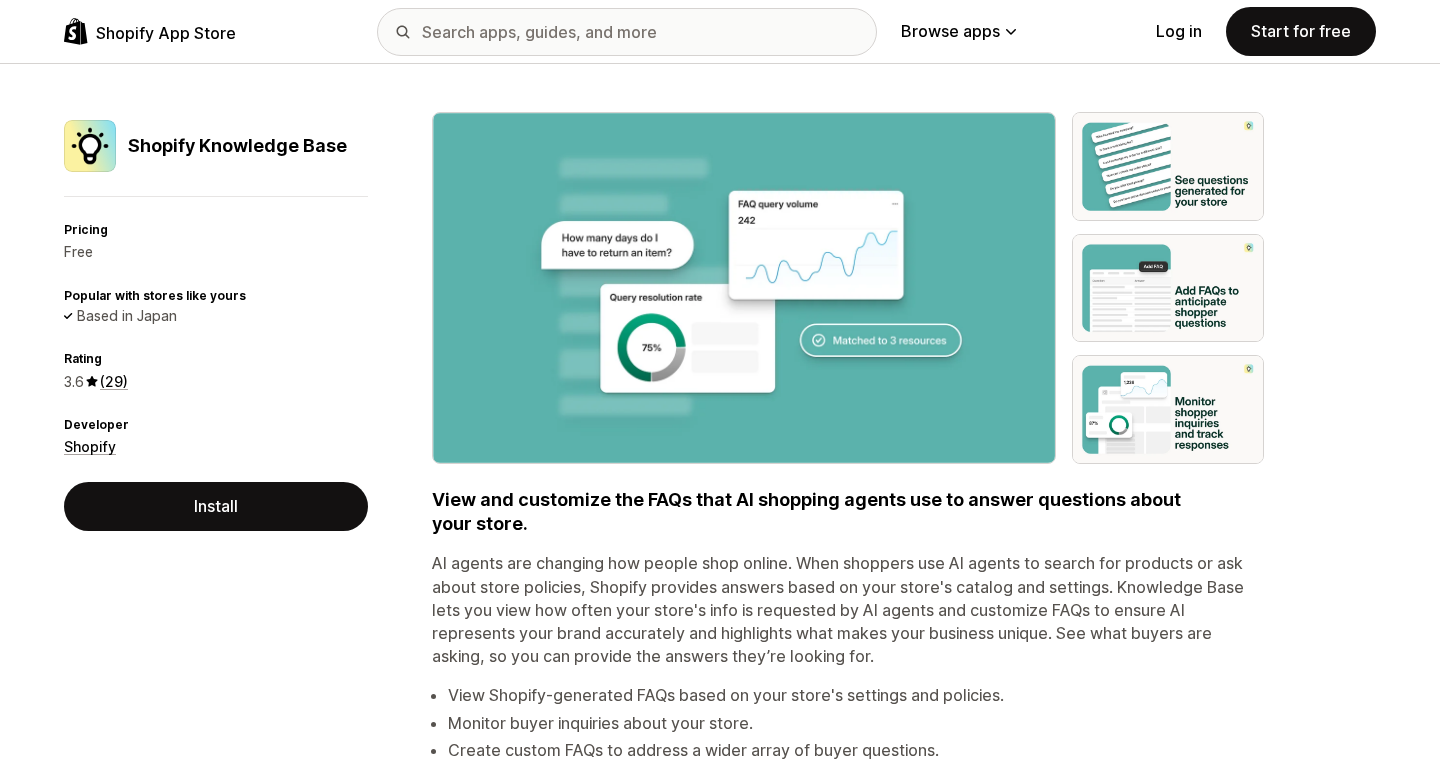
Source: Shopify App Store (Shopify Knowledge Base), retrieved September 13, 2026
Four live stores, one question
You can check any store's answers from outside. On September 13, 2026 we called search_shop_policies_and_faqs without authentication on four active US stores, asking about return policy and shipping destinations.
allbirds.com returned three question-and-answer pairs. Shipping destinations: US. Returns: accepted, within 31 days of delivery, no restocking fee, customer pays return shipping.
brooklinen.com, us.kotn.com, and www.deathwishcoffee.com each returned exactly one thing about returns:
Customers must contact the merchant to request a return.
Re-asking with a narrower question — return policy only, how many days — changed nothing. No window, no restocking fee, no answer about who pays return shipping. The agent does not have that information to give.
The difference is not whether these stores have a refund policy page. It is whether Return rules are configured in Shopify. That is one of the four sources Shopify's help documentation lists for FAQ generation, and every field in the Allbirds answer — thirty-one days, no restocking fee, customer pays shipping — maps to a setting by name.
These sentences were assembled, not written
Here is the Allbirds return answer as returned, unedited:
The store accepts returns within 31 days days of delivery.
days days. The template seam is visible in production. Values are being interpolated into a fixed sentence frame, and nobody is proofreading the join.
The shipping answers are blunter still. Brooklinen returns Rest of world, AU, BE, CA, CH, CZ, DE, ... — with the literal string Rest of world sitting in the same list as ISO codes. Death Wish Coffee returns roughly two hundred country codes on a single line. When a shopper asks whether you ship to Japan, an agent has to go find JP in that.
This is where a one-star review from May 13, 2026 stops being vague. Austria's epos | Apple Premium Partner reported that generated answers were inaccurate, including one claiming worldwide shipping when only two countries were actually active. If a country is enabled in a shipping zone, the generated sentence says you ship there. Whether you actually do is not part of the calculation.
Not everything comes from settings
Worth knowing before you assume the whole layer is mechanical: it isn't. Asked about materials and sustainability, the same stores returned content that exists in no settings screen.
Allbirds came back with merino wool, eucalyptus tree fiber (TENCEL Lyocell), sugarcane-based SweetFoam, and ZQ Merino and FSC certifications. Brooklinen listed STANDARD 100 by OEKO-TEX, DOWNMARK, and Global Recycled Standard certified fill. Both are brand-specific, extracted from store content.
So this layer mixes two kinds of generation: sentences composed from settings, and sentences generated from your content. Errors of the first kind disappear when you fix the setting. Errors of the second kind are harder to trace to a source — which is what that same reviewer meant in complaining that the brands they sell weren't being pulled from their product listings.
When nothing matches, you get nothing. Asked about gift wrapping and handwritten notes, Death Wish Coffee returned an empty array. Allbirds returned "Gift cards available," which does not answer the question that was asked.
What you can fix and what you're stuck with
| Action | Possible |
|---|---|
| View auto-generated FAQs | Yes |
| Override the answer on an auto-generated FAQ | Yes |
| Revert an override back to default | Yes |
| Edit the question text of an auto-generated FAQ | No |
| Delete an auto-generated FAQ | No |
| Edit or delete a manually created FAQ | Yes (deletion is permanent) |
| Add answers to top unanswered questions | Yes |
| Send a test question and see which source it matches | Yes |
The deletion limit is explicit in Shopify's documentation: "You can't delete an automatically generated FAQ." To change what it says, fix the source setting or override the answer.
Language is constrained too. Shopify states that the app's interface is English, and that while you can create custom FAQs in your storefront's primary language, the same FAQ cannot be stored in multiple languages within a single store. A June 5, 2026 review from KARGA in Brazil reports both halves of the problem: generated questions arrive in English regardless of the store's default language, and the question text cannot be edited. The App Store listing shows one supported language: English.
Everything you create or override is stored as a metaobject, editable in the Shopify admin under Content > Metaobjects — which is why the app's permissions include editing custom data.
The free one and the paid ones sell different things
Conflating these three layers is how merchants end up paying for something they already have, or buying something that solves a different problem.
| Shopify Knowledge Base | Trusted Help Center & FAQ | Kedra AI Index: AEO Visibility | AI Knowledge Base & FAQ Docs | |
|---|---|---|---|---|
| Developer | Shopify | Trusted apps | Kedra Apps | EPSI VENTURES LTD |
| Job | Edit the FAQ layer agents read | Publish an FAQ page for humans | Measure and improve AI visibility | Chat responses plus FAQ generation |
| Appears on storefront | No | Yes | No | In chat and FAQ |
| Pricing | Free | Free / $4.99 per month / $49.99 per year / $79 one-time (3-day trial on paid plans) | Free | Free / $14.99 / $39.99 / $149.99 per month |
| Metered on | Nothing | Flat plan | Nothing | AI replies ($0.020–$0.05 per extra reply) |
| Rating (reviews) | 3.6 (29) | 5.0 (90) | 4.9 (47) | No rating (0) |
| Built for Shopify | No | Yes | Yes | No |
| Launched | May 16, 2025 | January 25, 2021 | April 27, 2026 | August 8, 2025 |
Three ways to read that table.
If you need an FAQ page on your storefront, Knowledge Base cannot deliver it. Nothing it holds renders anywhere. Trusted Help Center & FAQ is the other category — a free tier gives you an FAQ on its own URL. The reverse also holds: installing an FAQ app does not change what the agent reads.
If you want to be surfaced more often, this is the wrong tool, and Shopify says as much. Kedra AI Index: AEO Visibility works that side, generating agents.md and llms.txt, tracking AI-referred visits, and monitoring prompt rankings. Before paying for llms.txt generation anywhere, confirm what Shopify already serves automatically and what Google has said it does with that file.
Apps that sell "FAQs for AI" are competing with a free first-party app. AI Knowledge Base & FAQ Docs gives 20 AI replies free, then $14.99, $39.99, or $149.99 per month on reply volume. It launched August 8, 2025 and has no reviews yet. Whether anything belongs on top of the free layer is a question you can answer after reading your own query log.
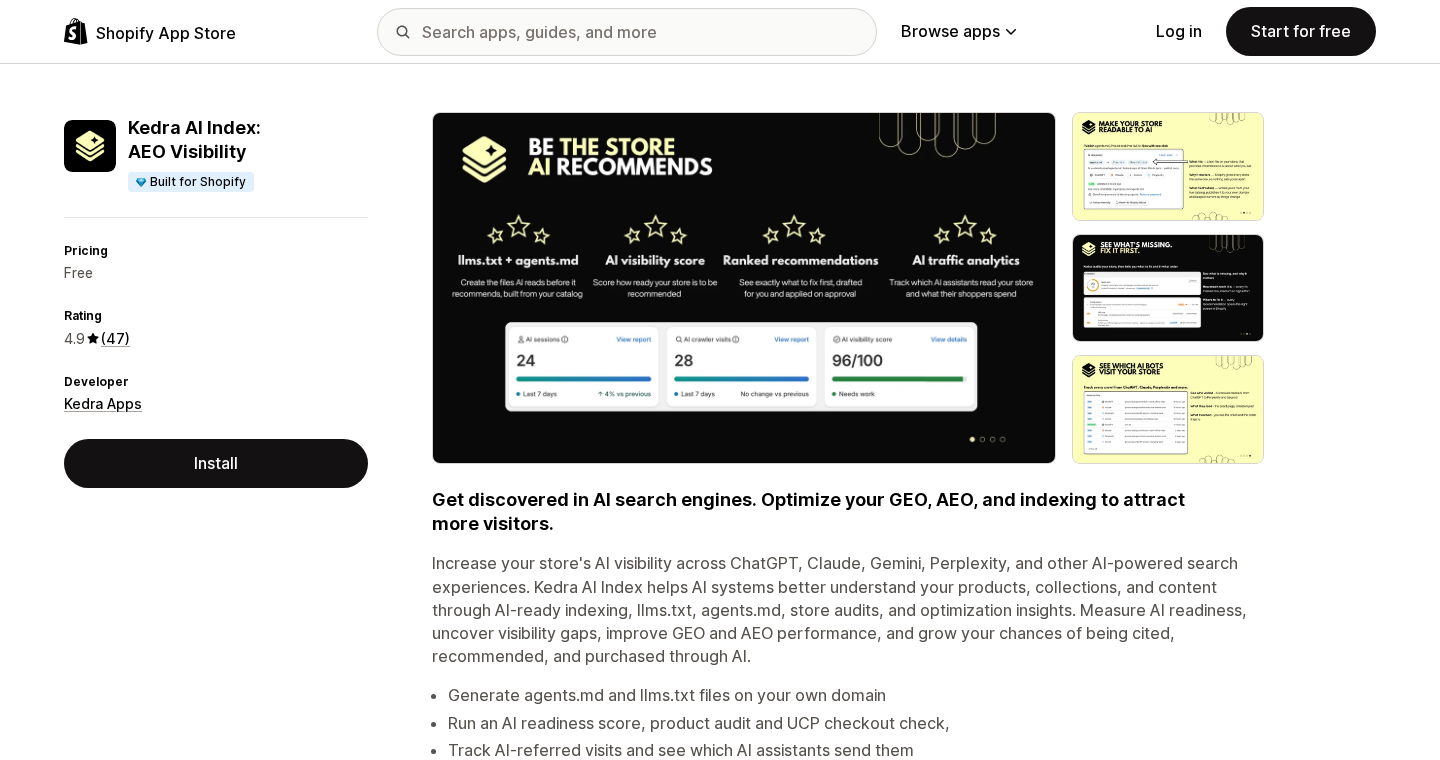
Source: Shopify App Store (Kedra AI Index: AEO Visibility), retrieved September 13, 2026
What to do this week, in order
1. Call your own endpoint and read what comes back. No authentication, no install. You will know what agents currently hold about you before you decide anything.
2. Configure Return rules. This is why three of four stores had nothing to say about returns. Rewriting your refund policy page will not change this layer.
3. Match your shipping zones to where you actually ship. An enabled country becomes a sentence saying you ship there.
4. Install Knowledge Base and read the query log. Which questions arrive, and which ones come back unanswered. This category of demand data did not exist eighteen months ago.
5. Write custom FAQs against the top unanswered questions. Shopify asks for one to two sentences. It is not a place for long copy.
6. Use test questions to see which source a query matches. No match shows as Unanswered.
7. Read every generated FAQ and override the ones that are wrong. You cannot delete them. Left alone, they are the answer your shoppers receive.
What this article could not verify
The app's admin screens require an install, so every capability listed above comes from Shopify's help documentation rather than from our own use of the interface.
We cannot tell from outside whether the four stores we queried have the Knowledge Base app installed, or whether any answer we received had been overridden rather than left at its generated default.
The documentation also lists get_cart and update_cart as standard tools on that endpoint, but tools/list at all four stores returned only search_shop_policies_and_faqs. Shopify notes that "Some stores may restrict access," so we treat this as store-level variation rather than a documentation error.
Twenty-nine reviews is a small base, and the three currently displayed report 33 minutes, about 6 hours, and about 13 hours of use. Expect that distribution to reflect first-run impressions heavily.
What is certain: this layer is generated from your settings, it is readable from outside right now, and when it is wrong, nothing in the pipeline corrects it before it reaches a shopper.
Sources
- Shopify Knowledge Base — Shopify Help Center
- Managing your store FAQs using the Shopify Knowledge Base app — Shopify Help Center
- Understanding your store FAQ metrics using the Shopify Knowledge Base app — Shopify Help Center
- Storefront MCP server — shopify.dev
- About Storefront MCP — shopify.dev
- Live
tools/listandsearch_shop_policies_and_faqsresponses from the/api/mcpendpoints of allbirds.com, brooklinen.com, us.kotn.com, and www.deathwishcoffee.com, retrieved September 13, 2026 - Shopify App Store listings for Shopify Knowledge Base, Trusted Help Center & FAQ, Kedra AI Index: AEO Visibility, and AI Knowledge Base & FAQ Docs, all retrieved September 13, 2026
OpenAI's September 2025 Instant Checkout launch promised Shopify's 1M+ merchants native in-chat purchases. By March 2026 that plan was scaled back for ChatGPT specifically. Shopify's current Help Center documentation confirms ChatGPT is discovery-only with a redirect to your own checkout, while Google AI Mode and Gemini, Microsoft Copilot, and Meta got real Shopify-powered direct checkout instead — and none of your GA4 or Meta pixels fire when a customer buys there. Researched from Shopify Help Center and official sources, September 4, 2026.