
What you will learn
On this pageContentsCloseOpen
A competitor drops their price on your best seller. You find out four days later from a sales report. You'd like Shopify to notice and react.
It won't, and the reason is more specific than "Shopify doesn't do pricing." Shopify does a fair amount with pricing. What it has no mechanism for is (a) seeing a price that exists outside your store, and (b) writing a new price automatically on a rule. Everything in this category exists to fill those two gaps, and knowing which of the two is actually your problem changes which tool you need — and whether you need one at all.
Flow cannot change a price
This is worth stating precisely because a lot of people assume otherwise.
We went through Shopify's published first-party Flow action reference in full. There is Add product tags, Update product status, Update product variant metafield, Publish product variant, Delete product variant, and about a hundred others. There is no Update price, no Update variant price, nothing that writes to the price field. (Installed apps can contribute their own Flow actions, so a pricing app could supply one — but Shopify itself provides none.)
The official workaround is Flow's two escape hatches: Send Admin API request and Run code. Shopify's own documentation says the Send Admin API request action lets you use most mutations, including ones that don't have a dedicated Flow action yet. In practice that means writing productVariantsBulkUpdate GraphQL yourself. Possible, but it is engineering work, not automation-builder work.
Two related confusions worth clearing up while we're here.
Shopify Functions don't do this either. Discount functions apply discounts at cart and checkout. They do not rewrite ProductVariant.price. "I'll build dynamic pricing with Functions" is the most common wrong turn in this topic — you'd be building a discount, not a price.
There is no scheduled price change. You can schedule a product's publish date. There is no equivalent for the price field.
What Shopify does do, natively and for free
More than most people expect, which is why the honest version of this article isn't a listicle.
Bulk editor. Select products, hit Bulk edit, add the Price and Compare at price columns, and edit like a spreadsheet — with a fill handle, range selection, and non-contiguous cell selection. For a few hundred SKUs updated weekly, this is genuinely sufficient. Shopify's own help page notes Microsoft Edge can hit URL-length errors here and recommends Chrome, Firefox, or Safari.
CSV import/export for larger catalogs.
Markets catalogs give you percentage price adjustments per catalog, fixed per-product prices that override the percentage, and catalog CSV import/export.
B2B catalogs give you fixed or percentage price lists assigned to companies and locations — capped at three active catalogs on Basic, Grow, and Advanced, unlimited on Shopify Plus.
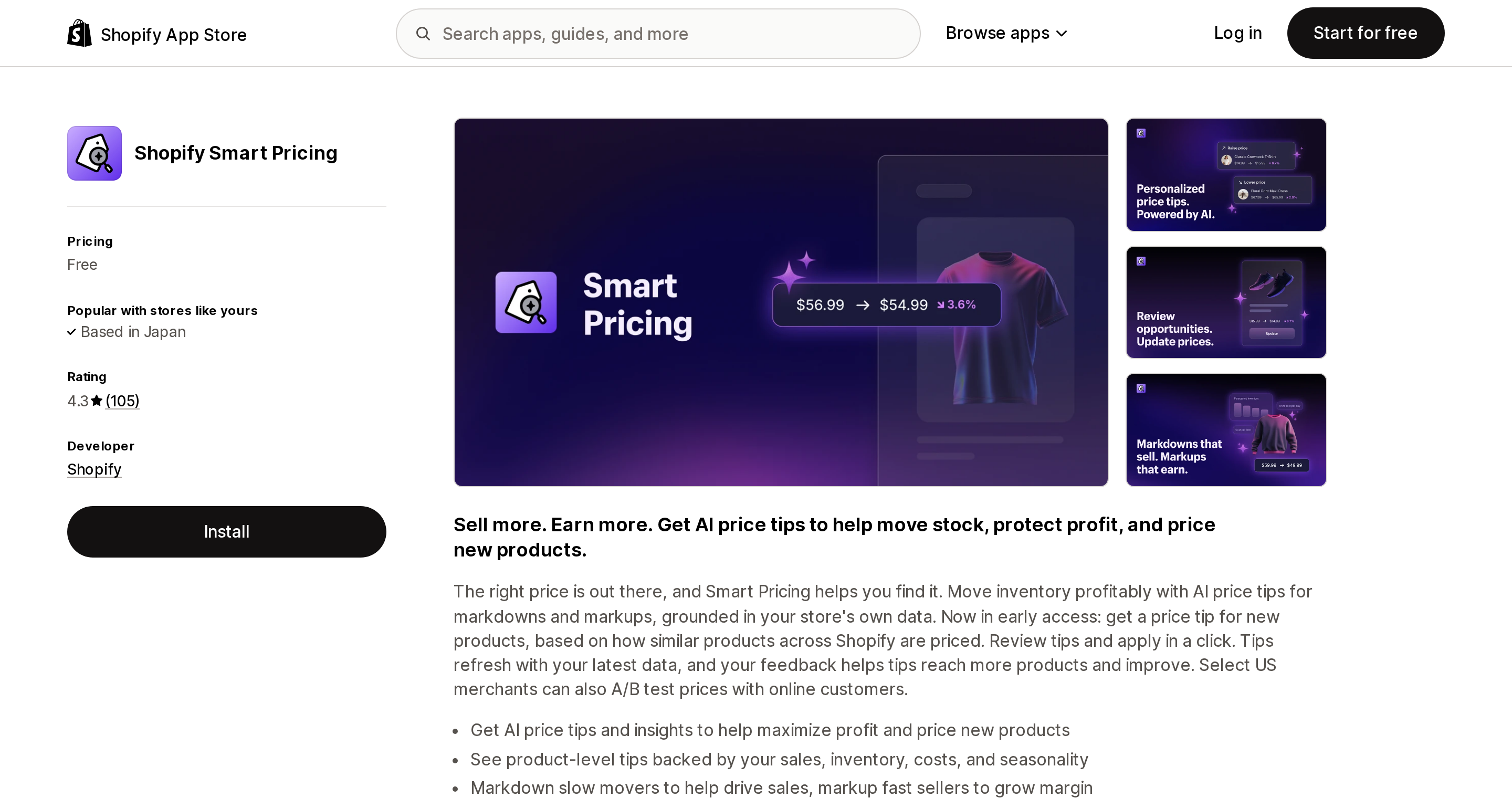
Shopify Smart Pricing, launched June 2025, developed by Shopify, free. This is the one most articles in this category don't mention at all, and it changes the shape of the decision.
Source: Shopify App Store (Shopify Smart Pricing), retrieved September 2, 2026
Smart Pricing generates weekly markdown and markup tips from your own sales, inventory, cost, and seasonality data. For products added in the last 30 days it suggests a price based on public prices of similar products across Shopify. Selected US merchants can also A/B test prices.
What it explicitly does not do is the important part. Shopify's documentation states: "The Smart Pricing app doesn't adjust your product prices in real time for customers based on demand," and, flatly, "There's no direct benchmarking against other brands or products." Only one price tip is generated per product, regardless of variants. And "any pricing changes are applied by you, so you remain in control of your product prices at all times."
So Smart Pricing is not a competitor repricer. It is a free first-party tool answering a different question — am I leaving margin on the table on my own catalog? — and for a brand selling its own products, that is very likely the right question.
It's rated 4.3 across 105 reviews, the lowest score in this whole comparison, and the negative reviews are unusually productive. One merchant complained of "markups that would shut down a brick and mortar small business in record time." Shopify's public reply both explained the cause — the model currently uses cost per item as its margin buffer, so overhead isn't in the picture — and conceded the point: "This is a fair critique... We're actively working on a solution to let merchants set their own minimum markup or margin target." A US merchant pointed out that the inventory signal counts print-on-demand and Shopify Collective stock; Shopify agreed that "POD and Shopify Collective products won't fit well there when that stock isn't really yours to move." First-party vendors conceding limitations in public is rare and worth reading before you install.
Read the scopes to see what an app will actually do
Here's a trick that saves an install. On any App Store listing, the Data access section tells you whether an app can change your prices, regardless of what the marketing copy claims.
Snoopie: Price Tracking requests View products and View Online Store: Theme — read only. It is structurally incapable of writing a price back, and that's a design choice, not a defect.
Prisync AI | Dynamic Pricing requests Edit products: Inventory, products, collections and Edit other data: Shopify Markets settings. It writes.
Three of the apps below don't display a Data access section on their listing at all, which means you can't check before installing. Worth knowing.
Five apps, and what they really cost
All figures from the en-US listings on September 2, 2026. Ratings and review counts in this category disagree between the detail page and the reviews page on the same day — the numbers below are from the detail pages.
None of these five carries a Built for Shopify badge. Review bases are small: the largest is around 209, against four figures in more mature categories. This is a thin market, and pretending otherwise would be dishonest.
| Prisync AI | Dynamic Pricing | AI Dynamic Pricing by Intelis | Pricefy | A.I. Dynamic Pricing | PriceMole | AI Dynamic Pricing | Snoopie: Price Tracking | |
|---|---|---|---|---|---|
| Developer | Prisync (TR) | Intelis (GB) | Pricefy (GB) | PriceMole (CA) | snoopie (US) |
| Writes price back | Yes | Yes | Only on Pro $99 and Business $189 | Yes | No, read-only |
| Entry price | $49/month | $49/month | Free, then $49/month | $49/month | Free |
| Free plan | No | No | 50 SKUs, 3 competitors | No | 1 alert, 3 emails |
| Free trial | 14-day | 14-day | n/a | 14-day | n/a |
| Annual discount | Not stated | 17% | 25% | Not stated | n/a |
| Metering unit | Products / Variants | Products / Variants | SKUs | Tracked products + channel connections | Alerts |
| Top tier | 5,000 @ $399 | 5,000 @ $399 | 15,000 @ $189 | 5,000 @ $399 | Not published |
| Refresh | 3x/day | Not stated | 1x–2x/day | 4x/day, all plans | "Instant" |
| US marketplaces | Amazon, Google Shopping | Google Shopping, GMC, Amazon | Google Shopping | Amazon, Walmart, eBay, Google Shopping | Competing Shopify stores |
| MAP monitoring | Marketing copy only | $399 Business only | Not a named feature | Marketing copy only | No |
| Rating (reviews) | 4.9 (209) | 4.9 (100) | 4.5 (68) | 4.8 (28) | 5.0 (8) |
| 1-star share | 1% | 1% | 13% | 7% | 0% |
Divide those by capacity and the spread is wide but not uniform. Reaching about 5,000 SKUs costs roughly $13 per 1,000 SKUs on Pricefy Business, and about $80 on Prisync Platinum, Intelis Business, and PriceMole Business alike. The gap opens at the lower end: 1,000 SKUs is roughly $50 on Pricefy Pro, $179 on Intelis Professional, and $199 on both Prisync Premium and PriceMole Professional.
That is not a recommendation to buy the cheapest. In this category price and reliability trade off against each other about as cleanly as you'll ever see, and the cheapest option has the worst review profile. Read on.
The metering trap
Prisync and Intelis both meter on "Products / Variants." If your catalog models a shirt as one product with 24 variants, you are tracking 24, not 1.
This was fought out in public. A merchant wrote in August 2025 that "the true cost is most likely 10x to 50x more expensive than the prices displayed." Prisync's founder replied that "you have a fair point with the product count & variant count distinction" and said the listing wording had been revised from "Products" to "Products / Variants." It now reads that way. Count your variants, not your products, before you compare any two plans here.
PriceMole meters on two axes at once — tracked products and channel connections: 100 products with 50 connections at $49, 1,000 with 500 at $199, 5,000 with 2,000 at $399. Watching Amazon, Walmart, and Google Shopping for the same SKU consumes connections faster than you'd guess. Its listing says there are "no extra fees for Channels," which is true, but the connection count is still capped per plan.
Prisync AI | Dynamic Pricing
Source: Shopify App Store (Prisync AI | Dynamic Pricing), retrieved September 2, 2026
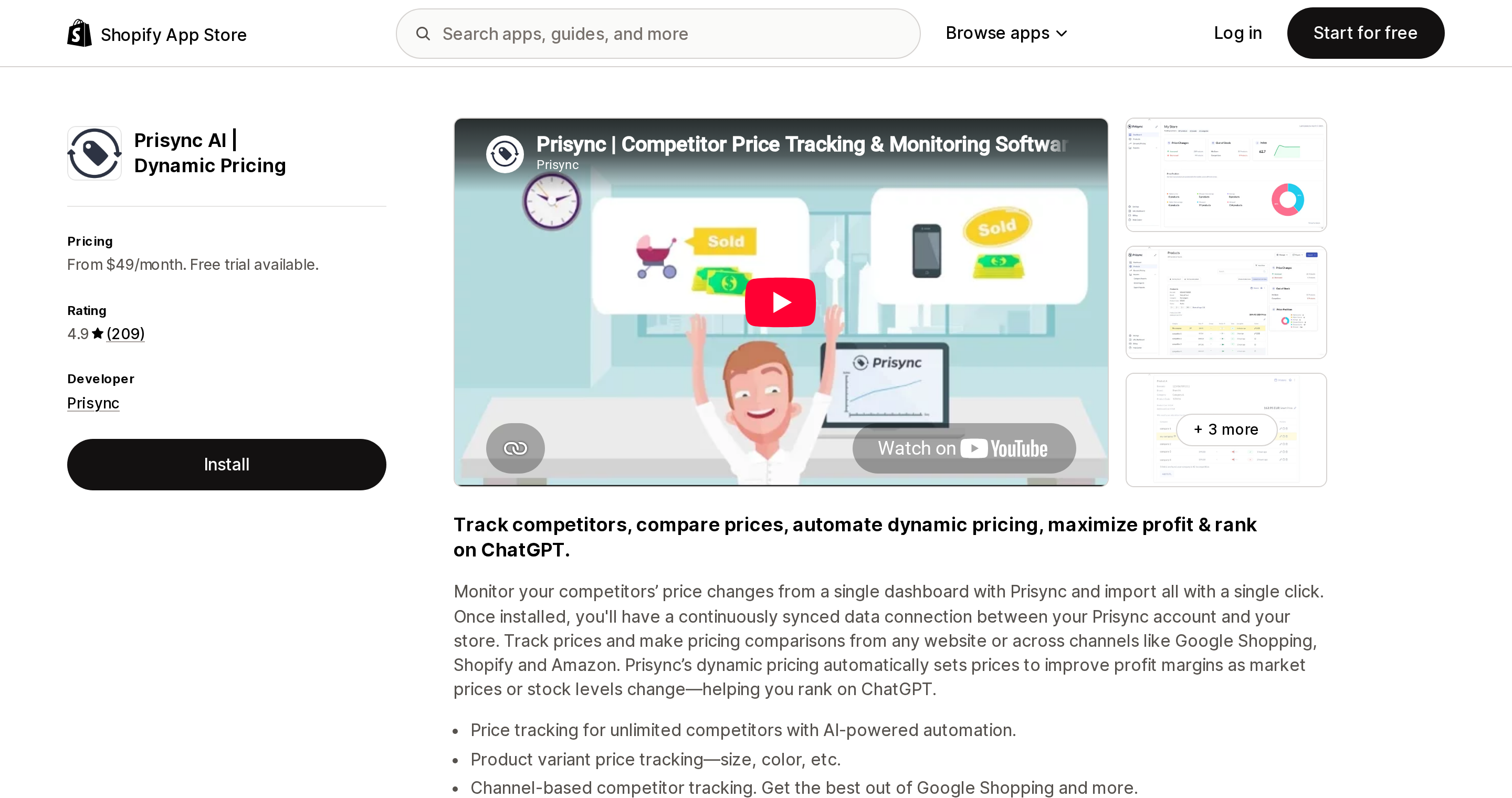
Launched June 2015, the oldest and most reviewed app here. Unlimited competitors on every plan, price and stock updates three times a day from the entry tier, and channel-based tracking free on Professional at $49/month — a feature rivals gate behind higher tiers.
The gating higher up is aggressive, though. Price history is Platinum only, at $399/month. Shopify Markets optimization is Platinum only. And on Premium and Platinum, additional channels cost $100 or $200 per month each, so the sticker price and the invoice can diverge substantially.
The most instructive review is from a Swedish merchant in August 2026 who had used the app four months. Their catalog models each flavor as a separate product rather than as variants, and Prisync couldn't recognize them as related, so prices drifted apart between them. The proposed fix was rebuilding the entire catalog around true Shopify variants, which wasn't feasible. They ended up running a hybrid — daily reports reviewed by a human — instead of the hands-off automation they'd bought. If your product families aren't modeled as variants, automated repricing may simply not work for you, and no pricing page will tell you that.
AI Dynamic Pricing by Intelis
Source: Shopify App Store (AI Dynamic Pricing by Intelis), retrieved September 2, 2026
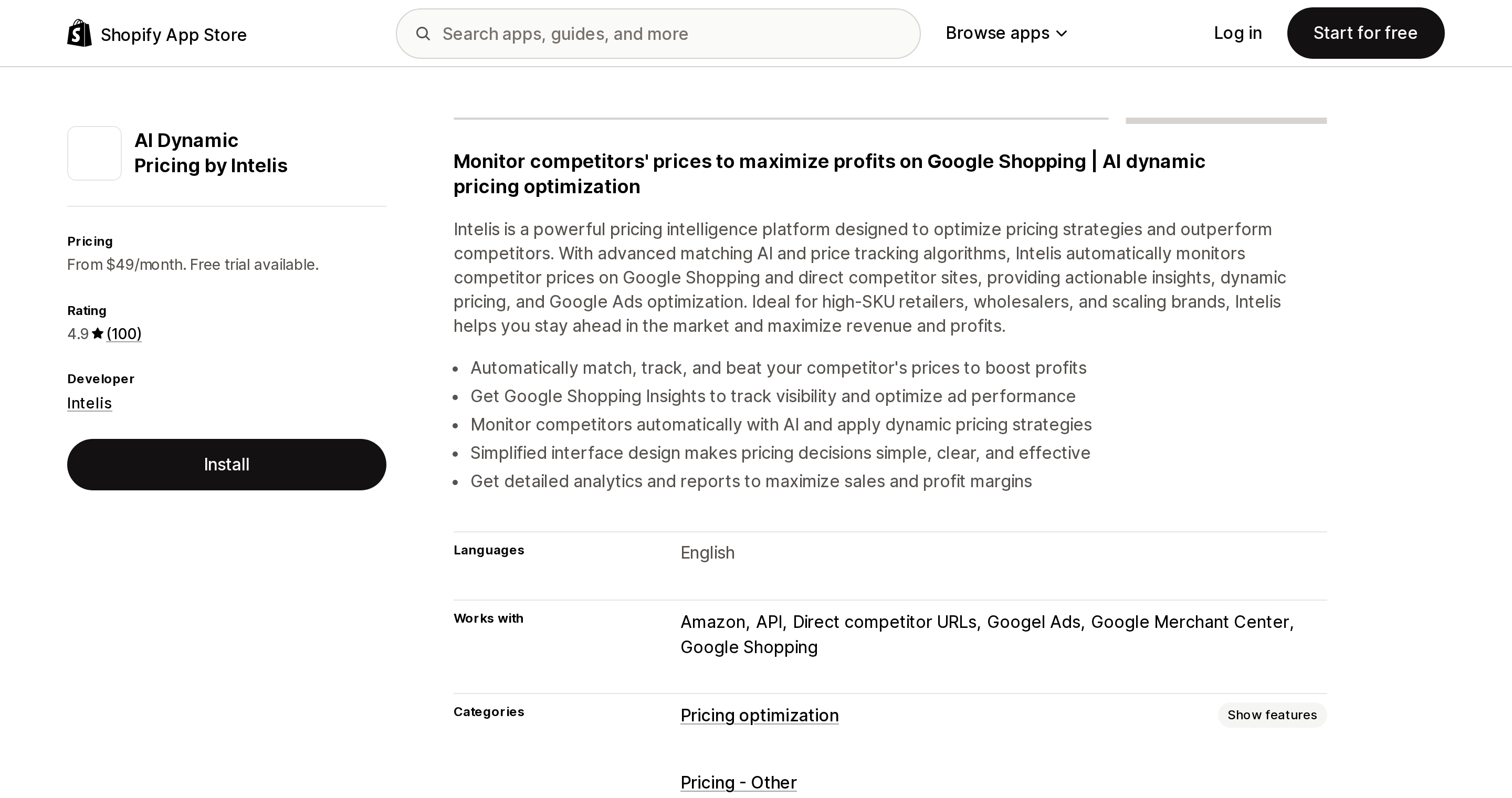
Formerly EcoPrice Analytics. Built around Google Shopping and Google Merchant Center, with Google Analytics integration from Premium at $249 and a custom labels feed for GMC on Business at $399. If Performance Max is where you're losing, this is the closest fit.
It is the only app here listing Revert pricing as a feature. For anyone nervous about handing price control to software, a documented rollback is worth more than most of the feature list.
The annual discount is 17% across all plans, which is real money at these prices. Variant tracking starts at $179 Professional, and MAP monitoring only at $399 Business — so a reseller of MAP-protected brands should budget the top tier from the start rather than discovering it later.
4.9 across 100 reviews, with 97% at five stars and roughly 1% at one star. That sounds unambiguously good until you notice how many recent reviews come from merchants who'd used the app for one, four, or eighteen days. There is very little evidence here about how it behaves over a year, and with almost no negative reviews the corpus tells you close to nothing about its limitations.
Pricefy | A.I. Dynamic Pricing
Source: Shopify App Store (Pricefy | A.I. Dynamic Pricing), retrieved September 2, 2026
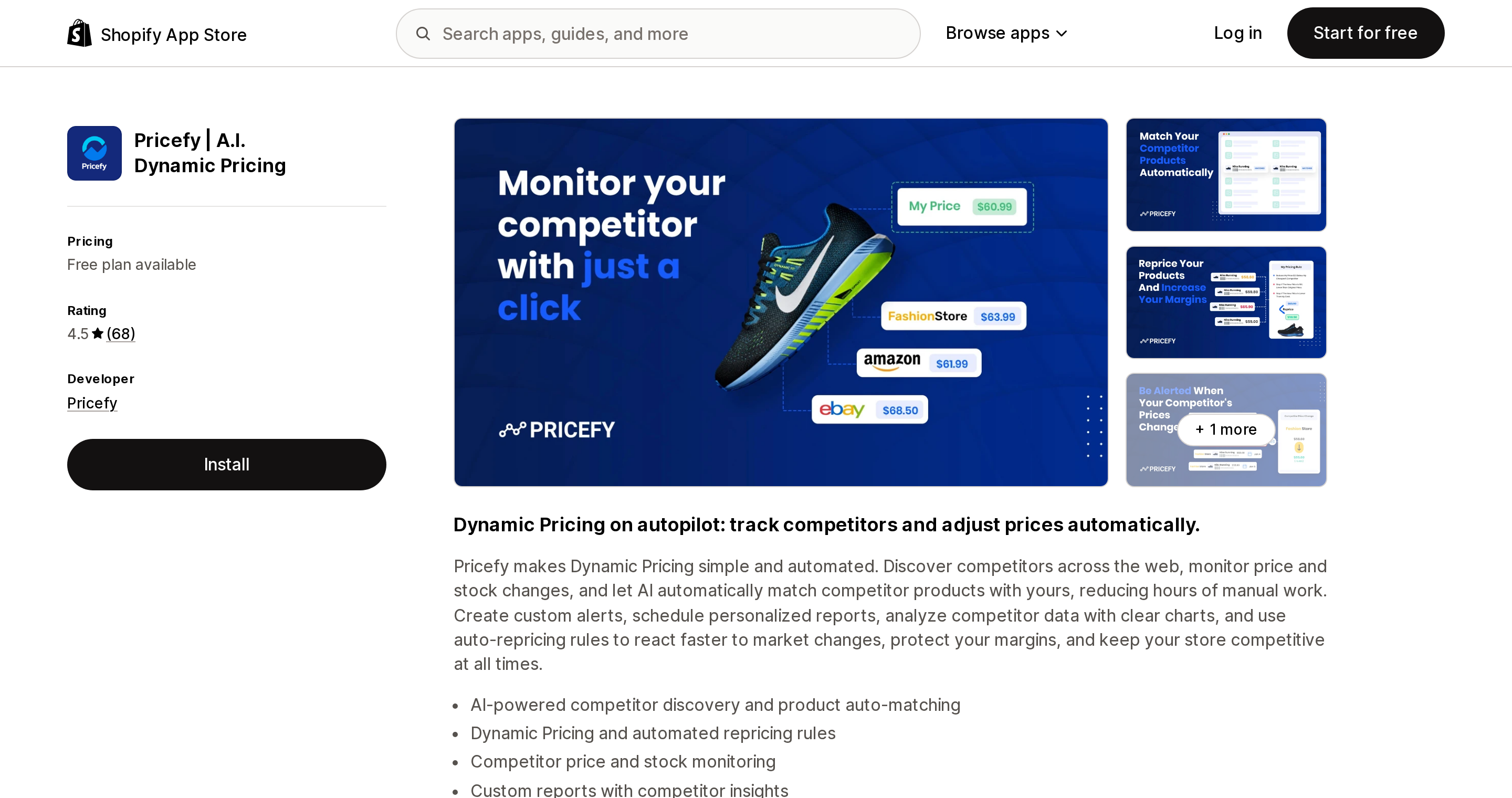
The cost outlier, and the only app here with a genuine free monitoring tier: 50 SKUs, 3 competitors, one price update a day, including competitor stock monitoring. Competitor stock-outs are the most reliable signal you'll ever get that you have room to raise a price, and getting that for free is a real offer. Annual billing saves 25%, the largest discount in the category.
Repricing is gated in an unusual way. Free and Starter are monitoring only. Pro at $99 says "Repricing." Business at $189 says "Auto-Repricing." The listing never defines the difference. Ask before you buy on that basis.
Then the caveats, and they are substantial. 13% of its reviews are one star — by far the highest here. Two failure modes recur with specifics. A UK merchant of over a year reported in April 2026 that all but 10 of the 608 URLs they tracked for a single competitor returned scraping failures, that on several competitor sites "virtually all URLs have failed," and that URLs were losing their final character and 404ing. An Australian merchant reported a GTIN mismatch that repriced a $2 product to $43,000, and a used item priced above their own new one. Support complaints appear in at least four reviews, including "there is no way to contact anyone for support," and several public developer replies carry a combative tone.
If you use this app, supervise the matches. That advice applies to the whole category, but here it is load-bearing.
PriceMole | AI Dynamic Pricing
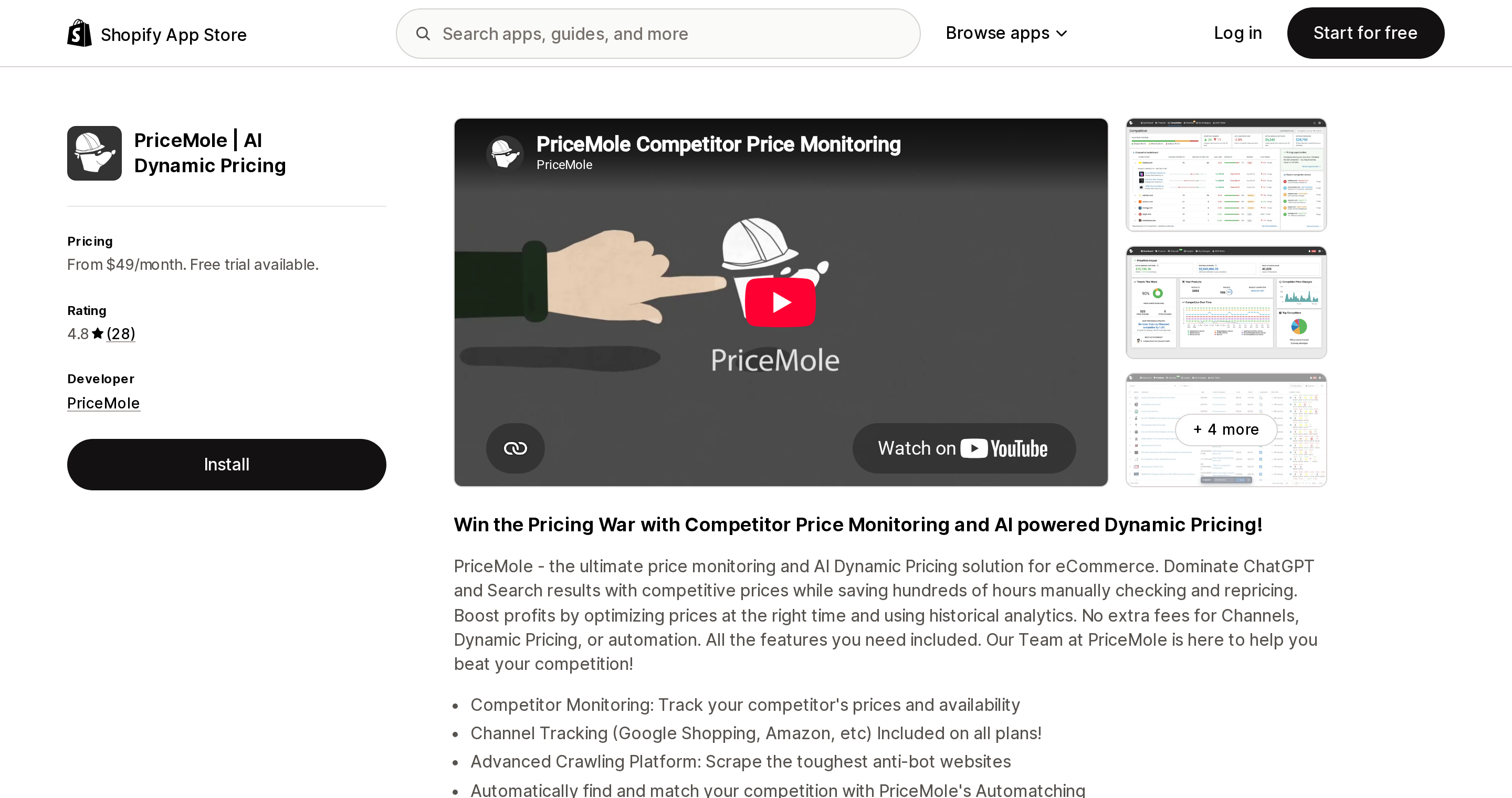
Source: Shopify App Store (PriceMole | AI Dynamic Pricing), retrieved September 2, 2026
The only app here that explicitly lists Amazon, Walmart, eBay, and Google Shopping. For a US reseller whose real competition is a Walmart Marketplace listing, that alone narrows the field to one.
It also crawls four times a day on every plan, includes channel tracking on every plan, and markets an "advanced crawling platform" to "scrape the toughest anti-bot websites." Given Pricefy's documented scraping failures, that positioning is aimed at a real problem. MAP monitoring appears in its feature bullets, but unlike Intelis it isn't attributed to a tier on the listing — so if MAP is why you're buying, confirm which plan carries it before you commit. Professional at $199 adds an embeddable storefront comparison widget, the only one of its kind here. Business at $399 adds API access and custom crawlers with login support, for wholesale portals behind a sign-in.
The mid-tier is where it gets expensive. Entry is $49, the same as Prisync and Intelis, but that buys 100 products; reaching 1,000 means $199, and 5,000 means $399 against Pricefy's 15,000 at $189. Twenty-eight reviews is a very thin base. One reviewer noted, in an otherwise positive review, that "pricing however could've been more generous, say up to 500 products at $99 would be more reasonable."
The developer is in British Columbia, which is the closest thing to US-hours support in this comparison.
Snoopie: Price Tracking
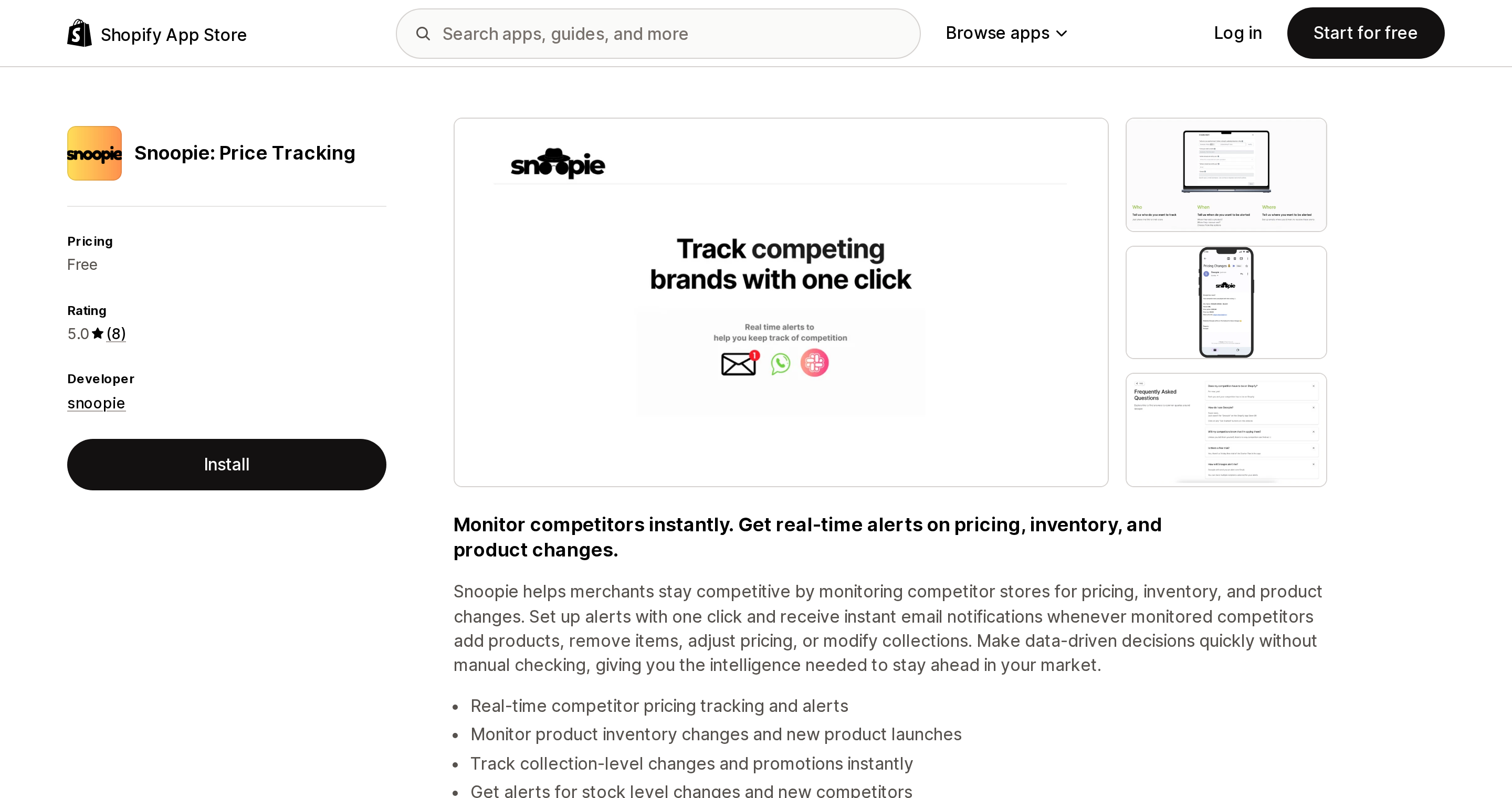
Source: Shopify App Store (Snoopie: Price Tracking), retrieved September 2, 2026
Free, US-based, read-only, and aimed at watching competing Shopify stores — price, stock, product additions and deletions, collection changes. Because it can't write, it's the zero-risk way to find out whether competitor price movement is even a real problem for you before spending $49 to $399 a month to react to it.
The free tier is small: one alert, three email notifications. There is no paid plan on the App Store listing at all — the "see all pricing options" link sends you to the vendor's own site, which in turn offers a demo booking. And the listing contradicts itself: the description promises real-time competitor price tracking, while the plan's own feature list says "Makes Pricing Changes (coming soon)." An August 2026 review describes threshold price alerts working, so treat the listing text as stale rather than the feature as absent, but verify it yourself.
Two reviews are worth reading despite the tiny base. A US merchant got 40 alerts a day from five competitor stores until support set a threshold filter, dropping it to three or four — alert fatigue is real and you should plan for it. Another had matches fail because of a trailing slash on a competitor URL. URL-based matching is fragile everywhere in this category.
Eight reviews. Too few to mean anything.
MAP, and the antitrust question
If you resell branded goods, this is the part that matters more than the feature comparison.
The FTC's guidance on manufacturer-imposed requirements is clear in both directions. On MSRP: "The key word is 'suggested.' A dealer is free to set the retail price of the products it sells." And then, in the same document: "A manufacturer also may stop dealing with a retailer that does not follow its resale price policy."
So setting your own price is lawful, and losing your supplier over it is also lawful. MAP policies govern advertised price — and the moment an automated repricer drops your displayed price below MAP, that is precisely the advertised-price event the policy exists to catch. Software will do this at 3 a.m. on a rule you wrote six months ago.
Only one app here attributes MAP monitoring to a specific plan: Intelis, on Business at $399. PriceMole lists MAP monitoring among its features without naming a tier. Nobody else mentions it. If you carry MAP-protected brands, that fact alone thins this table considerably — and it's the first thing to ask a vendor in a sales call.
On algorithmic pricing more broadly, the FTC's own business blog is titled "Price fixing by algorithm is still price fixing," and states that "your algorithm can't do anything that would be illegal if done by a real person," and that "an agreement to use shared pricing recommendations, lists, calculations, or algorithms can still be unlawful even where co-conspirators retain some pricing discretion."
Read that carefully, because the operative word is agreement. The concern is competitors agreeing to feed a common algorithm, or pooling non-public pricing data. Unilaterally observing publicly posted web prices and setting your own price is a different thing. That said, this is an active enforcement area and this article is not legal advice — if you carry MAP brands or are considering a shared pricing service, that's a conversation with your own counsel, not with a blog post.
Deciding
You sell your own brand and nobody else lists your SKUs. No competitor app. There's no comparable price to scrape, so there's no signal. Install Shopify Smart Pricing instead — it's free and it reads the data you actually have.
You just want to change lots of prices, or schedule a sale. Also no competitor app. Bulk editor and CSV, or a bulk price editor app. Different category, different problem.
You want a discount at checkout. That's discounts, not pricing. Shopify's automatic discounts and discount functions handle it, and none of this applies.
You can't see competitor prices at all. That's a data problem. Start with Snoopie if your competitors are Shopify stores and you want to spend nothing, or Pricefy's free tier for 50 SKUs across any sites. Run in alert-only mode first, for at least a month. Find out how often prices actually move before you automate a reaction to it.
You can see the prices and the problem is keeping up. That's an execution problem. Under a few hundred SKUs on a weekly cadence, the bulk editor is fine and you don't need an app for the writing half at all.
You compete against Amazon, Walmart, or eBay listings. PriceMole, on marketplace coverage alone — starting at $49 for 100 products, though the jump to 1,000 is $199.
Your battleground is Google Shopping. Intelis, especially annually, and at $399 if you need MAP monitoring.
You have thousands of SKUs and a tight budget. Pricefy — with the matching accuracy and support caveats fully in mind, and a human reviewing changes.
You want the longest track record and the deepest review base. Prisync, after confirming your product families are modeled as real Shopify variants.
Whatever you pick, set the guardrails before you turn on auto-apply: a price floor, a maximum percentage change per run, an exclusion list for MAP-protected brands, and a way to revert. Only one app here advertises a revert function, so for the other four, that plan is yours to build.
Sources
- Shopify Help Center — Bulk editing
- Shopify Help Center — Product pricing
- Shopify Help Center — Smart Pricing
- Shopify Help Center — Markets catalogs
- Shopify Help Center — B2B catalogs
- Shopify Help Center — Shopify Flow actions reference
- shopify.dev — productVariantsBulkUpdate
- FTC — Manufacturer-imposed requirements
- FTC Business Blog — Price fixing by algorithm is still price fixing
- Shopify App Store listings and review pages for all six apps, en-US locale, retrieved September 2, 2026
Shopify does keep an activity log, and it is not a Shopify Plus feature. The store activity log at Settings, General is gated on permissions rather than on your plan, and it sits alongside a user management activity log, a login history, an activity log for Shopify POS, and the Timeline on each order, draft order, customer, and transfer. The problem is not absence, it is fragmentation plus four hard limits that Shopify documents in writing: a maximum of 250 results, no export, no clickable event detail, and no date range filter. Retention is counted in entries rather than days, so a store making thirty admin changes a day keeps roughly a week of history. On top of that, Shopify publishes six scenarios in which the actor column reads Shopify rather than a person, and theme edits are attributed to Online Store by design. Inventory is the exception: the adjustment history Created by column names the staff member, app, or sales channel, and the Inventory adjustment changes report goes past 180 days and exports. This article maps the native logs, then compares seven Shopify audit log and change history apps checked on September 3, 2026 on price, metering, stated retention, scope, revert, export, and data access, including the finding that no app in this comparison reliably resolves the staff actor for every field.