
What you will learn
On this pageContentsCloseOpen
When a chargeback notification hits the admin, most merchants' first instinct is to go find an app to fight it. But Shopify's Help Center says something that gets overlooked:
Shopify automatically collects evidence and sends it to the credit card company on the due date.
In other words, if you're on Shopify Payments, you don't have to install anything or click anything. Shopify will assemble what it already has — order details, shipping and tracking data, billing address — and respond on your behalf by the deadline. For "product not received" disputes specifically, it goes a step further: Shopify now attaches AI-generated insights to the evidence automatically.
This article checks, against primary sources, exactly how far Shopify Payments' native dispute-handling flow actually goes and where it runs thin. Then it compares 5 real apps that promise better evidence and higher win rates, using their pricing structure as the organizing lens. Researched September 4, 2026.
The short version
Shopify Payments submits evidence for you even if you do nothing. It automatically compiles product details, shipping carrier and tracking, fulfillment date, shipping/billing address, order date, and the customer's IP address and country, then sends this to the card company by the due date. This baseline is free and applies to every store on Shopify Payments.
For "product not received" disputes, AI-generated insights are attached to the evidence automatically (you can opt out). This is a relatively new feature, and the fact that Shopify has already built AI into its native dispute flow is easy to miss.
Winning a dispute does not lower your chargeback rate. Shopify's own FAQ states plainly: "A dispute that's resolved in your favor still counts toward your overall dispute rate. The dispute rate is based on the number of disputes filed, not the outcomes." That means an app that helps you win money back does nothing to reduce your exposure to Visa or Mastercard's monitoring programs.
Visa tightened its monitoring threshold in April 2026. Under VAMP (the Visa Acquirer Monitoring Program), the merchant-level "Excessive" ratio for the US, Canada, EU, and Asia-Pacific dropped from 220 basis points (2.20%) to 150 basis points (1.50%), with a minimum monthly count of 1,500 combined fraud-and-dispute items. If you actually want to lower your dispute rate, you need something that stops disputes before they're filed — not something that helps you win them after the fact.
The chargeback fee is $15 in the US, ¥1,300 in Japan. It's refunded if you win, and kept by the processor if you lose or accept the chargeback.
The 5 apps compared here split into three pricing models: a percentage of the amount recovered (20-25%), a flat monthly fee tied to your Shopify plan tier ($19.99-$99.99), or free. Two apps that both call themselves "chargeback dispute apps" can be charging you in completely different ways.
What Shopify Payments handles natively
Chargebacks and inquiries are different things
Shopify splits disputes into two types. A chargeback pulls the disputed amount plus a chargeback fee out of your account immediately, the moment it's filed. An inquiry doesn't take any funds during the investigation — it can escalate into a full chargeback only if it's resolved against you.
The six-step process and its deadlines
- The customer disputes the charge with their bank.
- The bank initiates a chargeback; the disputed amount and a fee are withdrawn from your account.
- Shopify notifies you with a response deadline (and shows the issuer claim, when one is available).
- You gather and submit evidence. The deadline is 7 to 21 days from when the dispute was filed.
- The credit card company reviews the case, which can take up to 75 days after you submit.
- A decision is made: you win (full amount and fee returned), partially win, or lose (you keep nothing).
Once the deadline passes, you cannot submit any further evidence under any circumstances. Shopify's documentation states there are "no exceptions."
The evidence format rules are strict
Only PDF, JPEG, or PNG files are accepted. PDFs must be PDF/A compliant, under 50 pages, and not submitted as portfolios. Each evidence file must be under 2MB, and your combined evidence can't exceed 4MB. Audio, video, and external links aren't allowed. These constraints are themselves a big part of why apps that reformat and package evidence exist at all.
AI is already part of the native flow
For "product not received" disputes, Shopify automatically includes AI-generated insights — built from both the evidence you submit and the data Shopify already has — in what gets sent to the card company. You can opt out. On top of that, Sidekick (Shopify's admin AI assistant) can explain a dispute's reason code and walk you through how to respond, right from the order page. The assumption that "you need an app to get AI help with a dispute" doesn't hold for this specific case.
Winning doesn't make your dispute rate problem go away
Shopify's admin shows two dispute-rate metrics under Analytics: a standard chargeback rate, and an NDRP-inclusive rate that also counts disputes resolved automatically through network programs. These numbers affect your account standing, reserve requirements, and eligibility for features like the Shop app — and per Shopify's own FAQ, winning a dispute doesn't remove it from either calculation. Recovering money and staying out of a card network's monitoring program are two different problems, even though apps in this category tend to market themselves as solving both.
It's also worth knowing that if your store is enrolled in a network dispute resolution program (like Visa's Rapid Dispute Resolution), some disputes are resolved automatically — funds go back to the customer before the case ever becomes a formal chargeback, and there's no evidence-submission window at all.
Chargeback fees by country
| Country/region | Fee |
|---|---|
| United States | $15 USD |
| Canada | $15 CAD or $15 USD |
| Japan | ¥1,300 JPY |
| United Kingdom | £10 GBP |
| Most EU countries | €15 EUR |
| Australia | $25 AUD |
The fee is refunded if you win. It's kept if you lose or accept the chargeback.
Comparing 5 dispute apps
All five were live on the Shopify App Store as of September 4, 2026. Pay close attention to what each one actually charges for.
| App | Developer | Rating (reviews) | Pricing model | Built for Shopify |
|---|---|---|---|---|
| Chargeflow Prevent Chargebacks | Chargeflow, Inc. | 4.6 (414) | 25% of recovered amount, plus usage-based prevention fees | Not confirmed |
| DisputeShield: Win Chargebacks | SH Tech | 0.0 (0) | 25% of recovered amount, only on a win | Not confirmed |
| ChargePay‑Chargeback AI Agent | ChargePay | 4.5 (27) | Flat monthly fee by Shopify plan, $19.99-$99.99 | Yes |
| Reclaim: Chargeback Recovery | Redo Tech, Inc. | 5.0 (18) | Free | Not confirmed |
| Disputifier: Smart Chargebacks | Disputifier | 4.6 (114) | 20% of recovered amount, plus $17-$27.50 per alert | Not confirmed |
Chargeflow Prevent Chargebacks
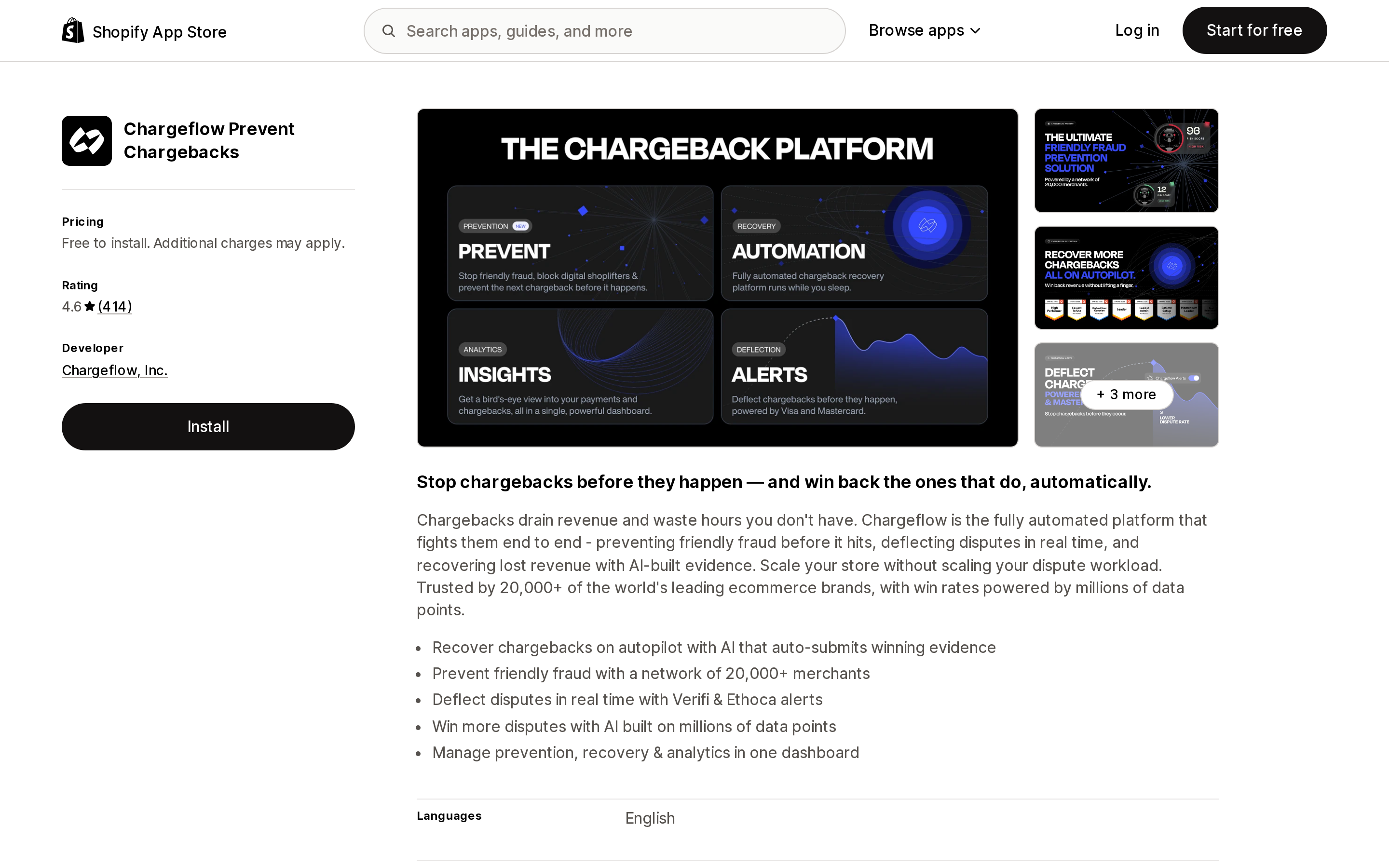
Source: Shopify App Store (Chargeflow Prevent Chargebacks), retrieved September 4, 2026
Installation is free. Pricing splits into three layers: Automation (25% of recovered chargebacks), Prevent (1,000 free, then $0.20 per order), and Alerts (usage-based, billed per prevented chargeback). It uses the Verifi and Ethoca alert networks to catch disputes before they become formal chargebacks. The listing claims 20,000+ merchants — a vendor-reported figure.
Multiple reviews raise the same theme around fee transparency. One (June 2026) describes a $100 authorization hold tied to Alerts enrollment that wasn't disclosed until late in onboarding; the developer replied acknowledging it should have been disclosed earlier. Another (May 2026, from a merchant using the app over two years) reports a win rate that dropped sharply after switching from self-managed disputes to Chargeflow, while still being charged the 25% fee — and being charged again when a case was re-disputed (pre-arbitration).
DisputeShield: Win Chargebacks
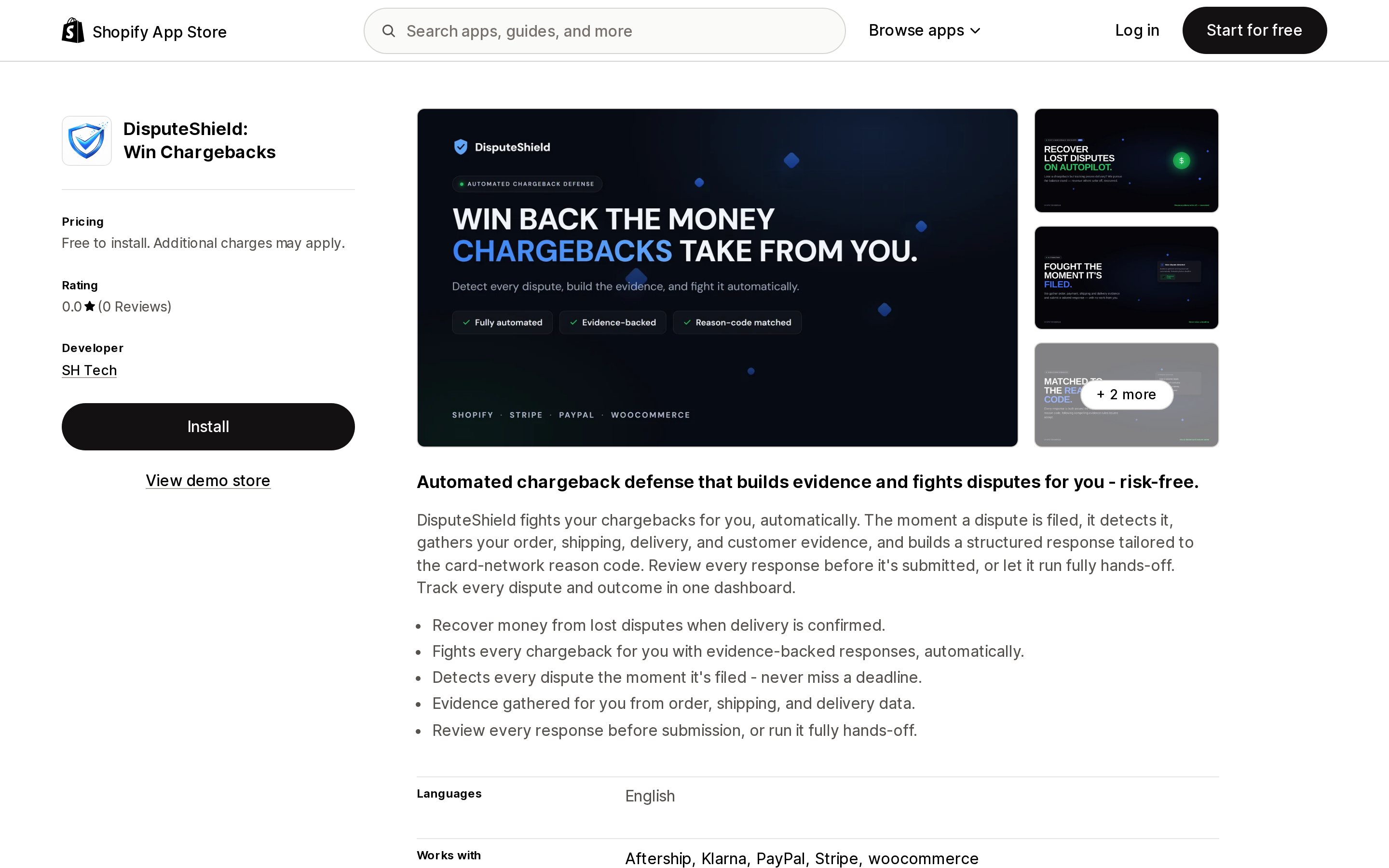
Source: Shopify App Store (DisputeShield: Win Chargebacks), retrieved September 4, 2026
Free to install, with a 25% fee charged only when the dispute is won. Launched May 18, 2026, it has zero reviews as of this writing, so its track record is unverified. The listing's "78% win rate" and "under 1 hour" response-time claims are vendor-reported. It works across Shopify, WooCommerce, PayPal, and Klarna, not exclusively Shopify.
ChargePay‑Chargeback AI Agent
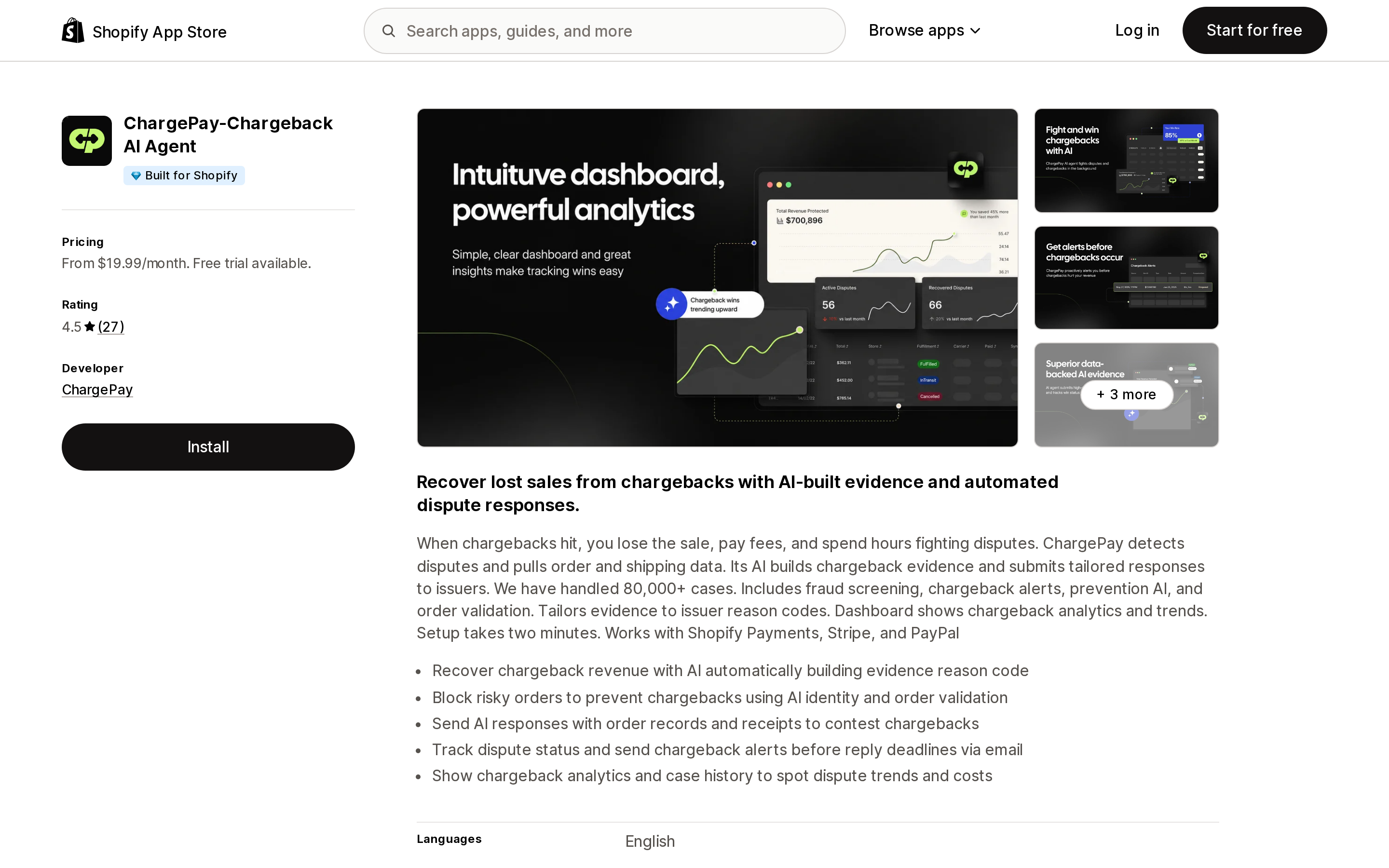
Source: Shopify App Store (ChargePay‑Chargeback AI Agent), retrieved September 4, 2026
The only one of the five carrying a Built for Shopify badge. Its pricing model is structurally different from the others: instead of a cut of what it recovers, it charges a flat monthly fee tied to your Shopify plan — $19.99/month on Basic, $39.99/month on Grow, $79.99/month on Advanced, $99.99/month on Plus (all with a 17% discount if paid annually). Every tier includes "unlimited chargebacks" and a 30-day free trial. Its "90%+ win rate" and "80,000+ cases handled" claims are vendor-reported. Its data-access disclosure explicitly lists access to Shopify Payments' own dispute-evidence objects — the same underlying data Shopify's native flow uses.
Reclaim: Chargeback Recovery
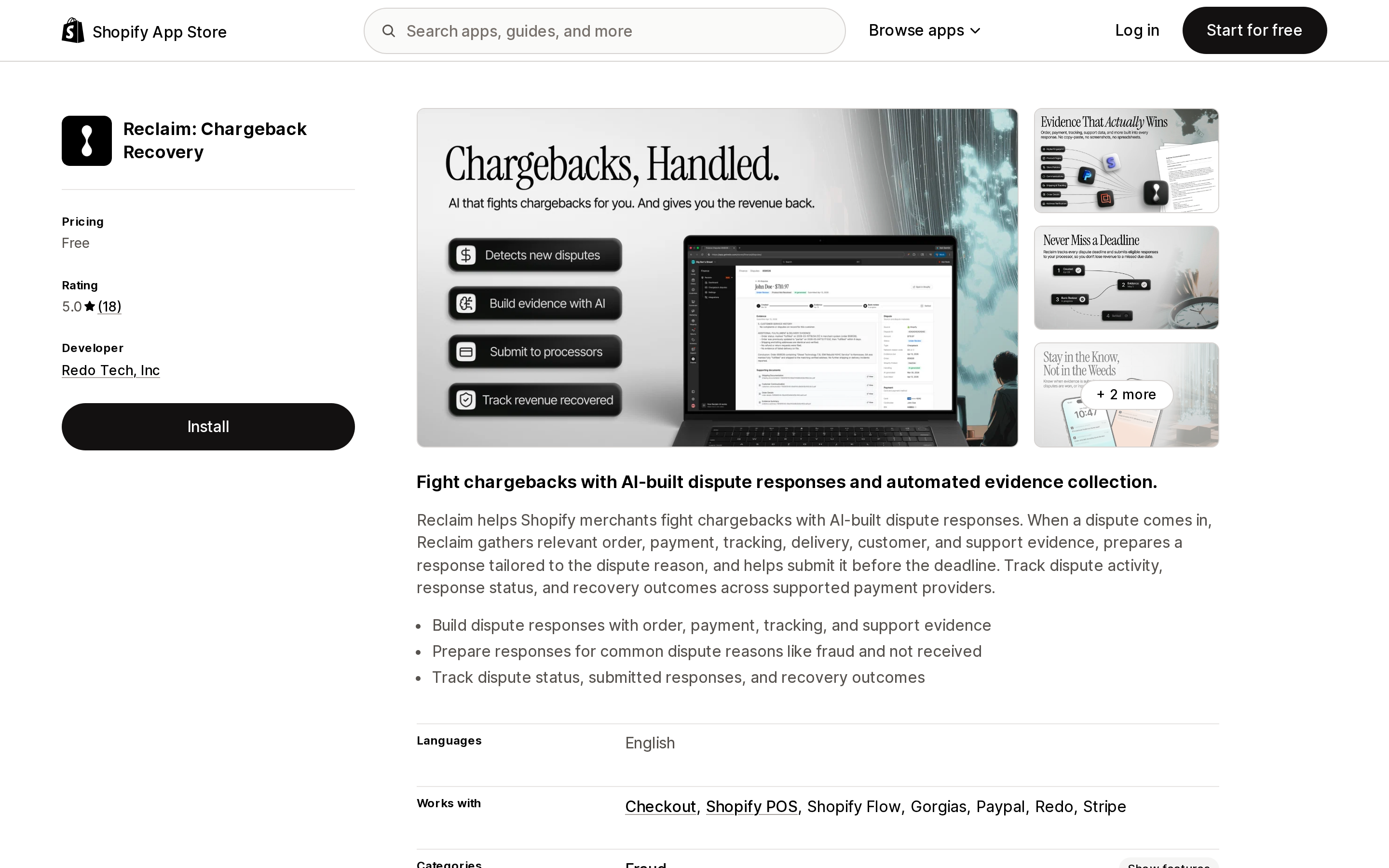
Source: Shopify App Store (Reclaim: Chargeback Recovery), retrieved September 4, 2026
Built by Redo Tech, Inc., a post-purchase platform better known for returns and warranties, as its chargeback module. Both the Shopify App Store listing and Redo's own pricing page list it simply as "Free," with no success fee or per-case charge disclosed anywhere. Of the five apps checked here, it's the only one with no visible take rate. That said, Redo runs a broader paid platform (returns, warranties, shipping, email), and how Reclaim fits into that bundle commercially isn't something the public pricing pages spell out. It automates evidence gathering from order, payment, tracking, delivery, and support history, and helps you submit before the deadline.
Disputifier: Smart Chargebacks
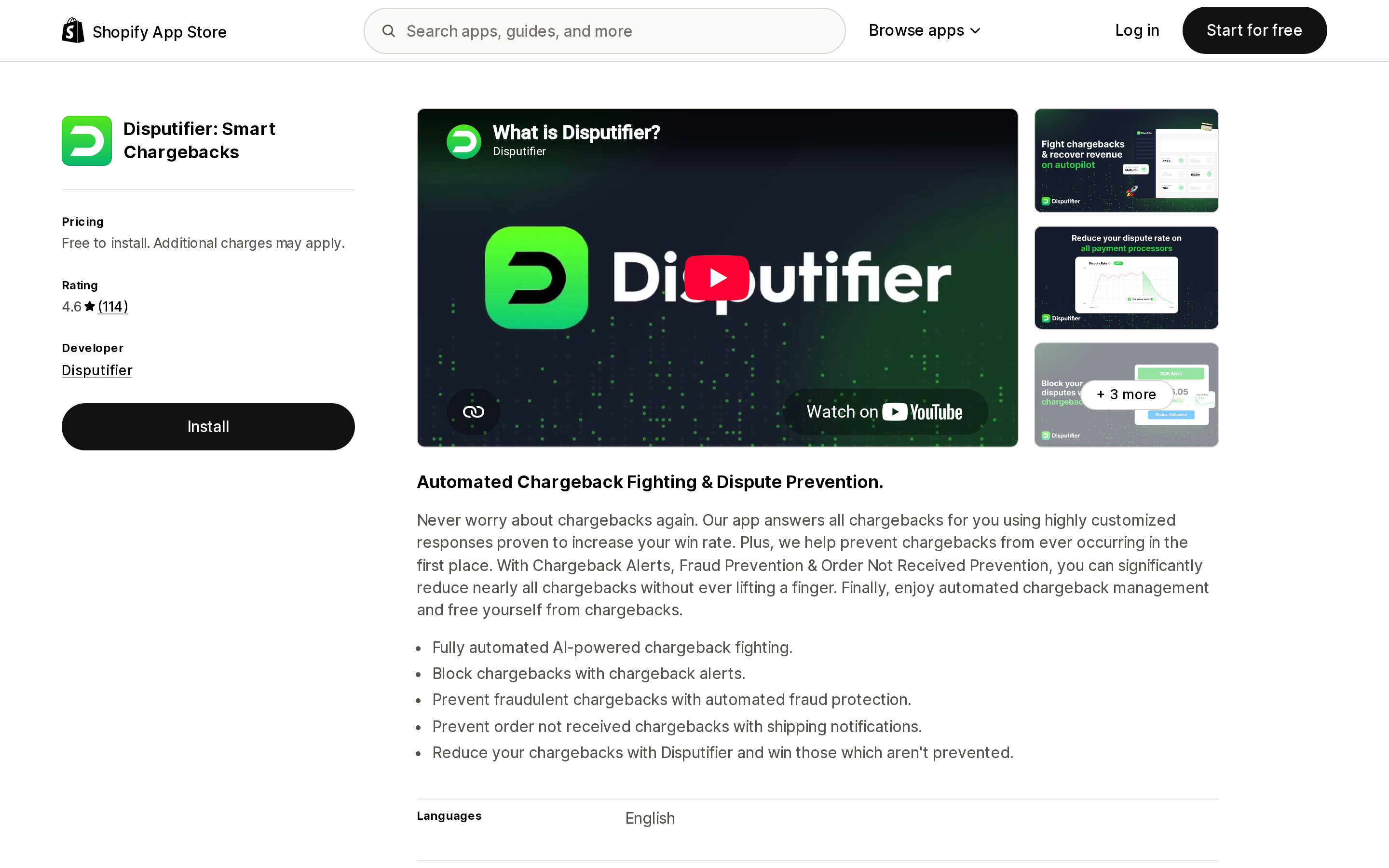
Source: Shopify App Store (Disputifier: Smart Chargebacks), retrieved September 4, 2026
Its pricing is two separate billing lines. "CB Fighting" (responding to disputes) costs 20% of the amount won back; "CB Alerts" (Verifi/Ethoca-style pre-dispute alerts) is billed separately at $17-$27.50 per alert. There's a 7-day risk-free trial.
One review (August 2026, 5 stars) describes needing to work with support to switch Ethoca/CDRN alerts from automatic refunds to manual review, after the default setting auto-refunded orders that had already been delivered — a useful reminder that automation aimed at preventing disputes can create its own unwanted side effects by default. A separate review (June 2026) describes a billing dispute following an account compromise; the developer disputes that account of events. Treat it as a contested, individual billing disagreement rather than a pattern.
How to think about which one fits
If your dispute volume is low and you're cost-sensitive, it's worth seeing how far Shopify's automatic evidence submission gets you on its own, or starting with a genuinely free option like Reclaim, before handing over 20-25% of what you recover.
If your order volume is high and disputes are predictable, a flat-fee model like ChargePay's avoids the "I did most of the work myself and still got charged 25%" complaint that shows up in Chargeflow's reviews — though you're paying that flat fee even in months with zero disputes.
If your real goal is staying under Visa's VAMP or Mastercard's ECM thresholds, recovery alone won't get you there, since winning doesn't reduce your filed-dispute count. That requires a pre-dispute deflection layer — the Alerts products from Chargeflow or Disputifier — billed and evaluated separately from their recovery fees.
Bottom line
Shopify Payments' native dispute handling is more complete than it gets credit for: automatic evidence collection and submission, AI-generated insights baked into product-not-received cases, and Sidekick explaining reason codes on the order page. Against that baseline, the five apps compared here charge in three fundamentally different ways — a cut of what they recover, a flat fee by plan tier, or nothing at all. Mixing those up is how you end up with a complaint like the ones in Chargeflow's reviews: paying a quarter of a recovered chargeback for work you feel you did yourself. And no matter which app you pick, winning a dispute by itself does nothing to lower the dispute rate that determines your exposure to Visa and Mastercard's monitoring programs — that's worth knowing before you evaluate any of these on cost.
Figures in this article were confirmed against Shopify's Help Center and live Shopify App Store listings as of September 4, 2026. Pricing, ratings, review counts, and network monitoring thresholds change over time — confirm current details before you commit.
Shopify's free link-in-bio page, Linkpop, retired on July 7, 2025 — linkpop.com now redirects to shopify.com. On August 15, 2026 Shopify's Help Center began saying the $5 Starter plan, the plan built around sharing product links on social, isn't available to new stores. And Shopify's own July 21, 2026 blog post on link-in-bio tools links to exactly two Shopify App Store listings: LinkShop, and Linktree — an app in the Marketplaces category, billed outside your Shopify invoice, rated 3.6 across 18 reviews. We priced seven link-in-bio apps on September 18, 2026. The dimension that matters isn't the monthly fee, which runs from $0 to $15. It's where the page lives: four apps serve it from your own storefront through a Shopify app proxy, which means it sits behind your store password — and on the new $0 Agentic plan, that password never comes off. Verified against the Shopify Help Center, shopify.dev, the Shopify App Store, and live store pages.