What you will learn
On this pageContentsCloseOpen
You are three tabs deep into a category, comparing two apps that do roughly the same thing, and one of them has a laurel wreath on its listing: 2026 — Build Award winner — For innovation and impact. The other one doesn't.
That is a real signal from Shopify, not vendor copy. But it answers a narrower question than it looks like it answers, and the badge sitting one line above it — Built for Shopify — works on completely different rules. One of the two is re-checked and can be taken away. The other, as far as Shopify's published documentation goes, is permanent.
Below: who actually won in 2026, what the award is judged on, why the 2025 winners still display theirs, and the one case where "Build Award winner" on a listing came from somewhere else entirely. Verified against primary sources on September 12, 2026.
The short version
Three apps won in 2026. The App Store story page, published July 22, 2026, names Discount Kit, Easyteam POS Time Clock In, and Smile: Loyalty Program Rewards. That is the complete app list. The App Store homepage puts the catalog at more than 16,000 apps.
The award has four categories and only one of them is apps. Shopify's Partners blog, same date: "This year we are recognizing excellence across four categories: apps, storefronts, merchant impact, and community." The other three went to agencies, studios, and a person. Only the app category appears in the App Store.
The marker does not expire. The four apps that won in 2025 still display a 2025 laurel wreath on their listings today, fifteen months later. Shopify's documentation describes no expiry, no re-evaluation, and no removal process for it.
Built for Shopify is the opposite. Shopify's developer documentation: "Apps are reviewed annually to ensure they continue to adhere to the Built for Shopify standards," an app "may be reviewed at any time," failures get 60 days to fix, and status is removed if they aren't. It also comes back on its own: "You'll automatically regain Built for Shopify status as soon your app meets all of the criteria again."
Shopify publishes numbers for the floor and nothing for the award. Being eligible to be featured in a story page — which is what a Build Awards page is — has published mandatory criteria: a minimum of 50 net installs from active shops on paid plans, a minimum of five reviews, a minimum recent rating, and a clean uninstall for storefront apps. Winning has none published.
There is no way to search for winners. Built for Shopify has a documented App Store search filter. The Build Award has no filter; the search facets are categories plus Checkout, Customer accounts, and Shopify POS.
What the element on the listing actually is
It renders directly beneath the Built for Shopify badge: a laurel wreath wrapped around the year, the words Build Award winner as a link, and the line For innovation and impact underneath. The link goes to that year's story page in the App Store.
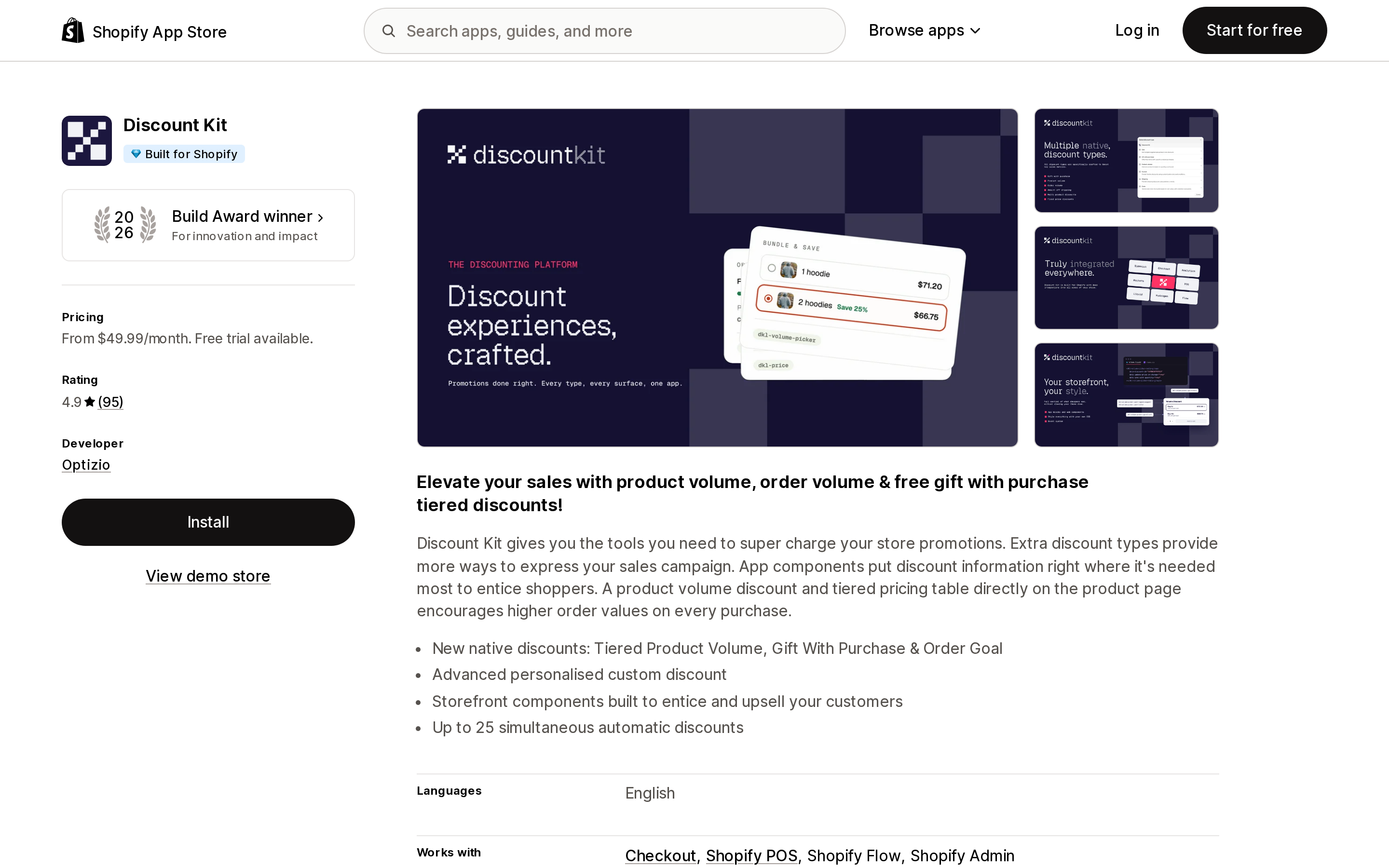
Source: Shopify App Store (Discount Kit), retrieved September 12, 2026
Two things are worth noticing in that screenshot. The first is the stacking: Built for Shopify on top, the award below it, both above the price. The second is that the award element carries a year. Read it as a timestamp, because that is what it is.
The 2026 winners, checked today
All three hold Built for Shopify as well. All three are on very different pricing models, which is the first hint that the award is not measuring the same thing across a category.
Discount Kit
Discount Kit is built by Optizio and launched October 27, 2022. It sits in the Discounts category and works with Checkout, Shopify POS, Shopify Flow, and Shopify Admin. Shopify's citation calls it "a benchmark for building with Shopify Functions," and specifically credits stacking behaviour "at peak BFCM traffic."
Pricing is Lite at $49.99/month, Pro at $99.99/month, and Enterprise at $349.99/month, with annual billing saving 17% and a 7-day free trial on every plan. The listing's own feature line caps automatic discounts at 25 — the same platform ceiling every discount app lives under.
It has 95 reviews at 4.9, with 96% of ratings at five stars and one at one star.
Easyteam POS Time Clock In
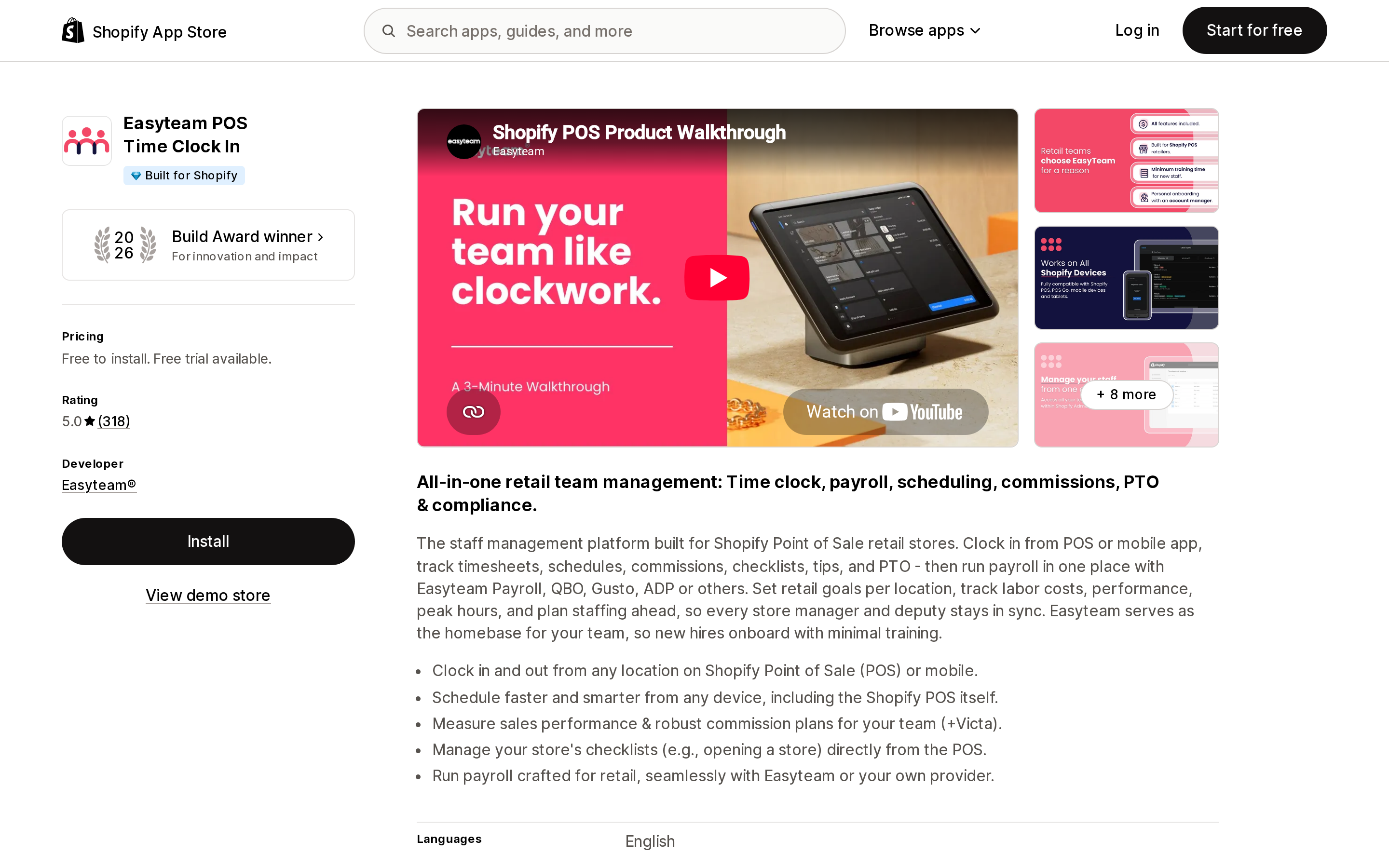
Source: Shopify App Store (Easyteam POS Time Clock In), retrieved September 12, 2026
Easyteam launched October 10, 2019 and covers time tracking, scheduling, checklists, commissions, PTO, and payroll for Shopify POS retailers. Shopify's citation is about integration depth: the app is "built to feel like part of Shopify POS rather than a bolt-on."
Pricing has a shape worth reading carefully. The Payroll US/CA Only plan is free to install and includes time tracking and basic scheduling for two locations when you run payroll through Easyteam — the payroll add-on itself is $45/month plus $6 per employee, and the plan is United States and Canada only. Easyteam Core is $30/month, described as $5/month per staff member with a $30 minimum, so the headline price is a floor rather than a flat rate. Enterprise starts at $490/month. Core and Enterprise carry a 14-day free trial.
It has 318 reviews at 5.0.
Smile: Loyalty Program Rewards
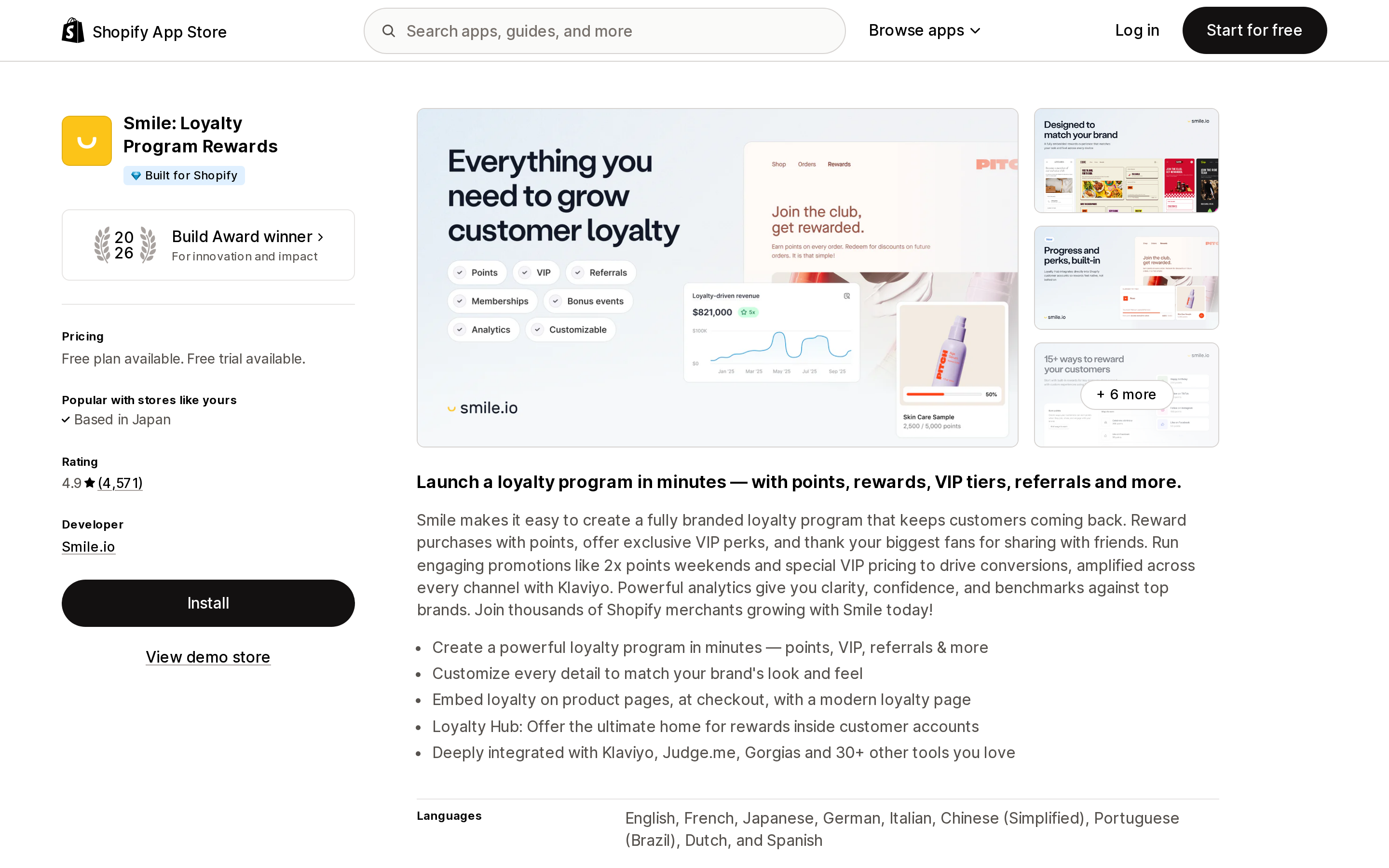
Source: Shopify App Store (Smile: Loyalty Program Rewards), retrieved September 12, 2026
Smile launched December 2, 2014 and is the oldest of the three. Shopify's citation is explicitly about it being a platform rather than an app: it "built a platform on top of Shopify's, with a public API other developers extend."
Pricing is metered on monthly orders, and the free tier has a ceiling that is easy to miss: Free, up to 200 monthly orders; Essential $15/month up to 500; Standard $79/month up to 1,000; Growth $199/month including 2,500, then $20 per additional 100 orders. Points redemption at checkout is listed under the Growth plan and requires Shopify Plus — a constraint that applies across the loyalty category, not just here. 14-day free trial on the paid plans.
It has 4,571 reviews at 4.9.
Note the spread: one winner has 95 reviews, another has 4,571. Whatever the award is measuring, install base is not the dominant variable.
The 2025 cohort, and why their wreaths are still there
The App Store publishes exactly two Build Awards story pages. guide-build-awards-2025 and guide-build-awards-2026 both resolve; the 2023, 2024, and 2027 equivalents return 404. Between them, seven apps have been named.
The 2025 page, dated June 05, 2025, is headed "Our favorite apps of 2025" and names four. Here is where all four stand today.
| App | Rating (reviews) | Built for Shopify | Pricing | Marker shown |
|---|---|---|---|---|
| Judge.me Product Reviews App | 5.0 (more than 46,800) | Yes | Forever Free $0; Awesome $15/month; 15-day trial | 2025 |
| Locksmith | 4.7 (307) | Yes | $12 / $29 / $99 / $199 per month, matched to Shopify Basic / Grow / Advanced / Plus; 15-day trial | 2025 |
| Atlas Pickup Points | 4.9 (75) | Yes | From $39/month; free trial | 2025 |
| Checkout Links | 5.0 (37) | Yes | $25/month; free trial | 2025 |
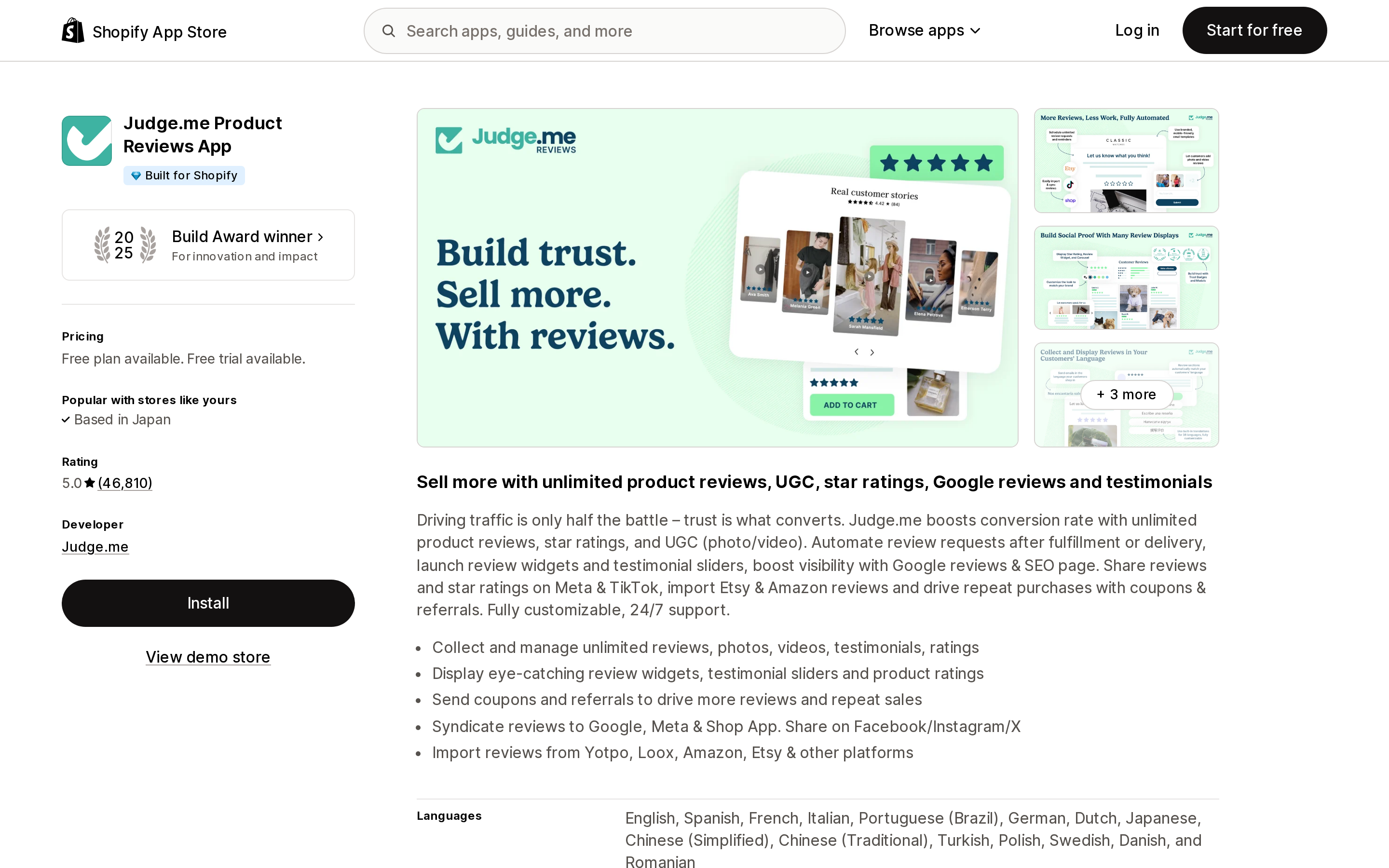
Source: Shopify App Store (Judge.me Product Reviews App), retrieved September 12, 2026
Locksmith is the interesting pricing case here: its four tiers are not feature tiers, they are matched to your Shopify plan — each one labelled "Suggested price for Shopify Basic / Grow / Advanced / Plus" — and developer Lightward attaches a "Pay what feels good" policy to all of them.
Atlas Pickup Points, meanwhile, went further than the element. Its App Store description opens with "Build Award 2025 winner – recognized for incredible user experience," which is copy the developer wrote, sitting on the same page as the Shopify-issued element. In that case both are accurate. That is not always how it works.
The third place the phrase shows up
Zapiet ‑ Pickup + Delivery — 4.9 across 1,873 reviews, Built for Shopify, plans at $49.99, $79.99 and $179.99 per month, launched February 17, 2015 — opens its App Store description with the words "Build Award Winner 2026." There is no Shopify-issued award element on that listing.
Both things are true at once, and Zapiet's own blog explains why more plainly than Shopify's does. The 2026 award went to co-founder Emili Horncastle in the Community category, at DotDev in Toronto. Zapiet's post, dated July 26, 2026: "Not apps. Not storefronts. Community." Shopify's Partners blog describes her as "the first recipient of the new community award."
So the company genuinely won a 2026 Shopify Build Award. It was not an app award, and Shopify's app-category page does not list the app. A merchant scanning listings has no way to tell those apart from description text alone — which is the practical reason to look for the element, not the phrase.
The 2026 non-app winners, for completeness: Human NYC, Commerce UI, and Unlikely in Storefronts; Elephant Room and Prosper Digital jointly in Merchant Impact, which the blog calls "the first-ever joint award"; Emili Horncastle of Zapiet in Community.
One more listing-level caution while you are checking developer names. A separate listing titled Zapiet Pickup & Delivery, by a developer called Siwon Dev team, launched June 15, 2026 and currently shows 0.0 with no reviews and no Built for Shopify badge. It is a different app from a different developer with a near-identical name. The Developer field on the listing is the fastest way to tell.
What each signal is actually promising
This is the comparison that matters when you are shortlisting.
| Built for Shopify | Build Award | |
|---|---|---|
| How it's granted | Apply from the Partner Dashboard after meeting published prerequisites | Selected by Shopify, announced annually at DotDev |
| Criteria published | Yes, itemized and largely auto-evaluated | No |
| Re-evaluated | Annually, plus "may be reviewed at any time" | Not documented |
| Can be lost | Yes, after 60 days of unresolved failure | Not documented |
| Comes back | Automatically, no reapplication | n/a |
| Searchable | Yes, documented search filter | No |
| Carries a date | No | Yes, the year is part of the element |
| How many apps | Not published | 3 in 2026, 4 in 2025 |
The automated criteria that can cost an app its Built for Shopify status are specific: clean uninstall via theme app extensions, being embedded in the Shopify admin, minimizing impact on checkout speed, meeting 75th-percentile Web Vitals targets in the admin, and minimum installs, reviews, and rating. Those are the things a merchant actually feels — an app that slows your checkout down can lose the badge for it. Nothing equivalent governs the wreath.
How to use the wreath when you're shortlisting
Read it as a dated editorial endorsement, not a certification. Shopify's own framing, from the Partners blog: "Not for the biggest company or the flashiest launch, but for the partners building what matters most to merchants." That is a judgement, made once, by people, in a named year.
Check the year first. A 2025 wreath is a June 2025 judgement about an app you are evaluating in late 2026. Everything that has happened to that app since — price changes, ownership changes, a rewrite — is outside it.
Treat Built for Shopify as the live signal. It is the one being re-checked, and it is the one that can quietly disappear from a listing between the day you bookmark an app and the day you install it.
Do not read absence as a negative. Three apps won in 2026. The overwhelming majority of good apps in any category have never been named and never will be, because the award does not scale with the catalog.
Do not read it as a price signal. Across the seven named apps, entry cost ranges from $0 (Judge.me, Smile) to $49.99/month (Discount Kit), and top published tiers reach $349.99/month and $490/month. The award says nothing about what you will pay at your order volume.
Look at the element, not the sentence. The laurel wreath with the year and the link to the story page is Shopify's. A sentence in the subtitle or description is the developer's. Both can be true; only one of them is Shopify saying it.
The honest limits of this
Shopify does not publish how many apps hold Built for Shopify, and the App Store's filtered search result count caps out rather than reporting a real total, so no number here. The minimum rating threshold for the automated criteria is described but not quantified in the documentation. And the Partners blog says the awards happen "every year at DotDev" while the App Store only hosts 2025 and 2026 pages — so 2025 is the earliest published app cohort, not necessarily the first awards ever held.
What you can rely on: seven apps carry a Shopify-issued Build Award element right now, the year on it is part of the signal, and the badge above it is the one with rules you can read.
Sources
- 2026 Shopify Build Awards — Shopify App Store, July 22, 2026
- 2025 Shopify Build Awards — Shopify App Store, June 05, 2025
- Meet the 2026 Shopify Build Award winners — Shopify Partners blog, July 22, 2026
- About Built for Shopify — shopify.dev
- Regain lost status — shopify.dev
- Built for Shopify requirements — shopify.dev
- Zapiet takes home a 2026 Shopify Build Award — Zapiet, July 26, 2026
- App Store listings for Discount Kit, Easyteam POS Time Clock In, Smile: Loyalty Program Rewards, Judge.me Product Reviews App, Locksmith, Atlas Pickup Points, Checkout Links, and Zapiet ‑ Pickup + Delivery, all retrieved September 12, 2026
Shopify added a Bin name column to the inventory CSV on August 25, 2025. It holds one bin per variant per location, it is created only by CSV import, and it prints on Order Printer pick lists. What it does not do is leave Shopify. Shopify staff confirmed on the developer forum in October 2025 and again in January 2026 that there is no public API access to the field, and the developer forum was still reporting the gap in June 2026. That single fact shapes the whole category: EasyScan and iPacky store bins in metafields, Bins-USA and ShelfPilot store them in their own databases, and a free app called Simple Bin Locations copies metafield bins into order notes so packing slips can show them. Shopify's own multi-bin model, with per-bin quantities and an unbinnedQuantity field, exists today only as a feature preview on development stores. Pricing, plan gates, and where each app keeps the bin data, verified on the Shopify App Store, the Shopify Help Center, shopify.dev, and the Shopify community forums on September 18, 2026.