What you will learn
On this pageContentsCloseOpen
Someone on a forum tells you to install Wishlist Plus. You search the App Store for "wishlist," and the first row of results gives you three apps. Two of them have "Wishlist Plus" in the name. Both carry the Built for Shopify badge.
One launched in 2016 and has 1,471 reviews. The other launched in May 2026 and has 41.
You are not confused because you missed something. Shopify published a rule against exactly this in July 2026 — and said in the same breath that enforcement would roll out gradually, in waves. The search results in front of you are the ones that exist while that is still happening.
The rule, and the gap it leaves open
On July 15, 2026, Shopify added requirement 4.1.2, "Use a unique name for your app" to the Shopify App Store requirements. The text is short:
Every app must have its own unique, recognizable name that leads with your distinctive brand identifier. Your app's name must not be identical or confusingly similar to another app, developer, brand, or Shopify product.
The changelog entry explains why it exists: "to reduce merchant confusion over identical and copycat app names in Shopify's App Store." It also explains why nothing changed overnight. "Affected apps will be audited in waves and given a designated timeframe to achieve compliance." Non-compliant apps get notified first; "failure to comply may result in being delisted from the App Store."
In the announcement post on the same day, Shopify put the merchant's side of it plainly: choosing an app "depends on being able to tell apps apart."
There is one more line worth reading twice. If your app's name is being copied, "Today, Shopify can act on reports backed by a valid registered trademark." A registered trademark is the entry ticket. An app that has been in the store for a decade under a name it never trademarked has no in-house path to complain.
So the standard exists. Enforcement is gradual and, for name-on-name disputes, currently gated behind trademark law. Which means the search results in front of you right now are the pre-enforcement ones, and you still have to do the telling-apart yourself.
What the results actually look like
On September 16, 2026, we searched the en-US Shopify App Store for two ordinary category terms and recorded the first 24 organic results for each.
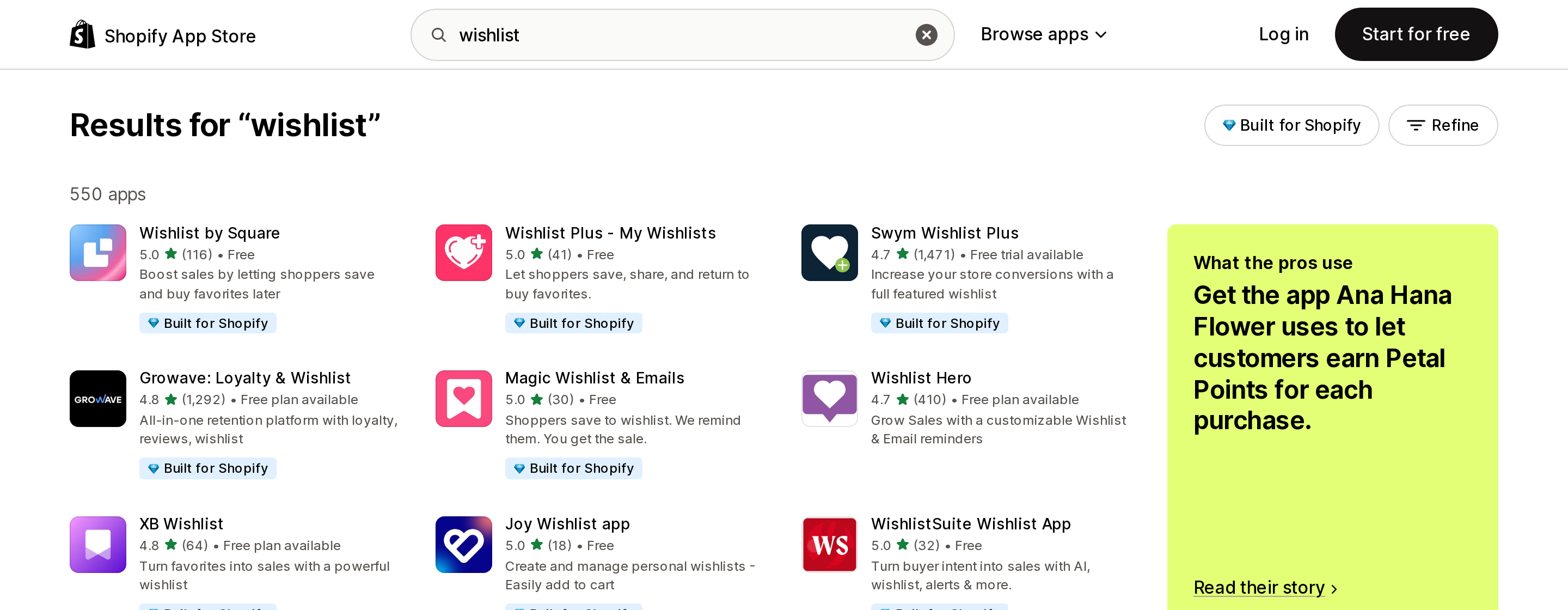
Source: Shopify App Store, search results for "wishlist", retrieved September 16, 2026
| Query | Apps matched, store-wide | Top 24 results whose name contains the category word | Top 24 with Built for Shopify |
|---|---|---|---|
wishlist | 550 | 23 ("Wishlist") | 19 |
product reviews | 7,112 | 24 ("Review") | not counted |
For "product reviews," 20 of those 24 names contain the exact phrase "Product Reviews." Not just "reviews" — the full phrase, in the name, twenty times on one page:
Judge.me Product Reviews App · AG Product Reviews App & UGC · TrustShop: Product Reviews · Loox ‑ Product Reviews App · Junip Product Reviews App & AI · REVIEWS.io Product Reviews App · CWILL(Trustoo) Product Reviews · Klaviyo: Product Reviews · Doran Product Reviews App & QA · Yotpo: Product Reviews App · LAI Product Reviews App · Trustyy Product Reviews & AI · Rivyo ‑ Product Reviews App · SS Product Reviews App & AI · EasyReviews ‑ Product Reviews · Lipscore Product Reviews · Fera Product Reviews App · MAG: Product Reviews · Dadao Product Reviews&Referral · Quoli Product Reviews & UGC
This is not an accusation against any of them. It is a structural observation: when the category phrase is shared, the prefix carries the entire identification load — and several of those prefixes are two- or three-letter initialisms. "AG," "SS," "MAG," "LAI" are distinct strings, but they do not tell a merchant who built the app.
That is the shape 4.1.2 asks for, incidentally. The rule says a name must "lead with your distinctive brand identifier." A two-letter initialism satisfies the letter of that and still leaves you unable to say the app's name out loud to a colleague without ambiguity.
The wishlist case
Two apps in the first row of the "wishlist" results both carry "Wishlist Plus":
| Swym Wishlist Plus | Wishlist Plus ‑ My Wishlists | |
|---|---|---|
| Listing URL | apps.shopify.com/swym-relay | apps.shopify.com/wishlist-plus-my-wishlist |
| Developer | Swym Corporation | Fade Commerce |
| Launched | July 29, 2016 | May 11, 2026 |
| Rating | 4.7 from 1,471 reviews | 5.0 from 41 reviews |
| Built for Shopify | Yes | Yes |
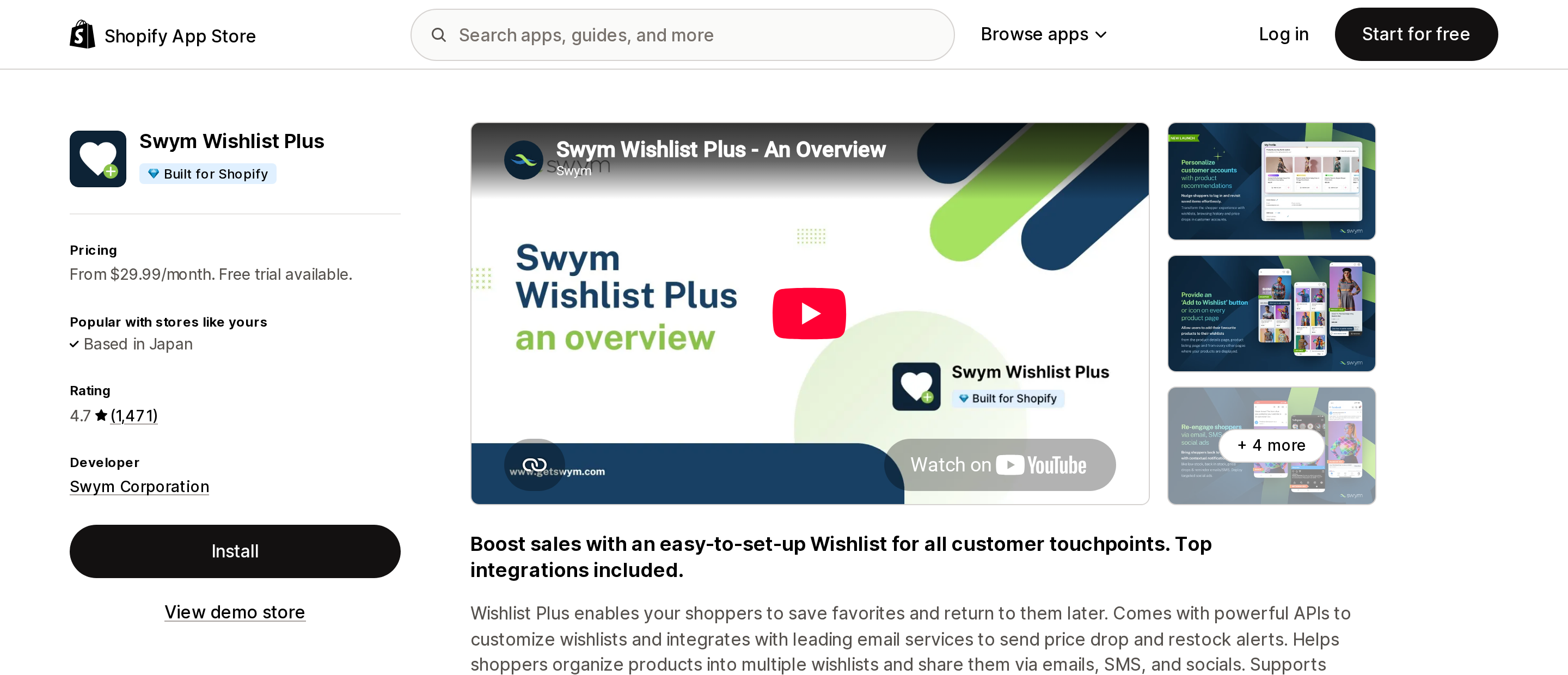
Source: Shopify App Store (Swym Wishlist Plus), retrieved September 16, 2026
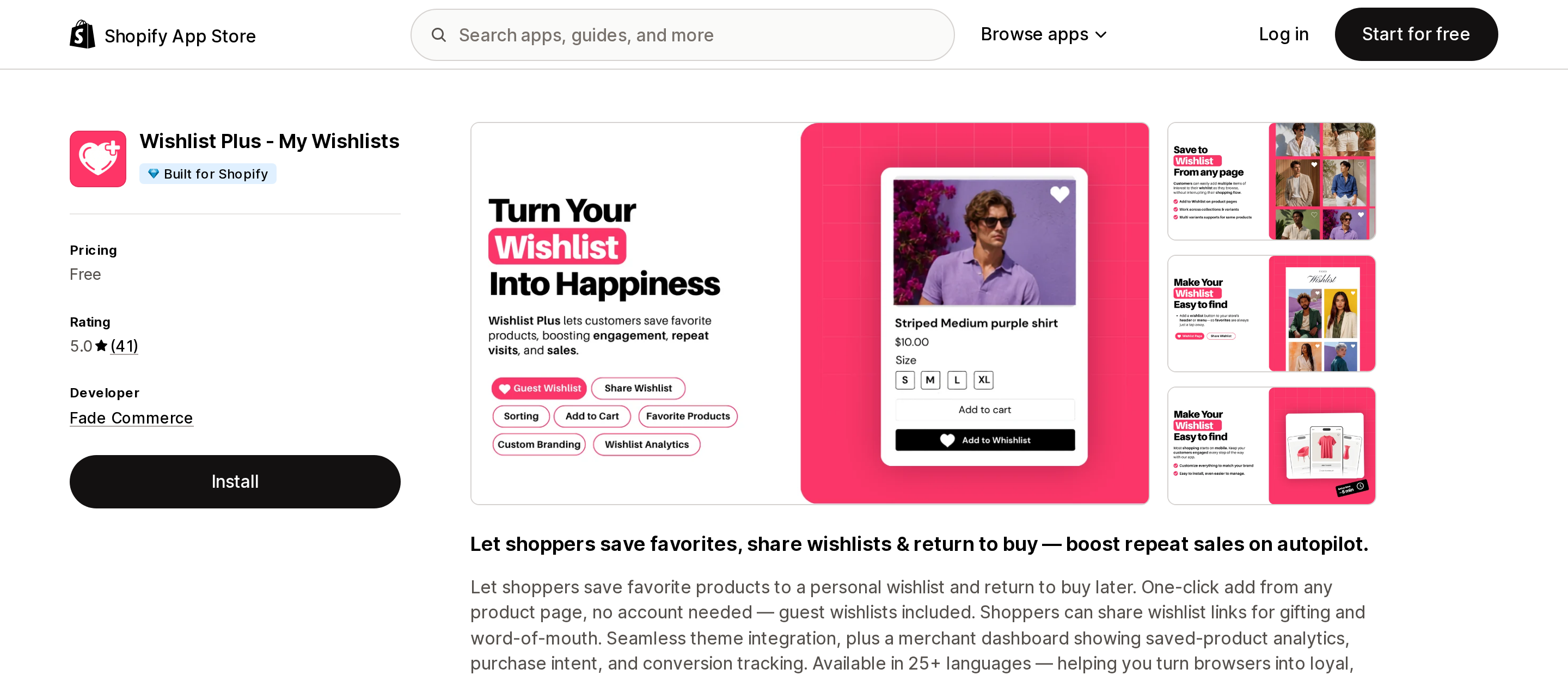
Source: Shopify App Store (Wishlist Plus ‑ My Wishlists), retrieved September 16, 2026
We are not saying either listing violates 4.1.2 — that is Shopify's audit to run, and the newer app launched on May 11, 2026, two months before the requirement was published. What we can say is the merchant-facing fact: if the app you were told to install is "Wishlist Plus," the name alone does not get you to one listing.
Note also what the Built for Shopify badge does here. Shopify's own guidance tells merchants to "use the Built for Shopify filter on search or category pages to browse certified, high-quality apps exclusively." Of the 24 wishlist results we checked, 19 carry the badge — including both of these listings. The badge is a quality signal, covering performance, design, and integration standards. It was never an identity signal, and it does not work as one.
The listing URL is the only identifier that doesn't move
An app's name can change. Its developer name can change. Its icon, its rating, its plan structure — all mutable. In every case we checked, the slug in the listing URL had stayed put through those changes, which is what makes it the thing to match on.
The catch is that a stable identifier is not the same as an accurate one. Where the name moved and the slug didn't, the URL is now a fossil of a name the app no longer uses.
| Listing URL | App name today | Developer |
|---|---|---|
apps.shopify.com/air-reviews | AG Product Reviews App & UGC | Air Reviews by Avada |
apps.shopify.com/email-1 | CWILL Back in Stock Notify Me! | CWILL |
apps.shopify.com/customer-accounts | Froonze VIP Loyalty & Wishlist | Froonze Limited |
apps.shopify.com/sealapps-product-review | CWILL(Trustoo) Product Reviews | CWILL |
apps.shopify.com/swym-relay | Swym Wishlist Plus | Swym Corporation |
apps.shopify.com/back-in-stock | Amp Back in Stock & Preorder + | HEL SG PTE LTD |
apps.shopify.com/multi-currency-converter | Hextom: Currency Converter | Hextom |
Source: Shopify App Store listings, retrieved September 16, 2026
AG Product Reviews App & UGC is the clearest specimen. Three strings describe one app, and no two of them match: the URL says air-reviews, the listing name says "AG Product Reviews App & UGC," and the Developer field says "Air Reviews by Avada." The listing has a 5.0 rating from 3,166 reviews and launched September 30, 2022. Every one of those facts is checkable. None of them is reachable by searching the name a colleague gave you two years ago.
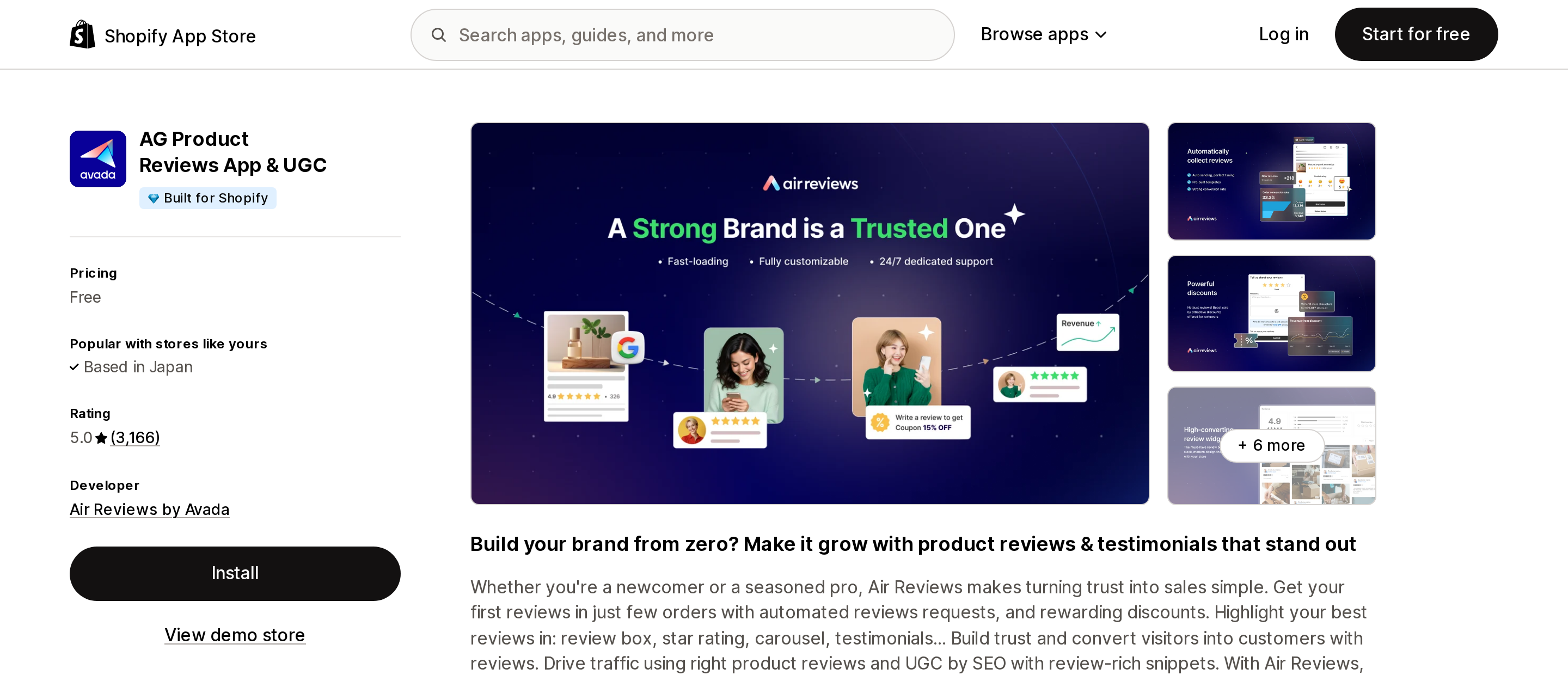
Source: Shopify App Store (AG Product Reviews App & UGC), retrieved September 16, 2026
The reverse trap is worth knowing too. A generic-sounding slug does not mean you've found the most-reviewed app in the category. apps.shopify.com/multi-currency-converter is Hextom: Currency Converter, with 39 reviews. apps.shopify.com/back-in-stock is Amp Back in Stock & Preorder +, with 940 — while the top result for that search, Notify Me! Back in Stock Alert, sits at preorder-back-in-stock with 3,780. Typing the obvious URL is not a shortcut to the obvious app.
The name in your admin doesn't have to match the name on the listing
This one is in the requirements, immediately above 4.1.2. Requirement 4.1.1, "App name fields must be similar," governs the relationship between the name a developer sets in the Developer Dashboard — which is what you see in your Shopify admin — and the name on the App Store listing:
Your app name needs to match, or be similar, between your Developer Dashboard ... and your App Submission form (which controls the App Store listing). "Similar" means that any variations of the name contain common words.
Similar, sharing common words. Not identical. So if you go looking in Settings → Apps and sales channels for the app you installed from a listing called "CWILL(Trustoo) Product Reviews," a shorter or differently-ordered variant is compliant behavior, not a bug. When you are auditing which apps are installed, or trying to work out which listing is billing you, expect the two strings to differ.
A four-step identity check
Before you install, and before you recommend an app to someone else:
- Trade URLs, not names. When you ask for or give a recommendation, use the full
apps.shopify.com/...link. It is the only identifier that survives a rename. - Read the Developer field. It is on every listing and it is the second-most stable string, though as
air-reviewsshows, it can also be a fossil. Two apps with near-identical names and different developers are two companies. - Check Launched and the review count together. Reviews accrue slowly and can only be left by merchants who installed the app. July 29, 2016 with 1,471 reviews and May 11, 2026 with 41 are describing different things, whatever the names suggest.
- Don't let the badge stand in for identity. Built for Shopify certifies performance, design, and integration standards. It was on 19 of the 24 wishlist results we checked, including both Wishlist Plus listings.
What changes as enforcement rolls out
Names will move. Shopify said apps will be reviewed in waves with a designated timeframe to comply, so over the coming months some listings you have bookmarked by name will be sitting under a different one. Requirement 4.1.1 is a reminder that the listing name and the Developer Dashboard name are two separate fields, which is why a rename can show up in one place before the other.
Two things probably won't change soon. Category phrases in names are not what 4.1.2 targets; it targets names that are "identical or confusingly similar to another app, developer, brand, or Shopify product." Twenty apps with "Product Reviews" in the name can all be compliant, provided the brand identifier in front is genuinely distinctive. And the trademark gate means the disputes that get resolved fastest will be the ones brought by developers who registered their brand — not necessarily the ones causing merchants the most confusion.
Which leaves the practical answer where it started. The name is a label. The URL is the app.
Primary sources
- Shopify App Store requirements — 4.1 Brand your app name uniquely and consistently (requirements 4.1.1 and 4.1.2)
- Updated App Store requirements: 4.1.2 Use a unique name for your app, Shopify developer changelog, July 15, 2026
- A Better, Clearer App Store for Everyone, Shopify Developer Community Forums, July 15, 2026
- Finding and choosing apps, Shopify Help Center
- Shopify App Store, en-US listings and search results, retrieved September 16, 2026
Shopify added a Bin name column to the inventory CSV on August 25, 2025. It holds one bin per variant per location, it is created only by CSV import, and it prints on Order Printer pick lists. What it does not do is leave Shopify. Shopify staff confirmed on the developer forum in October 2025 and again in January 2026 that there is no public API access to the field, and the developer forum was still reporting the gap in June 2026. That single fact shapes the whole category: EasyScan and iPacky store bins in metafields, Bins-USA and ShelfPilot store them in their own databases, and a free app called Simple Bin Locations copies metafield bins into order notes so packing slips can show them. Shopify's own multi-bin model, with per-bin quantities and an unbinnedQuantity field, exists today only as a feature preview on development stores. Pricing, plan gates, and where each app keeps the bin data, verified on the Shopify App Store, the Shopify Help Center, shopify.dev, and the Shopify community forums on September 18, 2026.