
What you will learn
On this pageContentsCloseOpen
Shopify has AI image tools built in, so the first question is whether you need an app at all. The answer turns on one sentence in Shopify's documentation and one number.
The sentence: Shopify Magic's media generation does backgrounds, scenes, lighting and outpainting. There is no on-model, garment try-on, or human-subject generation anywhere in its documented scope. The number: 1 megapixel.
If you sell apparel, that settles it — you are shopping for an app. This article prices six real ones from the US App Store, normalizes their wildly different billing units to a single figure, and then does the thing the listings never do, which is account for the images you throw away.
Research date: September 2, 2026. All prices are USD from the English App Store listings.
The short version
- Shopify Magic replaces backgrounds and generates scenes. It cannot put a product on a human model.
- Magic outputs at "1 megapixel (MP) resolution based on your image's aspect ratio," and "images larger than 1 MP are scaled down." Shopify itself accepts product images up to 25 megapixels. Magic gives you about a twenty-fifth of the pixel budget your product page zoom wants.
- The six apps price in six different ways. Only two define what one unit buys. One changes its unit halfway up the ladder to an undefined "Token."
- Normalized to dollars per generated image at the entry paid tier, the range is $0.030 to $0.920 — a 31x spread.
- That spread is an illusion. One merchant published a quantified reject rate: "you end up using 5 to 10 conversions to get one good one." At 5x, the ranking starts to invert. Only one vendor refunds credits for defective output, and its column does not move at all.
- One app's terms state that the vendor owns the generated photos and licenses them to you for the later of two years or your subscription, with deletion required on termination. Four of six publish no terms at all.
- If you run Google Shopping: Merchant Center requires an IPTC
DigitalSourceTypetag on generative-AI images and forbids stripping it. No app in this set states that it writes one.
What Shopify already does, and where it stops
Media generation in the file editor gives you two actions in Content, then Files: Color background, which replaces the background with a solid color or transparency using automatic subject detection, and Generate, which takes a natural-language prompt to change background, lighting or scene. Crop and transform adds Extend images, an outpainting tool, on desktop.
The resolution cap is stated plainly: "The default resolution for generated images is 1 megapixel (MP) resolution based on your image's aspect ratio. Aim to use images that are close to 1 megapixel in dimension." And: "Images larger than 1 MP are scaled down, whereas images under 1 MP are scaled up."
Set that against Shopify's own product media specification — images up to 5000 by 5000 pixels, or 25 megapixels, under 20 MB — and the gap is stark. Magic's output is roughly 1000 by 1000. That is fine for a collection tile and thin for a product page where the customer zooms.
Two more constraints worth knowing. Magic "creates 1 AI-generated scene at a time... any unused scenes are deleted when you close the editor unless you save the images to your device" — so it is not a bulk tool. And products cap at 250 media each, a limit that "can't be raised."
There is also a contradiction on Shopify's own page worth flagging. A plan requirement box says media generation with Sidekick is available on Basic, Grow, Advanced and Plus. The pricing section says that "for a limited time, media generation in the file editor is available on all Shopify plans at no additional cost." Free for now, unpriced later, is the operative risk.
On rights, Shopify is clean: it "doesn't claim ownership" of generated images, and while "an invisible watermark is applied to all generated images," that watermark "doesn't restrict commercial use."
The disclosure question, answered properly
A claim circulating in third-party articles says AI-generated product photos require no disclosure anywhere in 2026. Do not act on it.
Shopify's Acceptable Use Policy contains no AI-imagery clause at all. That is an absence of a rule, not a permission — and its operative principle pushes the obligation down to you.
Google Merchant Center is the opposite of silent. Its image requirements state that "all images created using generative AI must contain meta data indicating that the image was AI-generated by using the IPTC DigitalSourceType TrainedAlgorithmicMedia metadata tag," and separately: "Don't remove embedded metadata tags such as the IPTC DigitalSourceType property from images created using generative AI tools." This applies to your main image link, additional image links, and lifestyle image links.
So the honest version is: Shopify does not require disclosure on your own storefront. Your largest shopping channel does, in writing. No app in this set states that it writes the IPTC tag — check your pipeline, because a metadata-stripping upload step puts you out of compliance with a published requirement.
On the FTC: we found no ftc.gov guidance directly on point for AI-generated product imagery — the Endorsement Guides FAQ returns nothing for AI-related terms. General deception principles obviously still apply, but that is a reading rather than cited guidance.
The six apps
Modelize: AI Product Photos
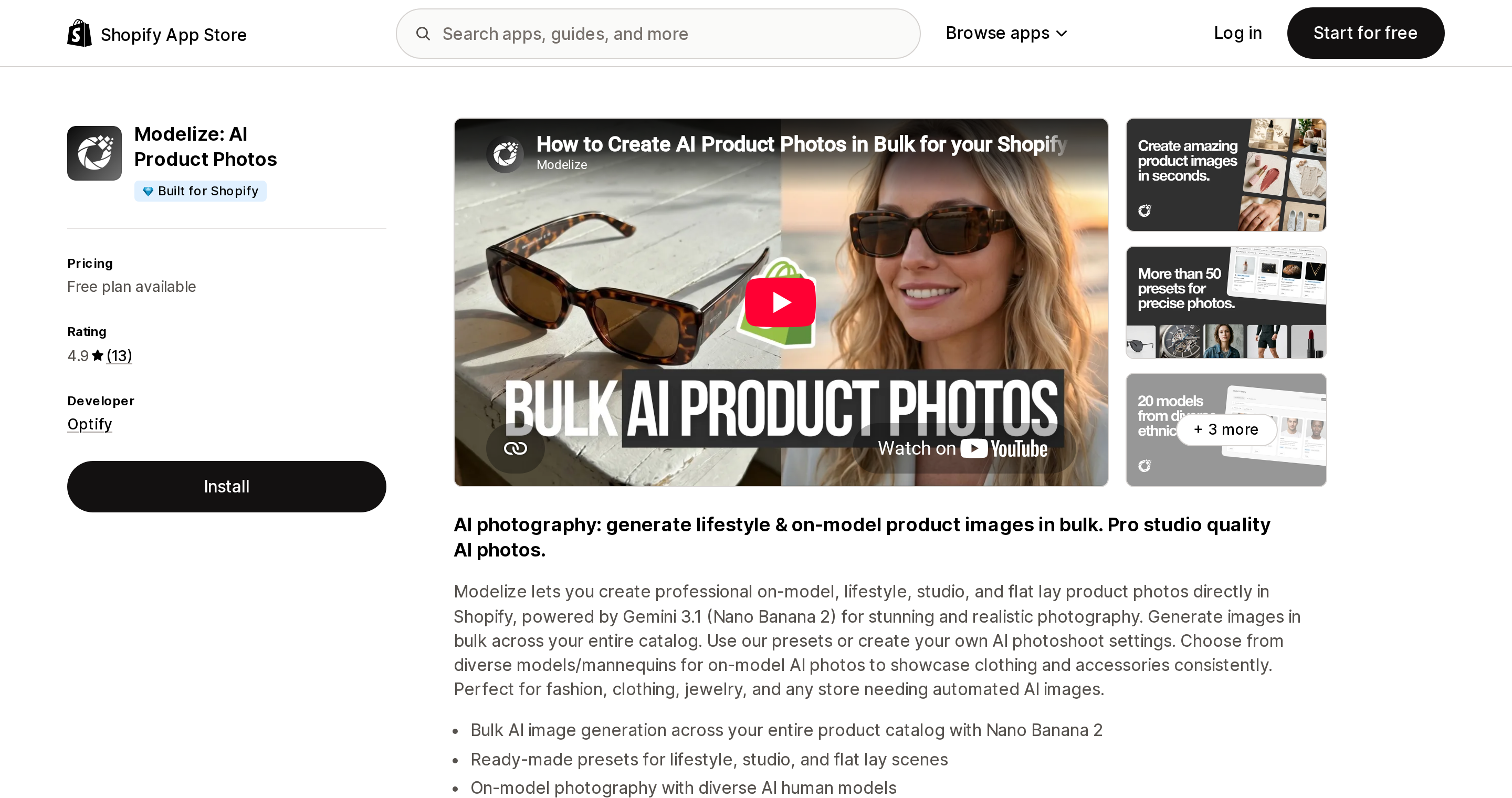
Source: Shopify App Store (Modelize: AI Product Photos), retrieved September 2, 2026
Modelize: AI Product Photos from Optify carries a Built for Shopify badge, rated 4.9 across 13 reviews, launched April 20, 2026 — the newest here.
Free gives 3 AI images, one-time, at 2K. Starter $19/month: 100 AI images per month, 3 custom presets, 3 custom models, 2K. Pro $49/month: 250 images, 10 presets, 10 models, up to 4K. Enterprise $99/month: 500 images, unlimited presets and models, 4K, and $0.20 per additional image.
It is the only app in the set whose unit needs no interpretation — one unit is one image — and the only one that publishes overage pricing. Its per-image cost is also flat across the whole ladder: $0.190, $0.196, $0.198, with overage at $0.20. No volume discount, but no surprises either.
Its terms are the strongest here. Section 4.2 reads: "You own the AI-generated images created through the Service. You are free to use, modify, distribute, and commercially exploit these images without restriction, subject to applicable laws." Section 3 is also the only place in this entire category that acknowledges disclosure law, prohibiting users from "misrepresent[ing] AI-generated images as traditional photographs in contexts where such disclosure is legally required."
Caveat: 13 reviews on an app four months old. The longest reviewer tenure is 29 days, so nobody has yet reported on it over a full catalogue cycle.
OnModel ‑ AI Models Photos
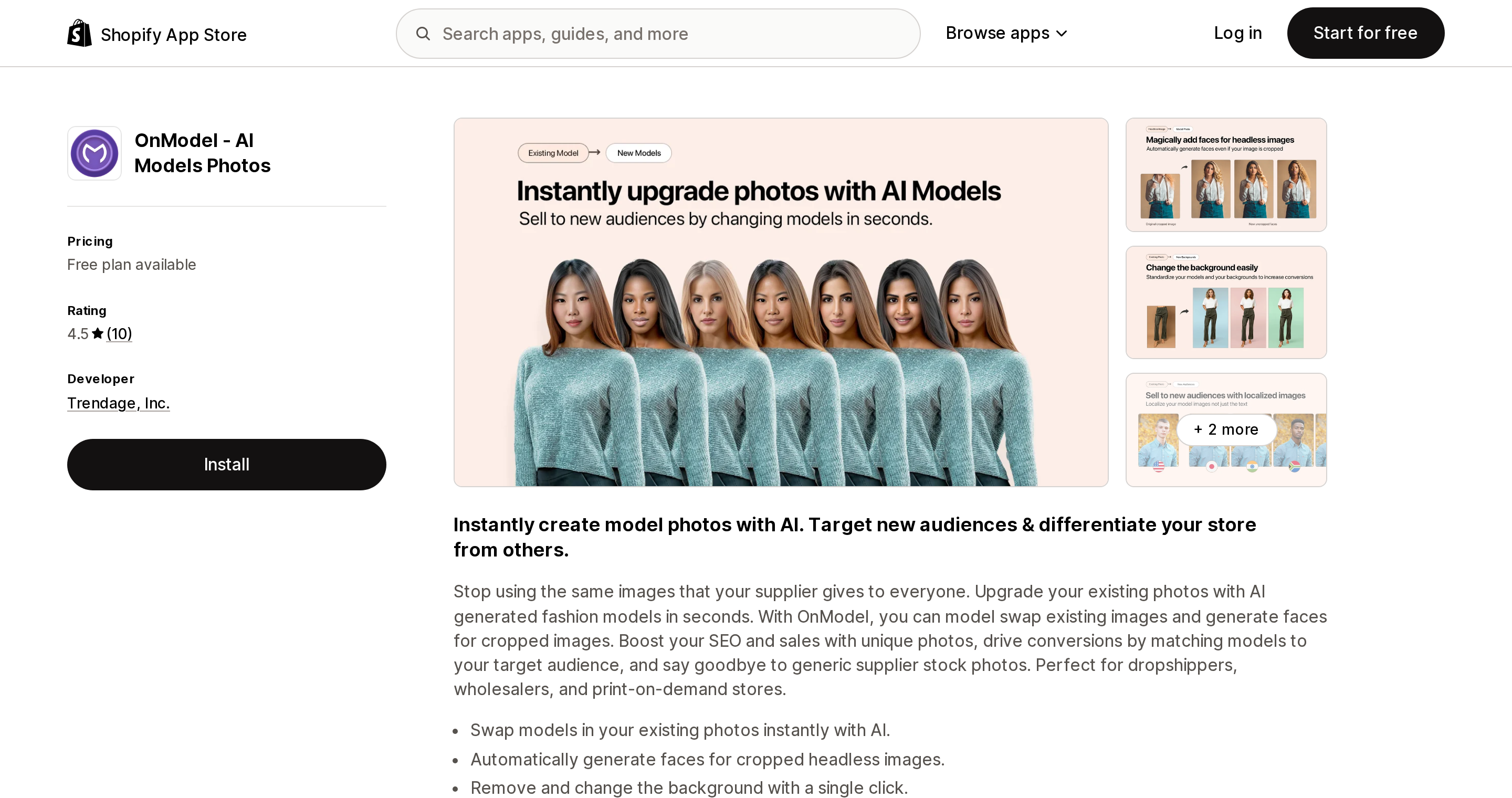
Source: Shopify App Store (OnModel ‑ AI Models Photos), retrieved September 2, 2026
OnModel ‑ AI Models Photos from Trendage, Inc. has no Built for Shopify badge, is rated 4.5 across 10 reviews, and launched February 24, 2023 — the oldest here.
Free swaps 25 models. Basic $9/month: 300 model swaps. Growth $19/month: 1,000. Advanced $49/month: 5,000. The tiers list no features beyond volume.
Note the verb: this is model replacement on an existing photo, not scene generation. That is a narrower job, and the pricing reflects it — $0.030 per swap at entry, dropping to $0.0098 at Advanced. It is by a wide margin the cheapest headline in the category.
It is also where the reject-rate evidence comes from. In January 2025 a US merchant who had used it five months wrote: "Extremely poor conversions from one race to another. You end up using 5 to 10 conversions to get one good one. Sometimes it mangles the body parts, hands, feet and it gives you white models when you call for people of color." A positive review from March 2025 concedes the same mechanism more gently: "difficult clothing designs may need to generate a few times." The rating distribution is a barbell — 80% five-star, 20% one-star, nothing in between.
No commercial rights statement is published; only a privacy policy.
Pictu Bulk AI Image Generation
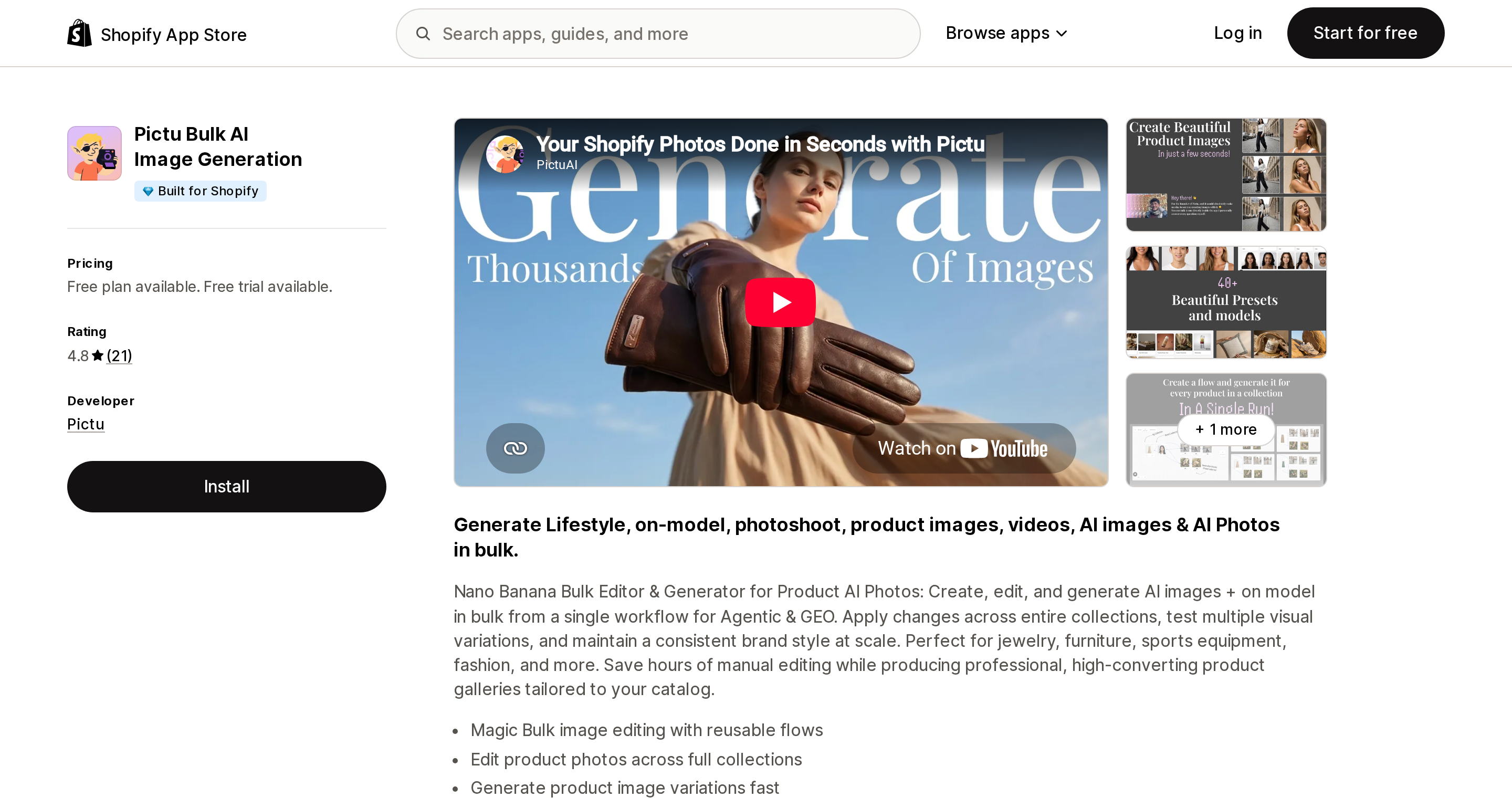
Source: Shopify App Store (Pictu Bulk AI Image Generation), retrieved September 2, 2026
Pictu Bulk AI Image Generation carries a Built for Shopify badge, rated 4.8 across 21 reviews, launched May 23, 2025.
Free gives 10 image edits and generations per month — the only recurring free allowance in this set. Starter $19.99/month: 150 image edits and generations per month, 3-day trial. Growth $99/month or $950.40/year: 1,000 Tokens month. Enterprise $239/month: 3,000 Tokens month.
Read that ladder again. The unit changes from "image edits and generations" to "Tokens" between Starter and Growth, and nowhere on the listing is a Token defined, nor is any conversion to images given. You literally cannot compare Starter to Growth from the published information. That is the finding.
Its reviews skew usefully toward hard goods rather than apparel: a UK wine merchant seven months in, a US liquor retailer who noted "we are limited to what images the supplier can provide. That is no longer the case." Rights are unverified — the only legal resource linked is a Google Doc privacy policy.
AI Models & Product Photos: ST
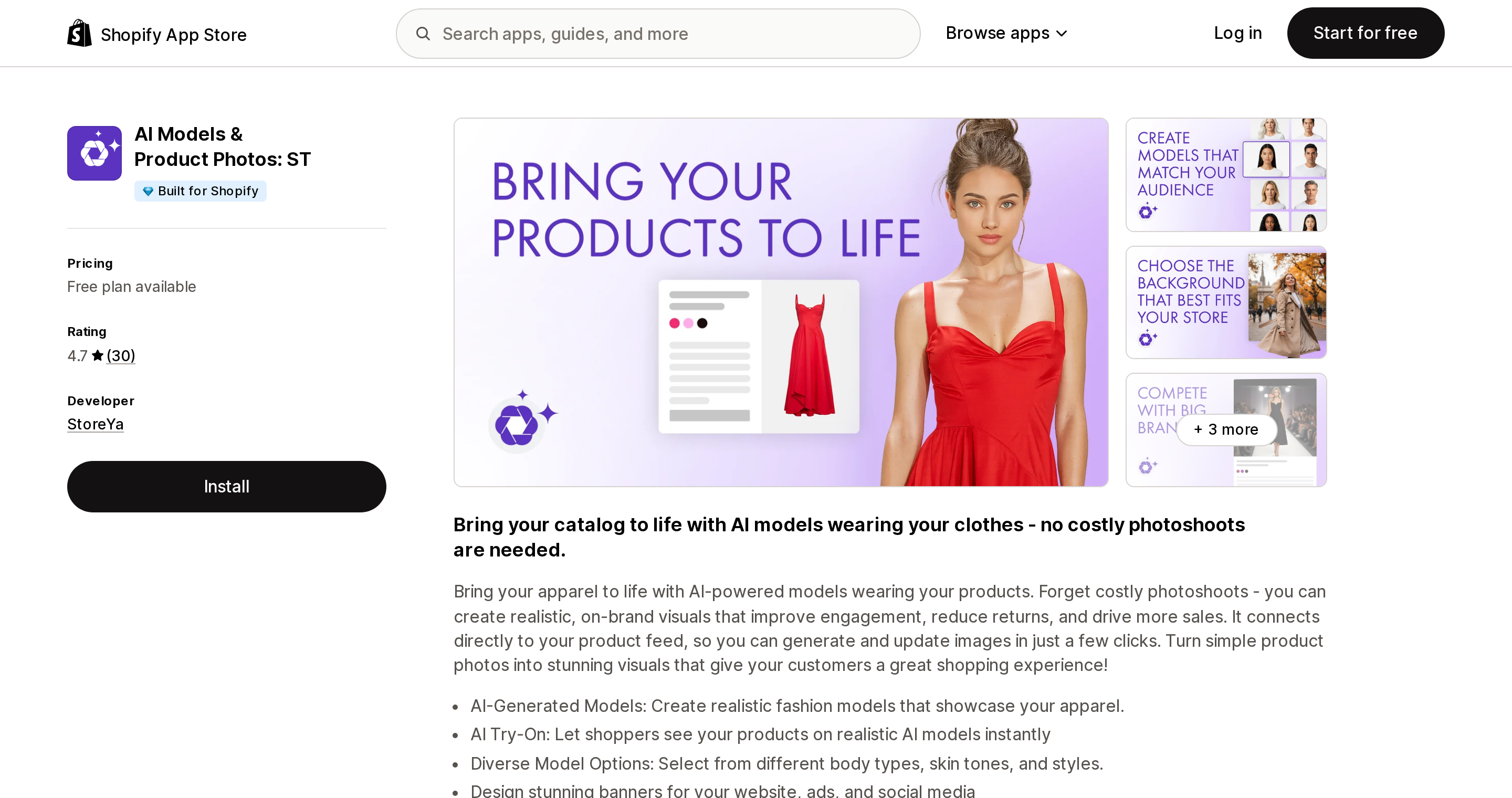
Source: Shopify App Store (AI Models & Product Photos: ST), retrieved September 2, 2026
AI Models & Product Photos: ST from StoreYa carries a Built for Shopify badge and is rated 4.7 across 30 reviews. Launched September 9, 2025.
Pricing is one-time rather than subscription. Free gives 15 AI image generations. Starter $14: 60. Growth $45: 225. Pro $99: 550. All tiers include ready-made or custom AI models, multiple poses and backgrounds, custom prompts, and an AI banner tool.
Two things to weigh. It requests "View orders — All order history for the last 60 days," which is unusually broad for an image tool. And a February 2026 review from an Austrian merchant is the clearest statement of the core risk in this whole category: "the jacket used looks mostly similar, yet most of the details are incorrect. The colors are wrong, buttons are missing, and the embroidery isn't there. I can't sell the jacket like this because the buyer would essentially be seeing a different item."
That is not a quality complaint. That is a description of a misrepresentation.
Lensia AI Ads Create and UGC
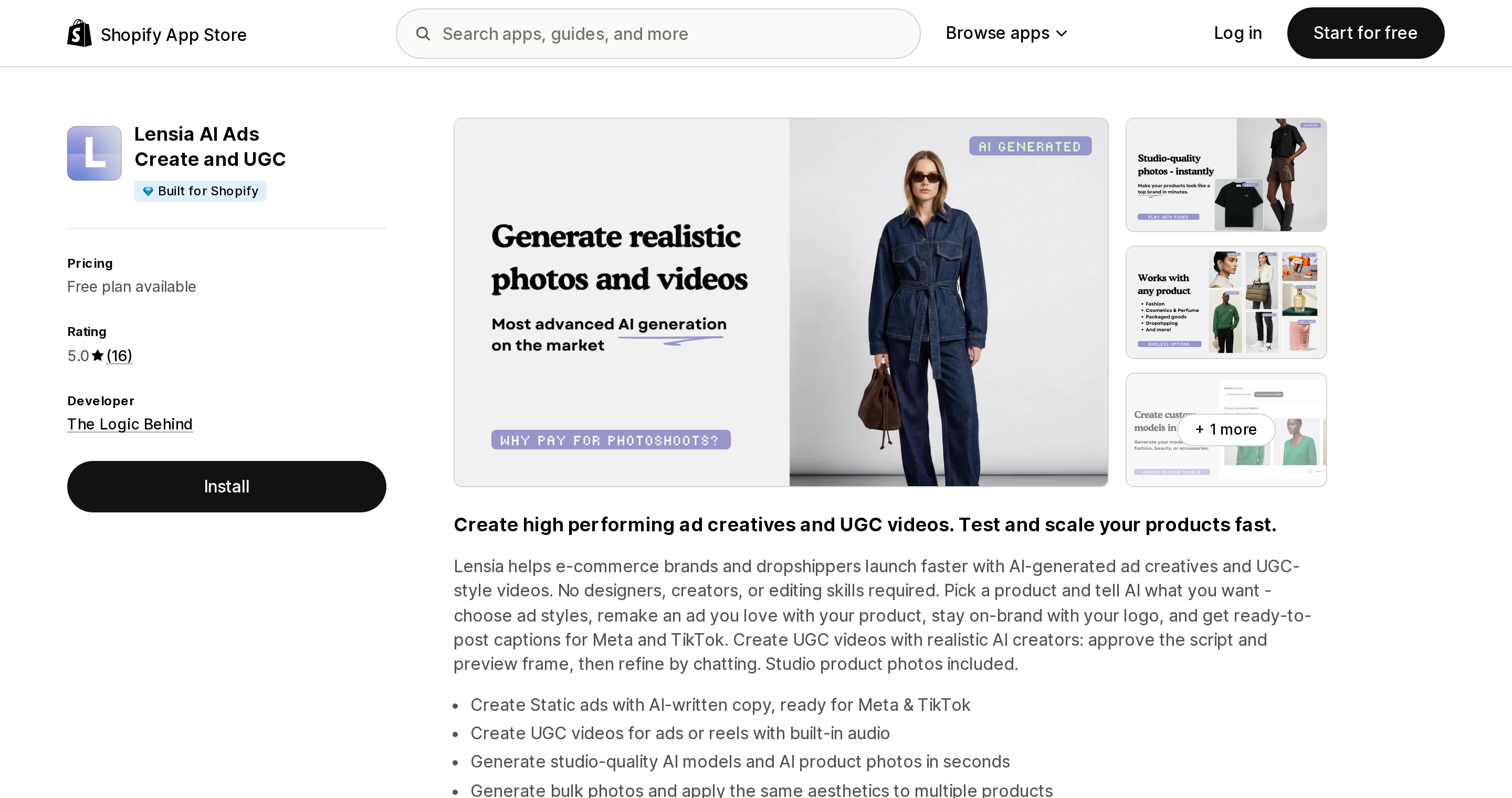
Source: Shopify App Store (Lensia AI Ads Create and UGC), retrieved September 2, 2026
Lensia AI Ads Create and UGC from The Logic Behind carries a Built for Shopify badge, rated 5.0 across 16 reviews, launched September 30, 2025.
The app has been renamed and repositioned: it now leads with Meta and TikTok ad creative and UGC video, and product photos are a sub-feature. Pricing is one-time — Free gives 15 credits, $15 gives 50, $49 gives 200, $115 gives 500 — and every tier states "Up to 2 free regenerations per image," which caps retry burn at three attempts.
But what one credit buys is not defined anywhere on the listing, and credits are shared across static ads, UGC video and product photos, which almost certainly consume different amounts. The free-regeneration policy protects a unit whose size you do not know.
One more flag: the listing's Privacy policy link resolves to the terms of an unrelated company for an unrelated store-builder product, so there is no discoverable statement on output ownership or commercial use.
Botika Connector
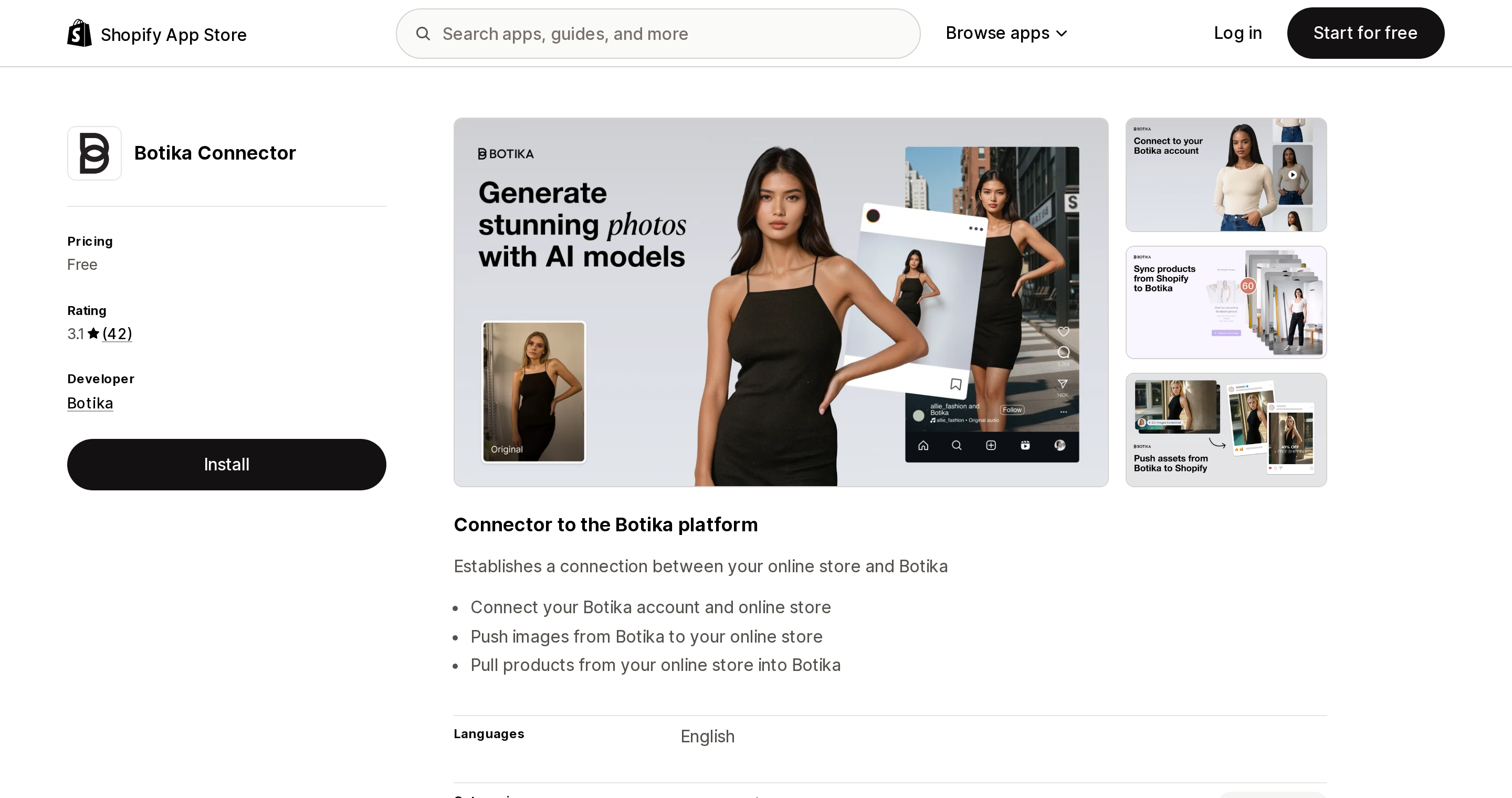
Source: Shopify App Store (Botika Connector), retrieved September 2, 2026
Botika Connector has no Built for Shopify badge and the lowest rating in the set at 3.1 across 42 reviews — also the largest review base. Launched May 18, 2023.
Its App Store pricing section reads, in full, "Free Connector — Free." The listing is a shell; real pricing lives on botika.com: Pro $55/month, or $46/month billed annually, 600 credits per year, and Advanced $100/month, 1,000 credits per year. It defines its unit as precisely as Modelize does — "each photo costs 1 credit and each video costs 5 credits" — with unlimited rollover while subscribed, and rollover credits expiring immediately on cancellation.
Botika is also the only vendor in this set that prices the reject rate into the product. Pro includes "2 retouch rounds per photo" with 2-day fix delivery; Advanced includes 3 rounds with 1-day delivery. Its FAQ says "if there's an issue, we'll fix it at no additional cost," and in a public review reply in November 2025 the vendor stated: "The credits for these images are 100% refunded and we don't charge extra credits for the fixes."
It needs that policy. In November 2025 a US merchant wrote that "around 95% of the generated photos had major errors" and that a product — men's briefs — "was completely changed into a different item." In May 2025 a UK merchant listed "twisted hands, shortened torsos, head size disproportionate to body." Its free output is watermarked, confirmed by the developer, so the free tier is a demo rather than a usable plan.
And then there are the terms, which are the most consequential finding in this article. Botika's terms of service state at 5.1 that "all right, title and interest in the Platform and in the photos generated by the Platform for Customer (the 'Licensed Photos')... belongs to the Company." Section 5.2 grants a license until "the later of (i) the lapse of two (2) years commencing as of the date such License Photo was generated, or (ii) termination of these Terms," and only "in connection with the Customer's own fashion business." Section 9.4: on termination, "Customer shall delete any Licensed Photos provided by the Company and used by the Customer." Section 11.1 warns that "the licensed photos may not be unique, and similar photos may be generated by the platform for other customers."
To its credit, Botika is also the only app here that addresses model likeness at all, stating at 11.4 that all synthetic models "are not intended to depict, represent, or resemble any actual, identifiable, or living person," with a takedown process.
What a generated image actually costs
Using only figures stated on the listings, at each app's entry paid tier:
| App | Entry paid tier | Allowance | Arithmetic | Dollars per generated image |
|---|---|---|---|---|
| OnModel ‑ AI Models Photos | $9/mo Basic | 300 swaps/mo | 9 ÷ 300 | $0.030 |
| Pictu Bulk AI Image Generation | $19.99/mo Starter | 150/mo | 19.99 ÷ 150 | $0.133 |
| Modelize: AI Product Photos | $19/mo Starter | 100/mo | 19 ÷ 100 | $0.190 |
| AI Models & Product Photos: ST | $14 one-time Starter | 60 total | 14 ÷ 60 | $0.233 |
| Lensia AI Ads Create and UGC | $15 one-time | 50 credits | 15 ÷ 50 | $0.300 per credit — images per credit undefined |
| Botika Connector | $46/mo billed annually, Pro | 600 credits/yr, 1 credit = 1 photo | (46 × 12) ÷ 600 | $0.920 |
Thirty-one times, top to bottom. On this table the decision looks obvious.
The reject rate erases the table
It is not obvious, because the denominator is wrong. You do not pay per generated image. You pay per usable image, and across three independent apps the reviews document the same failure modes: mangled hands and limbs, garment detail drift, ethnicity control failure.
Apply the one quantified rate a merchant actually published — 5 to 10 attempts per usable image, on apparel model swaps:
| App | Headline per image | At 5x | At 10x |
|---|---|---|---|
| OnModel, $9 Basic | $0.030 | $0.150 | $0.300 |
| Pictu, $19.99 Starter | $0.133 | $0.665 | $1.330 |
| Modelize, $19 Starter | $0.190 | $0.950 | $1.900 |
| AI Models & Product Photos: ST, $14 | $0.233 | $1.165 | $2.330 |
| Botika, $46 Pro | $0.920 | $0.920 | $0.920 |
Botika's column does not move, because retries are contractually free. At 5x it is already cheaper than ST and roughly level with Modelize; at 10x it beats all three of them. It never becomes the cheapest option overall — OnModel stays ahead at $0.300 even at 10x, because its starting point is so low — but the 31x headline gap collapses to about 3x, and against every app that meters per generation and refunds nothing, Botika wins on a long enough job. The spread is real at the headline and largely fictional in practice.
Who says anything about failed generations? Botika, explicitly, with retouch rounds in the plan and credits refunded. Lensia, partially, with up to two free regenerations per image. Modelize, OnModel, Pictu and AI Models & Product Photos: ST are silent. For four of six apps, every bad hand and every missing button is billed at full price.
Two caveats on this analysis. The 5-to-10x figure comes from a single quantified review, corroborated only qualitatively elsewhere, and it was measured on one app in January 2025. It is directional, not a benchmark. Your own rate depends heavily on your product category — which leads to the last section.
How to choose
Apparel, small catalogue, US storefront. Botika Pro, despite the headline. The retouch rounds and credit refunds are the only contractual protection against a documented reject rate, and it is the only vendor that addresses model likeness. But read section 5.2 first: if you might ever cancel, you are required to delete the images. If that is unacceptable, take Modelize Pro at $49 for 250 images a month at 4K with outright ownership, and budget for a 5x multiple.
Apparel, bulk catalogue. OnModel Advanced at $49 for 5,000 swaps works out to $0.0098 per generation — the only tier where a 10x reject rate is still survivable at under ten cents per usable image. Accept the trade-offs: no badge, no published rights, a 20% one-star rate. Pilot on twenty SKUs and measure your actual reject rate before committing.
Hard goods — jewellery, furniture, tools, beverages. The reject-rate problem largely evaporates. No hands, no faces, no garment drift. Pictu and Modelize both work, and Pictu's review base skews this way. Prefer Modelize if you want predictable unit economics, because Pictu's Token unit is undefined above Starter.
Backgrounds and scenes only, at web resolution. Use Shopify Magic and buy nothing. It is free on all plans right now, handles background replacement, scene generation and outpainting, and Shopify disclaims ownership of the output. This is the right answer more often than the category admits. Note that Shopify describes its invisible watermark as "a form of 'metadata'" but does not document it as the IPTC DigitalSourceType tag Merchant Center asks for, so do not treat Magic as a compliance answer.
Hire a photographer for the hero and primary product images on apparel, where fabric drape, texture and trim are the purchase decision — and for any SKU where the missing-buttons failure would put a materially different item in front of a US buyer. Use AI for secondary lifestyle slots, ad creative, and category tiles. Not for the image the customer zooms into before checkout.
What we could not confirm
Four of the six apps link no terms of service from their App Store listing, so output ownership, commercial-use grant and model-likeness status are unverified for the majority of this set. Some vendors may publish terms elsewhere on their own sites. Lensia's credit definition, and Pictu's Token definition, are both absent from their listings. No app states that it writes the IPTC DigitalSourceType tag Google Merchant Center requires; absence of a statement is not proof it does not. Watermarking on free tiers is confirmed only for Botika; the others are silent, which is not the same as watermark-free. And Pebblely, which appears in several third-party roundups, returns a 404 at its App Store URL — presumed delisted or relocated, unconfirmed.
Sources
Sidekick app extensions went generally available on June 17, 2026, and Shopify's merchant-facing guide lists 18 apps that use them. The platform cap is 20 apps per user on a store, so supply is the constraint, not the cap. This article reads the developer documentation for what merchants actually get: app data extensions are read-only, app actions navigate you to a pre-filled page and stage the change — Shopify's own walkthrough ends with \"Click Save in the form. The change is committed by your app, not by Sidekick.\" App actions are also limited to 13 declared intent types, and an unsupported type fails at deploy with no silent fallback. Four of those types — FAQ, quote, ticket, shipment — have no matching app on Shopify's list. Three build requirements explain the short list: existing MCP servers can't be reused, legacy OAuth installs are excluded, and each app gets 5 intents, 20 tools, and a 4,000-token response budget. Two of the guide's own cards show only \"Free trial available\" for apps that list at $49.99 and $299 a month. And no app listing shows a Sidekick badge at all: Seguno had to put \"Sidekick-able\" into its 62-character tagline. Ratings, pricing, and the app list verified on the Shopify App Store on September 8, 2026.