
What you will learn
On this pageContentsCloseOpen
In September 2025, OpenAI announced that ChatGPT users would soon buy directly from Shopify merchants without leaving the chat window. Etsy sellers went live immediately; more than a million Shopify merchants, including Glossier, SKIMS, Spanx, and Vuori, were listed as launching soon after.
That version of ChatGPT checkout for Shopify merchants never fully shipped. By March 2026, trade press reported OpenAI scaling back the original Instant Checkout pilot, and Shopify's current Help Center is explicit that ChatGPT functions purely as a discovery and referral channel. There is no setting in the Shopify admin to turn on direct checkout for ChatGPT, because it doesn't exist. Customers who buy through ChatGPT are redirected to your own online store checkout.
What did ship, quietly, in the same rollout: three other AI channels got real in-chat checkout. Google AI Mode and Gemini, Microsoft Copilot, and Meta can now complete a purchase inside the AI surface itself, on a Shopify-powered checkout, without the customer ever landing on your site. Several blog posts still published in mid-2026 describe this backwards — crediting ChatGPT with the in-chat purchase and treating the other three as afterthoughts.
Below is what's actually live, sourced from Shopify's current Help Center documentation, plus what the direct-checkout channels quietly break: your ad pixels.
The short version
ChatGPT is discovery-only. There's no direct-checkout toggle for it in the Shopify admin — customers are always sent to your own online store checkout, in a ChatGPT in-app browser on mobile or a new tab on the web.
Google AI Mode and Gemini, Microsoft Copilot, and Meta support Shopify-powered direct checkout, active by default for eligible stores, where the customer pays without leaving the AI surface at all.
Direct checkout can't sell subscriptions, product bundles, customizable products, or B2B-only products, on any of the three channels that offer it.
Google Analytics and custom pixels don't fire on direct-checkout orders. Only two server-to-server events — order started and order completed — reach your tracking. Ironically, the channel that lost its promised in-chat checkout (ChatGPT) is the one where your existing analytics still work perfectly, because the sale happens on your real site.
All four channels require your store to sell to US customers, and none charge a fee beyond your standard payment processing rate.
What actually happened to Instant Checkout
OpenAI's own announcement, published September 29, 2025, described Instant Checkout as letting US ChatGPT Plus, Pro, and Free users buy directly from US Etsy sellers inside the chat, with more than a million Shopify merchants set to follow. It was built on the Agentic Commerce Protocol (ACP), co-developed with Stripe and open-sourced the same day.
Etsy went live. Shopify did not, in the form originally described. Modern Retail reported on March 12, 2026 that Shopify had emailed merchants about a feature called "ChatGPT in Agentic Storefronts," describing buyers as able to complete purchases inside ChatGPT. Modern Retail separately confirmed with OpenAI that despite that wording, purchases on Shopify orders would not run through OpenAI's own Instant Checkout system. An OpenAI spokesperson told the outlet: "Instant Checkout is moving to Apps." The Information had reported the prior week that OpenAI was scaling back Instant Checkout inside ChatGPT.
Twelve days later, Shopify made it official in its own newsroom, describing the ChatGPT experience in marketing terms as shopping that never requires leaving the conversation — but its own Help Center is more precise: the purchase completes in a ChatGPT in-app browser (or a new browser tab on desktop), loading your actual online store checkout. That's a real distinction. It means your existing checkout customizations, upsells, payment methods, and branding all carry over on ChatGPT orders, because nothing about your checkout changed. It also means anyone claiming ChatGPT now has native in-chat checkout for Shopify merchants, the way it does for Etsy, is describing a plan that didn't ship that way.
Four channels, one admin screen, two very different mechanics
Shopify manages all four AI channels from Sales channels > Agentic in the admin. But "agentic storefronts" isn't one experience — it splits into two fundamentally different paths, confirmed across Shopify's per-channel Help Center pages as of September 4, 2026.
| Channel | Checkout location | Default state | Store requirement |
|---|---|---|---|
| ChatGPT | Your online store, in an in-app browser or new tab | Discovery active by default; no direct-checkout setting exists | Sells to US customers (store can be based anywhere) |
| Google AI Mode and Gemini | Shopify-powered direct checkout inside the AI surface | Direct checkout active by default for eligible stores (rolling out) | Store must be based in the US and sell to US customers |
| Microsoft Copilot | Shopify-powered direct checkout inside the AI surface | Direct checkout active by default for eligible stores | Sells to US customers (store can be based anywhere) |
| Meta | Shopify-powered direct checkout on Instagram/Facebook surfaces | Direct checkout active by default, but in limited release — some customers still redirected | Store must be based in the US and sell to US customers |
Notice the requirement isn't identical across channels. Google AI Mode and Gemini and Meta both require your store to be based in the United States, not just that you sell to US customers — a stricter bar than ChatGPT or Microsoft Copilot, which only require selling to US customers regardless of where the store is based.
Every channel requires products to be eligible for Shopify Catalog, agreement to the Shopify Agentic Storefronts Supplemental Terms of Service, and published Terms of Service, Privacy Policy, and Return and Refund policies. Google AI Mode and Gemini additionally requires a Google Merchant Center account with product syncing on; Meta requires the Facebook and Instagram by Meta sales channel with product syncing on.
You can opt out of Shopify Catalog access per channel (blocking discovery entirely, though external web crawling can still surface products), or — for the three direct-checkout channels — opt out of direct checkout alone while keeping discovery on, sending buyers to your own store instead. Turning off Catalog access takes up to seven days to fully propagate.
What direct checkout refuses to sell
The three channels with Shopify-powered direct checkout — Google AI Mode and Gemini, Microsoft Copilot, and Meta — each list the identical set of unsupported product types:
- Subscriptions
- Product bundles
- Customizable products (anything relying on line item properties)
- B2B-only products
If a meaningful share of your catalog runs on Shopify Subscriptions or Shopify Bundles, or on a subscription or bundling app, those specific products simply aren't purchasable through direct checkout — they can still be discovered and described, but the customer gets redirected to your online store to actually buy them, the same as a customer on ChatGPT would.
Delivery methods take a hit too: local delivery, pickup in store, and pickup points aren't supported as delivery options in any of the three direct checkouts. Forced account sign-in before checkout isn't supported either. Automatic discounts, discount codes, and Shopify Functions (shipping, discount, and validation) do carry over.
Checkout customization is the most fragile part. Only checkout blocks explicitly configured with checkout blocking enabled are even eligible to load in Google AI Mode/Gemini's or Microsoft Copilot's direct checkout, and even meeting that requirement doesn't guarantee a block appears — loyalty widgets, upsells, address autocomplete, and trust badges are explicitly named as block types that may not render. Meta is stricter still: it supports no checkout blocks at all.
Your ad pixels go dark on three channels — not on ChatGPT
Here's the detail most merchants miss, and the one most relevant if you run paid acquisition: Google Analytics and any custom pixels do not fire on Google AI Mode/Gemini, Microsoft Copilot, or Meta direct-checkout orders. Shopify's documentation states plainly that these checkouts fire only two server-to-server events — order started and order completed — with no client-side pixels of any kind, standard or custom. Shopify's Meta documentation goes further, noting this pixel gap applies to any direct checkout completed away from your own online store, not just Meta's.
Practically, that means Meta Ads and Google Ads conversion data for these orders won't reach your ad accounts through your normal client-side pixel setup, which directly affects campaign optimization and reported ROAS for anything sold through direct checkout.
ChatGPT orders don't have this problem, because nothing about the checkout changed — it's your real online store checkout, loading in a browser. Every pixel you already have installed fires exactly as it does for any other online store order. The irony: the channel that got downgraded from a native in-chat purchase to plain discovery-with-a-redirect is the one where your existing analytics setup is completely unaffected.
Shopify's own admin does record channel or referrer attribution for AI-channel orders regardless of checkout path, so revenue visibility inside Shopify itself isn't lost — what's lost is the data feeding your ad platforms' own conversion APIs and optimization models for direct-checkout orders specifically.
Server-side tracking apps that recover the gap
None of the apps below market themselves specifically around Agentic Storefronts — this is a general server-side/Conversions API tracking category that predates the AI-channel rollout, and its core job (send purchase events to ad platforms via API instead of a browser pixel) applies directly to orders that skip your storefront and pixels entirely.
| App | Rating / reviews | Free tier | Paid plans start at |
|---|---|---|---|
| Elevar Conversion Tracking | 4.6 / 167 | Free trial available | $225/month (Core, up to 2,000 orders/month, then $0.50 per extra order) |
| Analyzify (GA4 & Ads Tracking) | 4.7 / 313 | A free-plan badge is shown on the listing, but no $0 plan appears among the visible pricing cards | $145/month (Standard Tier 1) |
| ATB: Attribution Reports | 4.8 / 9 | Free trial available | $199/month (Pro Plan, plus $10 per 1,000 monthly unique visitors above 10,000) |
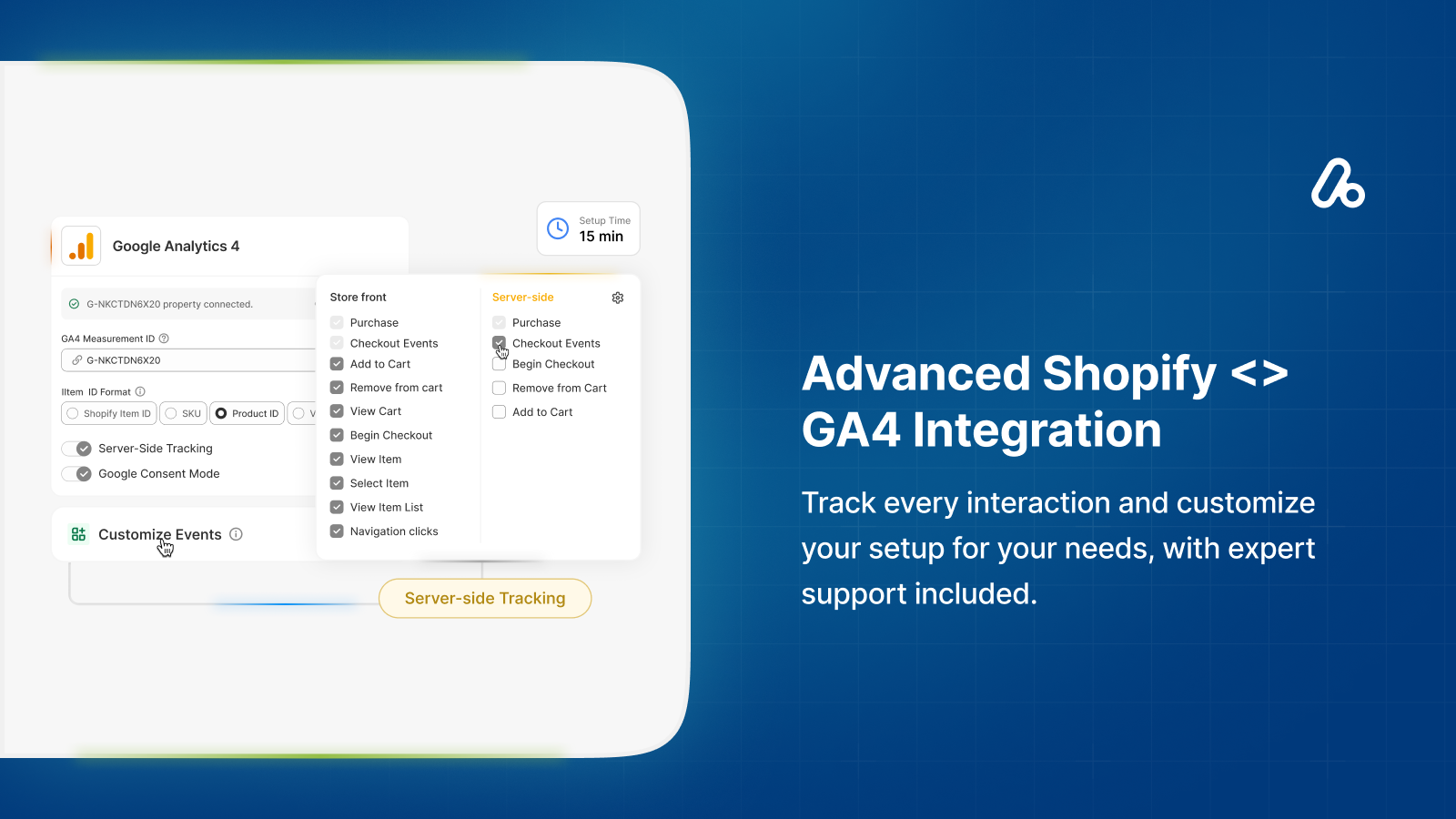
Source: Shopify App Store (Analyzify), retrieved September 4, 2026
Elevar Conversion Tracking builds a pre-configured ecommerce data layer and routes events server-side to Meta CAPI, Google Analytics, and other destinations, independent of whether the checkout happened on your storefront or a direct-checkout surface. Three tiers — Core, Advanced, and Premium (the last priced on request).
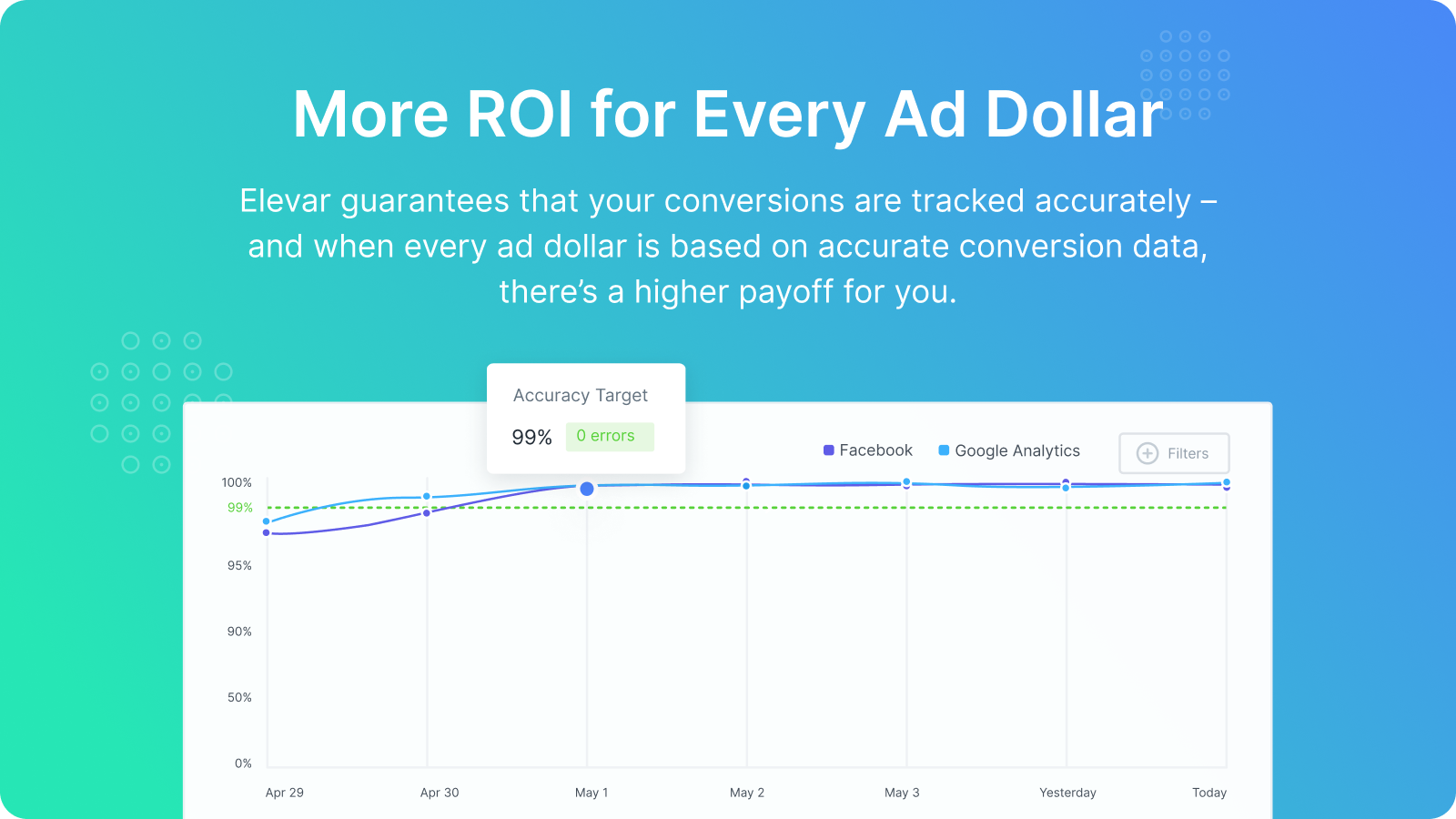
Source: Shopify App Store (Elevar Conversion Tracking), retrieved September 4, 2026
Analyzify offers a toggle between storefront and server-side event tracking for GA4, Meta, TikTok, and Google Ads, letting you enable server-side events specifically for the events client-side pixels can't reach. Its listing displays a free-plan badge, but the pricing section itself lists four visible paid tiers starting at $145/month — worth confirming directly in the app before assuming a no-cost option is available.
ATB: Attribution Reports takes a different angle: instead of only patching pixel gaps, it pulls ad spend from platform APIs and reconciles it against Shopify's own order data for a single ROAS number, and separately lists a Conversions API feed to Google and Meta as a built-in feature at no extra charge on its Pro Plan.
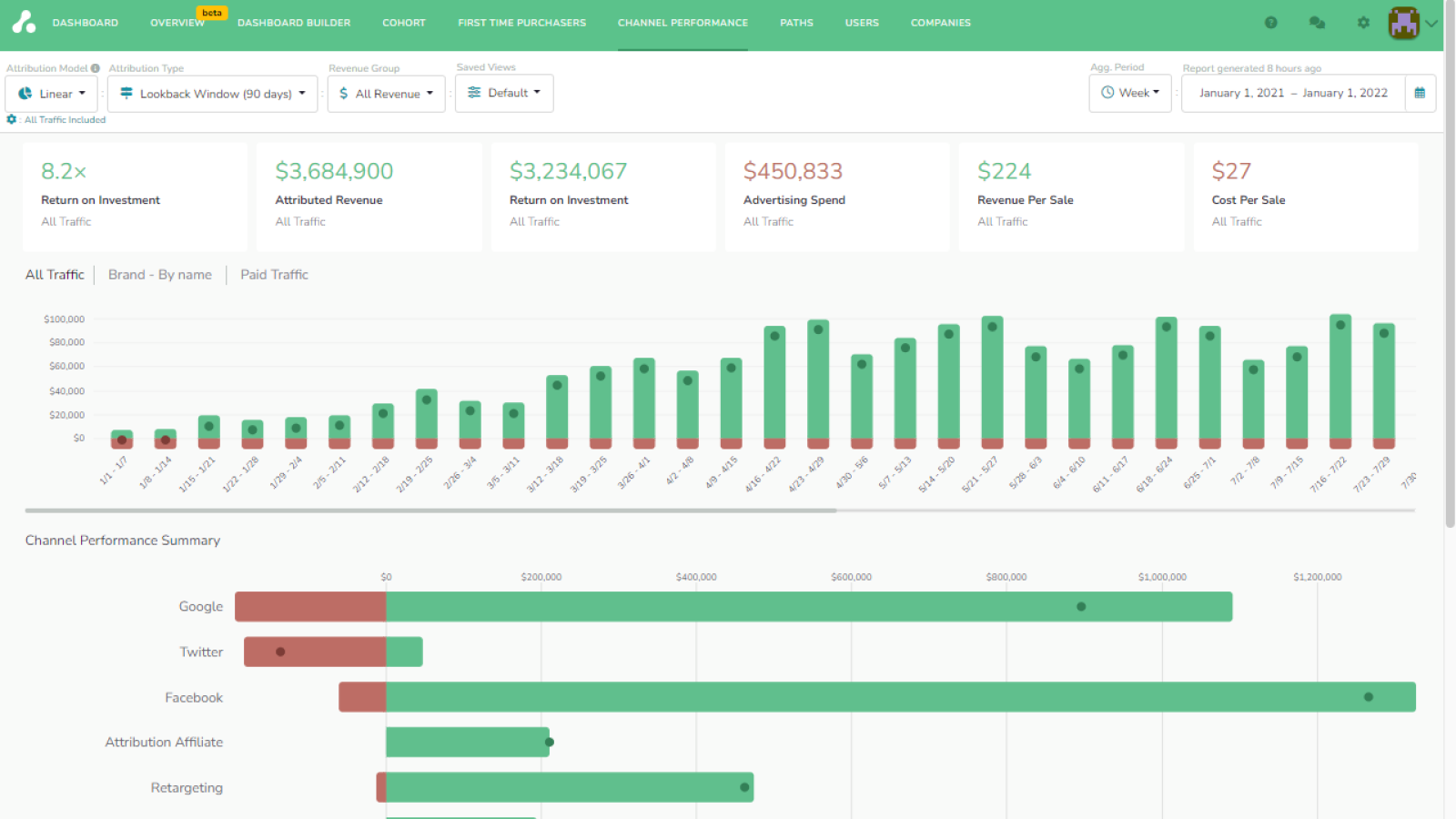
Source: Shopify App Store (ATB: Attribution Reports), retrieved September 4, 2026
None of these apps are required to use Agentic Storefronts — Shopify's native channel and referrer attribution works without installing anything. They matter specifically if your reported ad-platform ROAS needs to include orders placed through Google AI Mode/Gemini, Microsoft Copilot, or Meta's direct checkout.
Choosing by situation
Most of your catalog is subscriptions or bundles. Direct checkout can't sell those products regardless of which of the three channels you're on — customers get redirected to your own store either way, so the practical difference between ChatGPT and the direct-checkout channels shrinks for that part of your catalog.
You rely heavily on Meta or Google Ads and want a single trustworthy ROAS number. Confirm whether your current pixel setup already routes through a server-side/CAPI integration. If it doesn't, orders completed through direct checkout on those two channels won't reach your ad account's own attribution — an app in the table above closes that gap.
Your checkout has custom blocks for upsells, loyalty, or address autocomplete. Those are explicitly named as block types that may not render in Google AI Mode/Gemini or Microsoft Copilot direct checkout, and none render on Meta's. Budget for a degraded checkout experience on those two channels specifically, not a broken one — customers can still complete the purchase.
You sell B2B-only products, or use local delivery/pickup as your primary fulfillment method. None of the three direct-checkout channels support these; discovery still works, but every purchase funnels back to your own store checkout regardless of channel settings.
You're outside the continental delivery footprint the channels expect, or don't want AI agents completing purchases on your behalf at all. Direct checkout can be turned off per channel while keeping discovery on, or Shopify Catalog access can be removed entirely per channel from Sales channels > Agentic.
Pre-launch checklist
- Confirm whether your store is eligible for Shopify Catalog, and whether it's specifically based in the US (required for Google AI Mode/Gemini and Meta) versus merely selling to US customers (sufficient for ChatGPT and Microsoft Copilot)
- Check which of your products are subscriptions, bundles, customizable, or B2B-only — these won't transact through any direct checkout regardless of channel
- Decide per channel whether direct checkout should stay on, or whether you'd rather every AI-driven sale land on your own store checkout
- If Meta or Google Ads ROAS reporting matters to you, verify whether your current pixel setup includes a server-side/Conversions API path, or whether direct-checkout orders on those two channels will be invisible to your ad platforms
- Confirm your Terms of Service, Privacy Policy, and Return and Refund policy pages are published — all four channels require this
- If you use custom checkout blocks for upsells or loyalty, check whether they have checkout blocking enabled, and don't assume they'll render on Google AI Mode/Gemini or Microsoft Copilot — and assume they won't on Meta
In short
Three facts, in order of how often they get reported backwards.
- ChatGPT does not have native in-chat checkout for Shopify merchants. The September 2025 plan was scaled back; Shopify's own Help Center confirms ChatGPT redirects to your existing online store checkout, full stop.
- Google AI Mode and Gemini, Microsoft Copilot, and Meta do have it — a real Shopify-powered checkout inside the AI surface, active by default for eligible stores, but unable to sell subscriptions, bundles, customizable products, or B2B-only items.
- The channels with the more impressive-sounding checkout are the ones where your ad pixels go dark. ChatGPT, ironically, is the one channel where your existing tracking setup needs no changes at all.
Facts reflect Shopify's Help Center documentation, OpenAI's official announcement, and Shopify's own newsroom as of September 4, 2026. Agentic commerce is an actively moving target — Shopify's own Google AI Mode and Gemini documentation notes that the rollout is still in progress and may not have reached every store yet. Re-check the admin's Sales channels > Agentic screen before making decisions based on this article.
Most articles claim Shopify has no native RFM. Shopify's own documentation says otherwise: RFM analysis assigns every customer a 3-digit score with each digit from 1 to 5, sorts them into 11 named RFM groups, and exposes them through an RFM customer analysis report, an RFM customer list, and an rfm_group filter in the customer segment query language — with a Preview segment button that turns a report row into a live segment. The real limitation is different: Shopify says specific RFM scores for individual customers aren't displayed anywhere in the admin. This article verifies all of that against help.shopify.com and shopify.dev as of September 2, 2026, then shows why the actual buying decision is refresh behavior, audience sync, and metering unit — and prices the same hypothetical store at 450 and 6,000 orders per month across four live apps whose bills range from $49 to $750+ per month for overlapping work.